

Every now and then, someone takes the Pond Formulas Blueprint and runs with it — and Leslie and John from California did exactly that.
They used both the Blueprint and KevBot to plan, problem-solve, and bring their massive pool conversion to life. What they’ve created is a truly inspiring example of what can be achieved with determination, creativity, and a lot of elbow grease.
Here’s their story, in their own words 👇
The Location
Sacramento, California – Mediterranean climate with hot, dry summers and mild, somewhat wet winters.
The Project
When John and I moved to our garden-filled country property, a stagnant green swimming pool–turned–pond bloomed abundantly with pink and yellow lilies as a centerpiece.
However, as the years passed, we yearned for a clear, healthy pond with filtration and recirculation.

The Build
We converted an old stagnant swimming pool (originally 30,000 gallons) into a 6,000-gallon pond with a 1,200-gallon wetland bog filter and recirculation.
Almost everything was completed by hand — mainly the two of us, plus one part-time laborer. Friends also chipped in with time and muscle.
The old pool had been used as a pond for many years, but the water was stagnant green. The bottom was thick with about 12 inches (30 cm) of black muck and many vigorously growing water lilies.
The first step was to drain the pool, muck it out, and remove all the waterlilies.

We then poured an 8-inch-wide concrete wall to separate the bog area from the pond area. The bog wall was about 6 inches higher than the pond apron so water could flow naturally from the bog back into the pond.
The concrete wall was anchored into the pool bottom and sides with ½-inch rebar epoxied into holes drilled in the bottom and sides of the pool.

(Ask ChatGPT for some ideas on how to pour a concrete wall divider in a pool — and always review with a concrete professional who knows what they’re doing!)
Our bog area is at one end of the pool and was built to hold between 1,200 and 1,500 gallons.
(We probably could have used sandbags to build the wall instead of concrete, but we weren’t sure — so we went with concrete.)

Once the bog area was sectioned off with a concrete wall, we wanted to reduce the pool depth from nearly 6 feet to about 3½ feet.
To do this, we added ¾-inch road base to the pool and packed it with a vibrating plate compactor.
We ended up buying a compactor from Amazon, but you can rent them too.

After about 21 cubic yards of road base, the pool depth was around 4 feet.
(Note: previous owners had already filled the deep end with broken concrete up to the 6-foot depth.)
The next problem: how to create different levels (terraces) in the pool.
We decided the most flexible and adjustable way was to use sandbags.
We used sandbags to create the terraces and back-filled with more road base.
We also built an inlet bay area with sandbags.
The road base had sharp edges, so to protect the liner we covered it with construction sand and 6 oz non-woven geotextile liner before installing a 45-mil EPDM rubber liner.


Filtration System
The wetland bog filter is about 1,200–1,500 gallons.
Dimensions are irregular — approximately 12 feet by 8 feet and about 2½–3 feet deep.
Materials Used:
- Liner: 45 mil EPDM (Firestone)
- Fabric: Non-woven geotextile fabric (6 oz)
- Pump: Periha Variable PB-2500 Version 2 (32V, uses 160W at 6000 gph setting)
- Circulation Pump: Orlushy DC-12000 aquarium pump (80W, 3100 gph — probably a little undersized). We used 1-inch PVC pressure pipe (should have used 1¼”) and reduced it to ¾” for each jet placed in the corners to push water toward the inlet bay.
- Piping: 2” flexible PVC (Schedule 40)
- Pump Vaults: Gamma2 Vittles pet food containers — the square shape made it easy to cut square holes in stacked plastic pallets.
The height (about 2 feet) fit perfectly.
We used KevBot to figure out how many holes to drill for flow — horizontal slats or holes.
We found multiple 1-inch holes drilled in an offset grid gave greater stability. - Foam: Great Stuff black multipurpose foam (used on the waterfall only)
- Sandbags: Durasac heavy-duty, 14”×26”, filled by hand with construction sand.
Reservoir / Inlet Bay
- (3) 45”×56” plastic pallets (found on Craigslist)
- Overflow: scrap hose, gravity-fed to French drain
Bog Filter
- Liner: 45 mil EPDM (Firestone)
- 1 olive barrel (Craigslist)
- Bio-diffuser chamber: septic leachfield chamber at bottom of bog
- (4) 44”×56” plastic pallets (Facebook Marketplace)
- Media: 8” layers each of 3–6” cobble, 2–4” cobble, and 1½” cobble, covered with about 2” of pea gravel
- Concrete blocks were used to create a straight channel for the bio-diffuser and pickle barrel
Pond Basin
- Sandbags and road base for shape
- Liner: 45 mil EPDM (Firestone), 450 lbs — a challenge to move!
- Air Pump: Blue Diamond ET60 (60 L/hr)
- Diffusers: Matala self-weighted air hose with heavy-duty air manifold and two MD11 diffusers (9” disks)
Rocks and Stonework
Resources from local rock yards — a mix of granite and river boulders.
About 74 tons of sand, road base, gravel, cobble, boulders, and other stones were used.
Plants and Wildlife
Bog plants: calla lilies, canna lilies, bacopa, creeping jenny, and sweet flag (Acorus).
Pond plants: water hyacinth, water lilies, papyrus.
Fish: koi, goldfish, and mosquito fish — some from our previous pond and others donated by friends.
The pond and bog are full of wildlife. Birds bathe in the shallow bog stream and waterfall, dragonflies and insects are everywhere, and a garter snake has taken up residence near the water’s edge.
Although we have many predators nearby, we haven’t had any problems — probably because we have dogs.

Helpful Resources
Ozponds and KevBot were invaluable.
Although we searched high and low, we found only one example of using sandbags for pond shaping — at EarthbagBuilding.com.
Other Helpful Information:
- Auction sites: Great for tools and supplies. We bought a 36-inch mini skid steer for $2,800 — a life saver for moving boulders and sandbags.
- Tools: Rent, buy, or borrow — then resell when finished.
- Research: We spent a lot of time researching before starting. KevBot was unbelievably helpful — usually spot on.
- Electricity: Variable-speed DC pumps use far less energy (recommended by Ozponds).
- Sandbags: Easy to work with and adjust. Fill to about 45 lbs for manageability.
- Terraces: Next time, we’d make the rises shorter (12”) and runs longer (18”).
- Rocks: Some affect pH — limestone and moss rock can raise it.
- Planning: We kept a daily task and resource list. Supply chain delays were real!
- Mistakes: Things go wrong — it’s part of the learning process. Stay positive.
- Cost: About $30,000 USD total, mainly due to rock and gravel.
The build took 74 days — we’re retired, so we had the time to enjoy it.
Leslie and John
Sacramento, California
Thanks for sharing your inspiring story Leslie and John. What a transformation! If you would like to share your pond with the world use the contact page, I look forward to seeing what everyone is creating.
12-Month Update: How Is the Pool-to-Pond Conversion Going?
About a year after completing the conversion, Leslie got back in touch with an update — and the pond is looking fantastic.
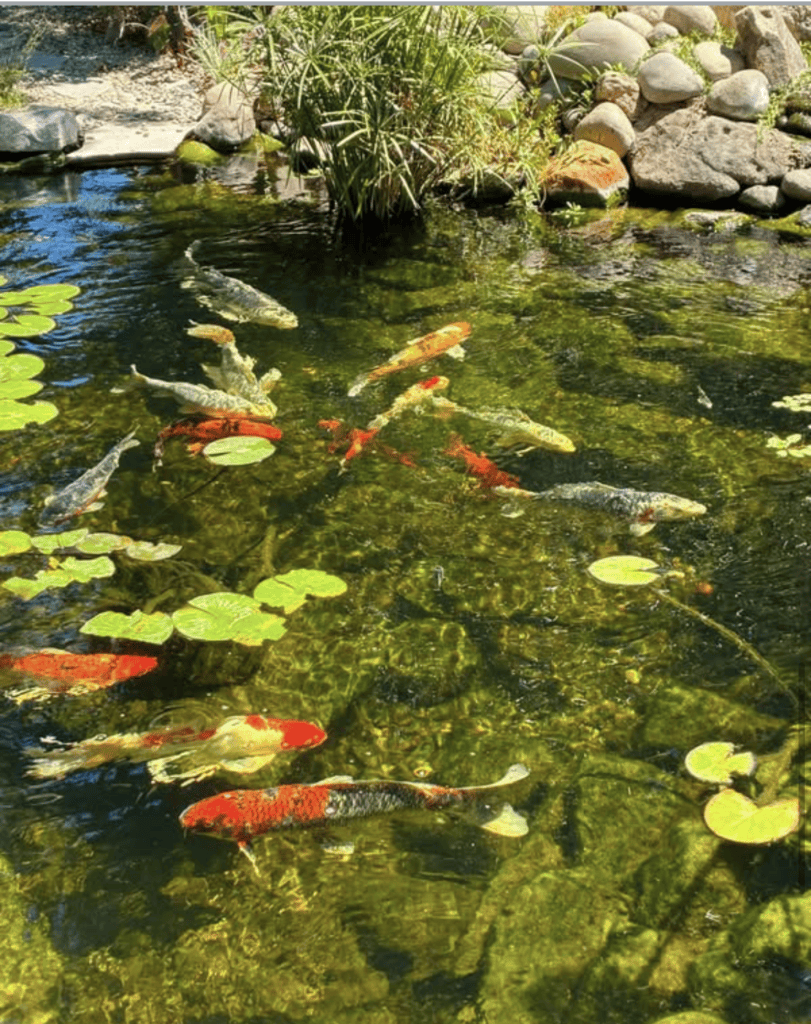
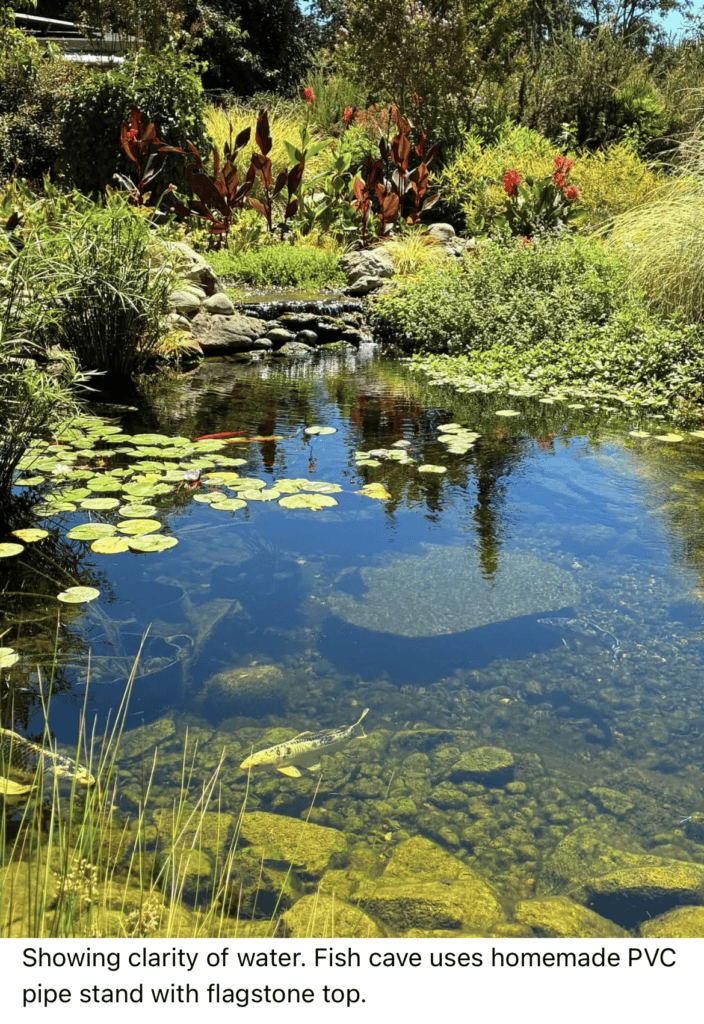
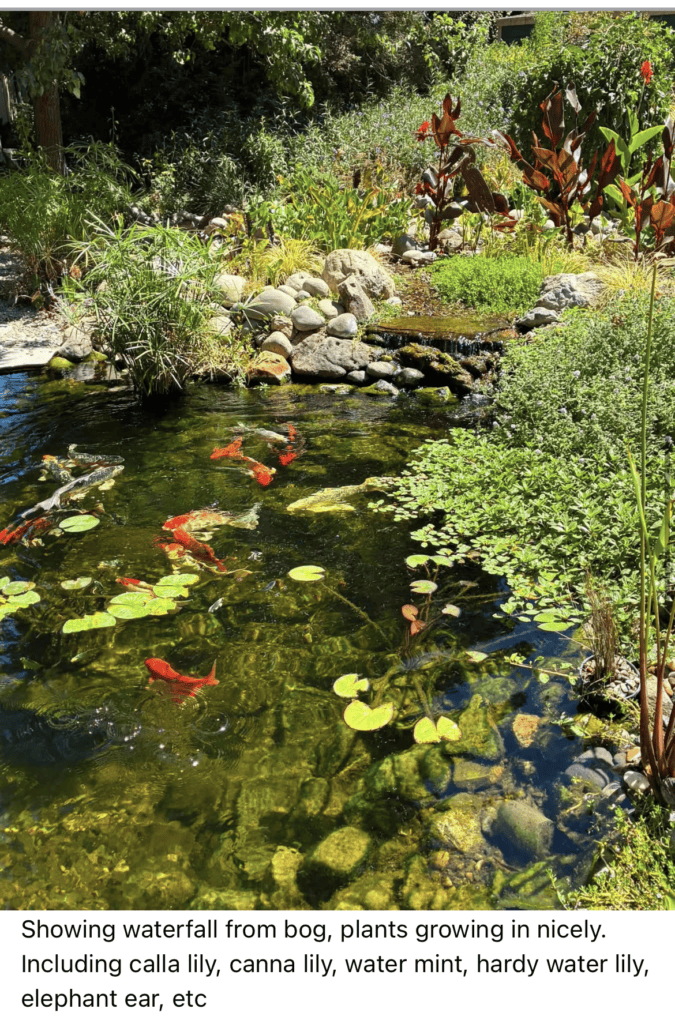
The water is wonderfully clear, the bog filter is working well and the plants have really filled out.
Leslie also gave a shout-out to the Ozponds Pond Formulas Blueprint and KevBot, which she used for help with the planning and calculations during the project.
But as you’d expect with a pond this size, the first year hasn’t been completely trouble-free.
A Big String Algae Bloom
A few months after completing the pond, Leslie experienced a pretty serious outbreak of string algae.
Rather than assuming something was fundamentally wrong with the pond, she made some adjustments. She increased the pump flow, physically removed the algae and also experimented with barley straw.
Over time, the pond settled down and eventually reached what Leslie describes as an equilibrium.
I think this is worth mentioning because new ecosystem ponds don’t always look perfect from day one. They change as plants establish, nutrients move through the system and the biological community develops.
Looking at the pond 12 months later, that process seems to have worked out pretty well.
The Bog Has Really Grown In
One of the biggest changes is the amount of plant growth in the bog filter.
The root systems have become so dense that the water level through the bog has actually risen by around 2 inches. Leslie has needed to raise a few of the lower areas around the edge to accommodate the higher water level.
That’s an interesting reminder when building a bog filter: what you build on day one isn’t necessarily what you’ll have several years later. Plants grow, roots occupy space and water will always find the lowest point.
A Surprising Cause of Water Loss
Leslie also discovered an interesting source of water loss.
Some exposed felt underlay around the pond edge was touching the water and wicking it up and out of the pond.
Think of a towel hanging over the edge of a bathtub. If part of the towel is sitting in the water, it can slowly draw water up and over the edge.
It’s an easy little detail to overlook when finishing the edges of a liner pond and another useful lesson from seeing how the pond behaves over time.
Baby Koi Living in the Bog Filter
Perhaps the most surprising discovery was inside the bog.
Some koi eggs apparently made their way into the bog filter and hatched in the void space underneath the gravel.
The young koi managed to survive in there and had grown to around 3 inches long before Leslie discovered them.
I certainly wouldn’t design a bog filter as a koi nursery, but it does give you an idea of just how much life can establish inside these systems.
One Year Later
The bog is now packed with plants including calla lilies, canna lilies, water mint, hardy water lilies and elephant ear, and the whole pool conversion has matured considerably since the original photos were taken.
For me, these follow-up updates are particularly useful because the real test of any pond isn’t how it looks on the day you finish building it.
It’s how it performs months and years later.
Thanks again to Leslie and John for sharing the original project — and to Leslie for coming back and showing us how it is progressing a year later.
If you’d like to plan a pond using the same principles, you can learn more about the Pond Formulas Blueprint and KevBot here.
And if you’ve built a pond of your own, I’d love to see it. You can share your pond here.
About to build a pond… or already have one?
Sign up for my email list and I’ll send you DIY-friendly pond tips, along with a few helpful tools like calculators, gear recommendations, and more.