

I keep seeing more and more over engineered bog filters in containers. There also seems to be growing confusion around dispersal pipes, cleanouts, siphoning, and how these systems are actually supposed to work.
So in this article, I want to explain the thinking behind the container bog filters I build and why I keep them relatively simple. This isn’t the only way to build a bog filter, but it’s the approach that has worked well for me and many other DIY pond builders over the years.
If you don’t already know me, my name’s Kev. I help people build and maintain ponds without spending a fortune.
What Is the Purpose of a Bog Filter?
For me, a bog filter has a few important jobs:
- Biological filtration
- Trapping heavy solid waste
- Nutrient uptake through plants
- Low-maintenance pond cleaning
The bog filter becomes the primary biological filter for the pond. Beneficial bacteria grow throughout the rock and pebble, helping break down waste produced by fish and decaying organic matter.
Plants can also help absorb leftover nutrients from the system.
But one of the biggest things I focus on is maintenance. I’m lazy. I don’t want to spend every weekend cleaning pond equipment. So I build my systems around simplicity and easy cleaning.
Bog Filter Size Matters
Before worrying about plumbing layouts and fancy pipe systems, the first thing that matters is sizing the filter properly.
The ideal bog filter size depends on:
- Pond size
- Fish load
- Flow rate
- Desired maintenance level
If the filter is too small, the system becomes harder to maintain and less stable over time.
That’s also why flow rate matters.
I prefer a relatively slow and even flow through the bog filter. Slower flow allows:
- Better contact time with bacteria
- Improved settling of heavy solids
- More even filtration
- Reduced turbulence
If water blasts through the filter too quickly, it becomes harder for solid waste to settle inside the system. I have a free calculator to help you size and bog filter and thyme pumps to run it and you can find that here.
Choosing a Container for a DIY Bog Filter
One thing I mention in the video is that I honestly don’t care what type of container people use, as long as it meets a few basic requirements.
The container should:
- Be large enough for the application
- Be fish safe
- Handle your climate conditions
- Be easy to drill holes into
Food-grade containers are usually a good option.
You’ll also need room for:
- An inflow pipe
- An overflow back to the pond
- A cleanout drain
The container can sit above ground or be partially buried. Fully burying it changes the design slightly, especially around cleaning access.
Why I Bring Water In Over the Top
This is probably the thing people ask me about the most.
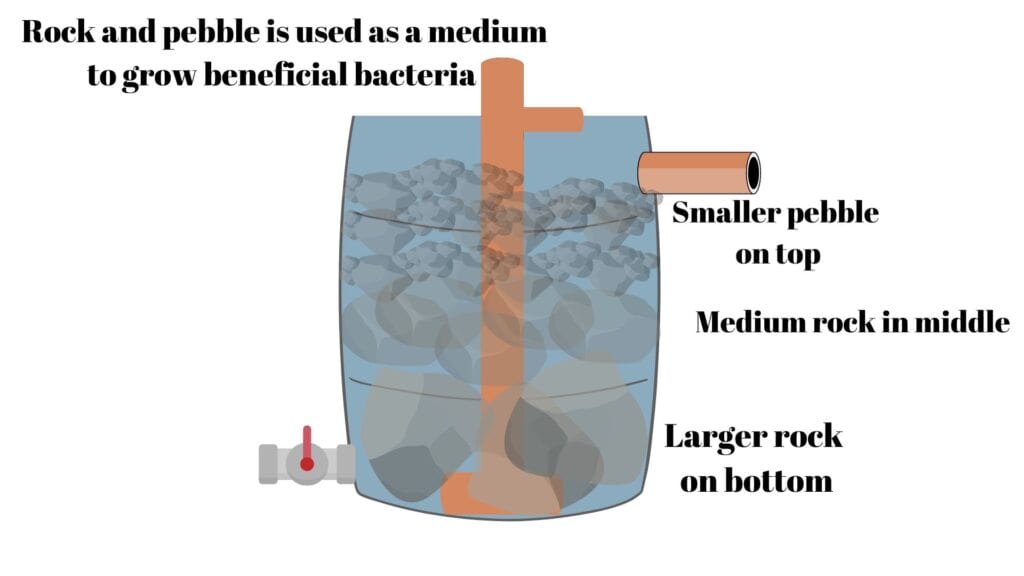
In my container bog filters, I bring the plumbing up over the top of the container and then down to the base of the filter using a simple T-piece.
I do not use elaborate dispersal pipe grids with lots of tiny holes drilled everywhere.
Instead, I usually use:
- One pipe down to the base
- A T-piece
- Plenty of void space beneath the rock and pebble
That’s it.
The reason I come over the top is because it allows me to add a breather hole or valve near the top of the pipe. This prevents the bog filter from siphoning backward into the pond if the pump shuts off.
Without a breather hole, the filter can continue draining after the pump stops.
Some people use check valves instead, and you absolutely can do that, but personally I’ve had them fail before. Plenty of other people have told me the same thing.
The breather hole approach is simple and reliable.
Bulkheads vs Uniseals
To create watertight plumbing connections, I typically use either:
Bulkheads work well on flat surfaces.
Uniseals are often better for round containers like barrels or tubs because they can flex slightly with the curve of the container.
Why the Overflow Must Be Larger Than the Inflow
This is another detail that confuses people.
The inflow pipe is under pressure because the pump is forcing water into the filter.
The overflow is not under pressure.
It’s simply gravity overflowing back into the pond.
Because of that, the overflow pipe needs to be larger than the inflow pipe. Otherwise the container may overflow faster than it can drain safely.
You can also use:
- Multiple overflow pipes
- Spillways
- Small streams
- Waterfalls
There are plenty of ways to make a container bog filter look natural and attractive.
The Importance of Void Space
One of the biggest misunderstandings around bog filters is the role of void space.
In my systems, the void space beneath the rock and pebble does most of the work that people often try to achieve with complicated dispersal pipe systems.
I create this void space using:
- Larger rocks
- Milk crates
- Support blocks
- Any structure strong enough to hold the rock above
This lower section becomes an area where heavier solid waste can settle.
Then above that:
- Larger rock
- Medium rock
- Smaller pebble
The water naturally percolates upward through the media.
Dirty water enters the base.
Clean water exits the top.
Pretty simple.
Do You Need Dispersal Pipes?
Sometimes yes.
Sometimes no.
This is where a lot of confusion comes from.
Container Bog Filters
In the container bog filters I build:
- Slow flow rate
- Large void space
- Short water path
- Simple cleanout valve
Because of this, I usually don’t find complicated dispersal pipe systems necessary.
The water distributes itself relatively evenly through the void space and rock layers.
When Dispersal Pipes Do Matter
Some systems absolutely require dispersal pipes.
A good example is the Nelson Water Gardens bog filter design.
Those systems use:
- Multiple perforated pipes
- Gravel directly over the pipes
- Minimal lower void space
In that design, the dispersal pipes are extremely important because they:
- Evenly distribute water
- Double as cleanout ports
The same principle applies to Aquascape-style wetland filters.
Why In-Ground Bog Filters Are Different
When I build large in-ground bog filters, I build them more like an Aquascape wetland filter.
The principle is still the same:
- Water enters the base
- Water rises through rock and pebble
- Clean water returns to the pond
But these larger systems often include:
- Large dispersal pipes
- Cleanout ports
- Additional void chambers
The reason is cleaning.

In-ground systems are usually vacuumed or pumped out during maintenance rather than simply draining under pressure like a container bog filter.
That means the waste needs a pathway back toward the cleanout.
This is why:
- Large holes
- Slots
- Oversized pipes
…become important.
Tiny holes can clog easily.
That’s one of the reasons I strongly dislike small drilled dispersal pipes in larger systems.
My Theory on Why Container Bogs Work So Well
In a container bog filter, when the cleanout valve opens:
- The entire water column inside the filter is under pressure
- Water wants to rush out quickly
- The heavy waste near the bottom gets pushed out first
In my experience, that makes these systems surprisingly effective and easy to maintain without needing complicated plumbing grids.
Again, I’m not saying this is the only correct way to build a bog filter.
I’m simply showing what has worked well for me and many other DIY pond builders.
Simplicity Usually Wins
A lot of DIY pond builders assume more plumbing automatically means better filtration.
I don’t necessarily think that’s true.
Often:
- Simpler systems are easier to maintain
- Easier systems get cleaned more often
- Better maintenance leads to healthier ponds
For me, bog filters are about:
- Slow flow
- Biological stability
- Waste settling
- Easy maintenance
- Practical DIY construction
Not building the most complicated plumbing system possible.
Learn More About DIY Pond Design
If you want to learn more about the process I use when designing DIY ponds and bog filters, you can check out the ozponds blueprint.
The goal is simple:
Help people build and maintain ponds without spending a fortune.
About to build a pond… or already have one?
Sign up for my email list and I’ll send you DIY-friendly pond tips, along with a few helpful tools like calculators, gear recommendations, and more.