
A pond can look completely different in winter.
Plants slow down, algae can become more noticeable, debris accumulates, and the biological processes that normally help break down waste aren’t working as quickly.
That doesn’t necessarily mean the pond is unhealthy.
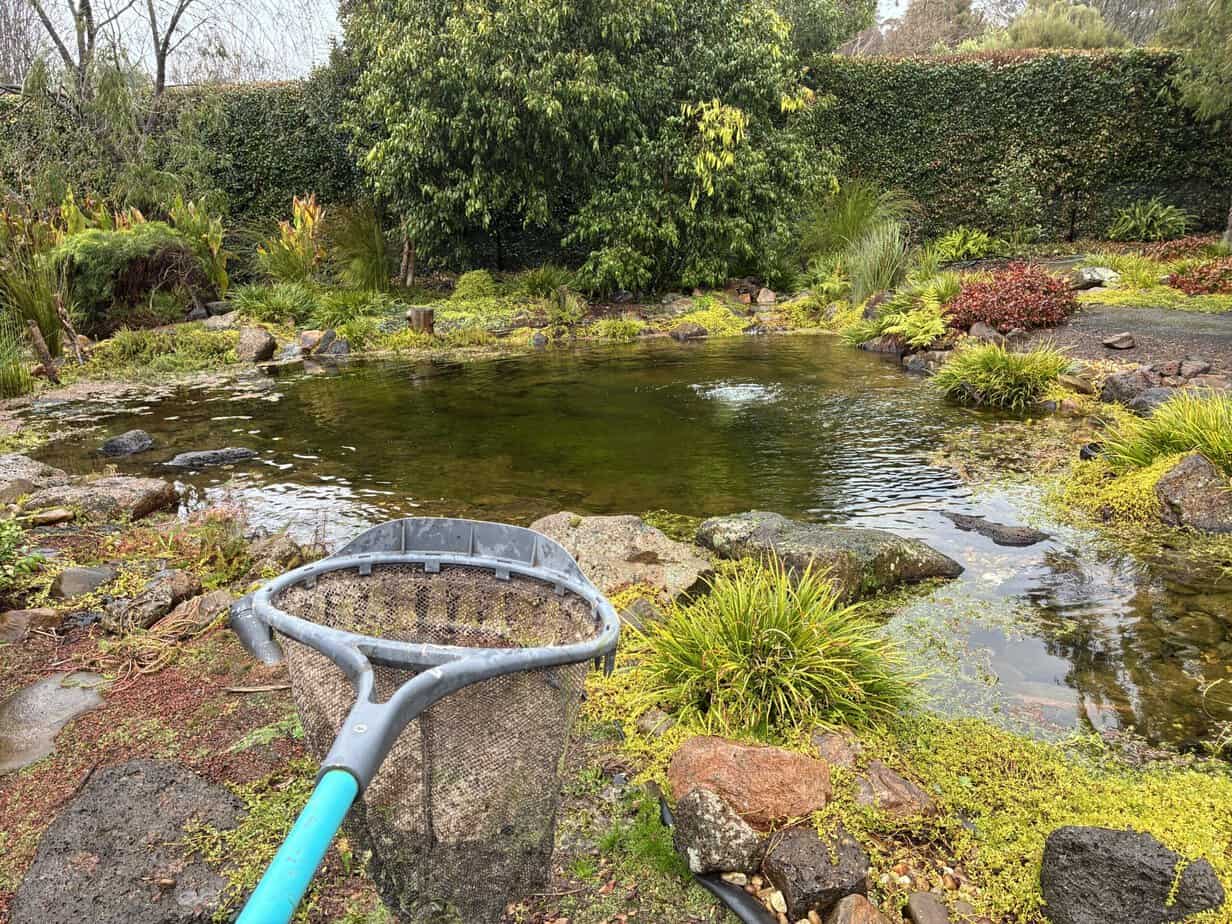
One of my larger ponds is now around five years old, and every winter it goes through a similar cycle. The water stays clear and the pond remains healthy, but string algae increases, plants get untidy and the whole pond looks a little less pristine than it does during the warmer months.
So in this article, I want to explain why ponds change during winter, what maintenance I actually do, and why I don’t panic when a healthy pond starts looking a bit rough around the edges.
Why Do Ponds Look Worse in Winter?
A lot changes when pond water gets cold.
In my case, winter water temperatures can sit around 5–6°C, or a little over 40°F. At those temperatures, many of the biological processes inside the pond slow down.
Leaves, fish waste and other organic material still enter the pond, but the organisms that help process that material become less active.
At the same time, pond plants aren’t growing as quickly.
In warmer weather, those plants are actively taking up nutrients and using them to build new roots, shoots and leaves. In winter, that nutrient uptake slows.
So you can end up with:
- waste continuing to accumulate
- slower biological breakdown
- reduced plant growth
- fewer nutrients being physically removed from the pond
- algae taking advantage of the available nutrients
That is one reason a pond can look worse in winter even though the filtration system hasn’t changed.
Why Algae Can Increase in Cold Pond Water
One thing people often assume is that algae should disappear when the weather gets cold.
That isn’t always what happens.
In my pond, string algae appears every winter despite having substantial filtration, aeration and circulation. The pond has two DIY bog filters, a planted stream, additional biological filtration, circulation jets and an air pump.
The issue isn’t simply a lack of filtration.
Cold water changes the competition for nutrients.
The organisms responsible for breaking down waste are less active, and pond plants aren’t growing rapidly enough to consume as many nutrients.
The algae can still make use of those nutrients.
That means winter algae doesn’t automatically tell you that your pond system has failed.
In my pond, I’ve seen the same seasonal pattern for years: algae increases during winter, then the pond improves again as the weather warms.
A Healthy Pond Doesn’t Always Look Perfect
This is an important distinction.
Clear water and a tidy-looking pond are not necessarily the same thing as a healthy ecosystem.
My large pond can have clear water while still having:
- string algae
- sediment
- old plant growth
- accumulated leaves
- organic material in the intake bay
The water column itself remains relatively clean because circulation carries suspended debris toward the intake bay, where it can either settle or eventually make its way into the filtration system.
So I don’t judge the health of the pond solely by whether every rock is spotless.
A mature ecosystem pond is always processing something.
Why I Do Less Pond Maintenance in Winter
There’s also a very scientific explanation for why my pond looks worse in winter:
I’m lazy when it’s cold.
In summer I’m constantly around the pond.
I’ll scoop debris from the intake bay, thin plants, remove some algae, vacuum bits of sediment and generally disturb the bottom enough to move loose material toward the filters.
In winter, I’m not nearly as enthusiastic about putting my hands and feet into freezing water.
As a result, more material accumulates.
That means fewer nutrients are physically exported from the pond during winter.
This is an important part of pond maintenance that is sometimes overlooked.
Filtration can process waste, but physically removing organic matter removes nutrients from the system altogether.
Should You Remove Dead Pond Plants in Winter?
Usually, yes — at least some of them.
Aquatic plants are excellent at pulling nutrients from the water while they’re growing.
But if that plant material dies and decomposes back into the pond, many of those nutrients simply return to the system.
That’s why periodically removing excess plant material can be useful.
In my pond I had quite a lot of azolla and other plant growth trapped around the margins and inside the intake bay.
Removing some of that material physically exports nutrients from the pond.
You don’t necessarily need to strip everything out.
The goal isn’t sterility.
It’s simply to stop excessive amounts of organic material accumulating and decomposing.
Should You Remove String Algae From a Pond?
If there’s a lot of it, I usually remove some.
String algae isn’t inherently evil.
In fact, it’s using nutrients from the water and incorporating them into its own growth.
That means every handful you physically pull out of the pond is also removing some nutrients.
So while algae might be annoying aesthetically, it is performing a biological function.
The useful part comes when you remove it before it dies and decomposes back into the pond.
That is exactly what I do during winter maintenance.
I’ll net out larger clumps or use a pond vacuum to remove algae and accumulated sediment.
Do Pond Bacteria Stop Working in Winter?
No, but biological activity generally slows.
The organisms responsible for processing organic material and nutrients become less active as the water cools.
That means sludge, leaves, fish waste and other organic material are typically processed more slowly during winter.
I experimented with a cold-water bacteria product this year, although I added it after the algae had already become established.
I’m fairly neutral about bottled bacteria products. If they help your pond, great.
But they’re not magic.
Even bacteria marketed for cold water still operate more slowly than biological communities working under warmer conditions.

Design Your Pond Using The Same System I Use
- A simple system that has helped people around the world design clear, low-maintenance ponds without spending a fortune.
- Includes access to the Private Ozponds community and Virtual Kev, a tool that helps you plan your pond step-by-step.
Why My Smaller Pond Stays Cleaner in Winter
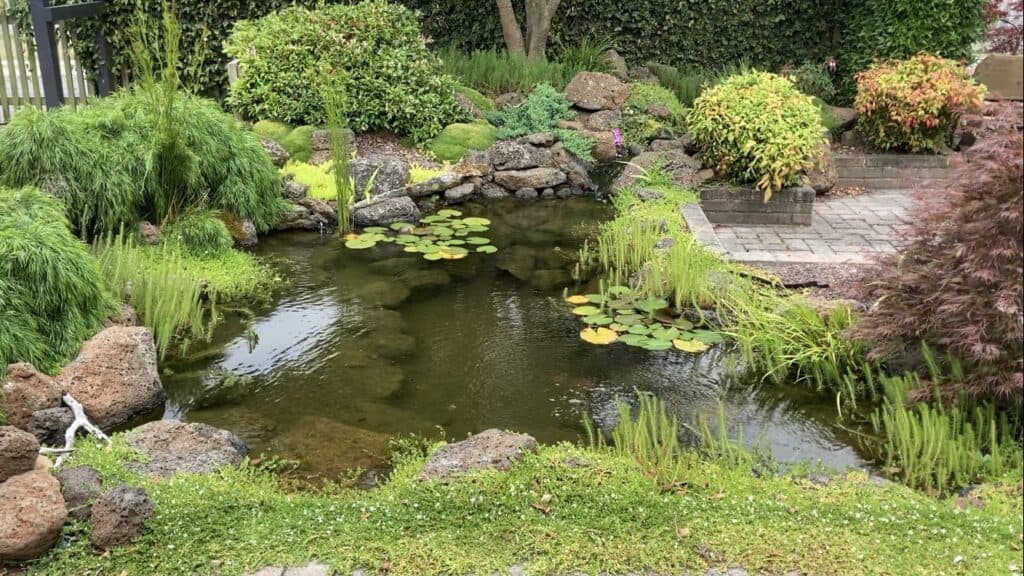
Interestingly, my smaller courtyard pond doesn’t experience the same winter algae problem.
The filtration system is broadly similar.
It has:
- a DIY bog filter
- a stream
- aeration
- a DIY skimming system
But there are a couple of important differences.
Firstly, it contains goldfish.
The goldfish spend a lot of time grazing on algae, which helps keep it under control.
Secondly, the pond is small enough that I can easily reach everything with a net without climbing into freezing water.
That means it still gets occasional maintenance during winter.
This highlights something important:
Pond maintenance isn’t just about filtration capacity.
The animals in the pond, the shape of the pond, access for cleaning and how much debris enters the system all affect how the pond behaves.
Fish and Other Animals Can Affect Pond Maintenance
Every pond is slightly different because its inhabitants form part of the ecosystem.
Fish can help stir sediment and move material into circulation where it may eventually reach the filtration system.
Some fish also graze on algae.
Small scavengers such as freshwater shrimp may help process organic material in suitable ponds where they aren’t immediately eaten.
The important question is always:
What happens to the waste and nutrients entering the pond?
They either need to be:
- physically removed
- captured by filtration
- broken down biologically
- absorbed by plants
- incorporated into the food web
If waste continually enters the pond without somewhere useful to go, it accumulates.
That’s true whether the pond is 500 litres or 50,000 litres.
Clean the Intake Bay or Skimmer
One of the easiest places to remove accumulated organic matter is the pond’s intake bay or skimmer.
My intake bay collects surface debris and suspended particles carried across the pond by circulation.
Leaves, twigs, fish waste and dust can all end up there.
Ideally, I’d net this material out regularly.
In reality, during winter it can sit there for quite a while.
Eventually it begins to break down into smaller particles, and some of those particles make their way through the gravel and into the pumps and filtration system.
So simply scooping accumulated debris from your skimmer or intake bay can be one of the most useful winter pond maintenance jobs.
It’s quick, easy and physically removes nutrients from the system.
Check Your Pond Pump Flow
Winter can also be a good time to check whether the pumps are still moving the amount of water you expect.
On this maintenance day, I noticed that one of my bog filters had reduced flow.
That pump sits inside a separate barrel rather than the intake bay, so it doesn’t receive the same amount of prefiltration.
Originally, the pump cage clogged constantly.
I eventually wrapped the pump in a coarse sponge — what I jokingly call my pump burrito — which dramatically reduced how often I needed to clean it.
Instead of cleaning it every couple of weeks, it can now go months between cleans.
If your waterfall or filter flow suddenly drops, checking the pump intake is one of the first things I’d do.
Don’t Sit Your Pond Pump Directly on the Bottom
I also prefer not to place a pump directly on the deepest part of the pond.
There are two reasons.
Firstly, sediment naturally accumulates on the pond bottom.
A pump sitting right in that material is far more likely to clog.
Secondly, there’s a safety advantage.
If a plumbing line outside the pond develops a major leak, a pump sitting on the bottom may continue pumping until the pond is nearly empty.
If the pump is positioned higher, or sits inside a skimmer or intake bay, the water level can only fall to the level at which the pump loses access to water.
It’s something worth considering when designing the pond rather than after you’ve built it.
Do Bog Filters Need Cleaning in Winter?
Not necessarily.
My two bog filters trap a certain amount of organic material over time.
The filters are designed so that I can access their lowest point through a barrel connected to the bottom distribution area.
That allows me to remove accumulated waste and, when required, completely drain and flush the filters.
But I don’t always perform a full clean.
On this particular day, I deliberately avoided completely draining the bogs because we’d had substantial rain and the groundwater level was high.
Because of the way these filters were constructed, completely draining them while groundwater was pushing underneath the liner could potentially cause the liner to lift or distort.
So instead, I simply vacuumed accumulated waste from the accessible chamber.
That’s an important general lesson:
Don’t perform maintenance just because a calendar says you should.
Consider what is actually happening in your pond and how your particular system is built.
When Should You Fully Clean a Bog Filter?
For my pond, I’ll wait until the weather is warmer.
Then I can:
- drain and flush the filters
- remove accumulated sediment
- thin excessive plant growth
- tidy the bog
- allow the plants to regrow strongly through the warmer months
Those fresh plants will then take up nutrients and produce new growth.
That plant growth can eventually be thinned again, physically removing those nutrients from the pond.
It becomes part of the nutrient cycle.
Should You Completely Clean a Pond Before Spring?
I wouldn’t necessarily try to make the pond spotless.
A mature pond contains enormous numbers of microorganisms and small creatures living throughout:
- gravel
- rocks
- plant roots
- sediment
- filter media
- biofilms
They are part of the system.
The goal of maintenance is usually managing excess accumulation, not removing every trace of organic material.
In my own pond, I mainly want to remove the obvious excess: accumulated debris, excessive algae, dying plant growth and sludge where it becomes problematic.
Simple Pond Maintenance Checklist
If your pond is basically healthy but looking a little untidy during winter, I’d start with the easy jobs:
- Remove accumulated leaves and debris.
- Net excessive string algae.
- Remove dead or excessive plant growth.
- Clean out the skimmer or intake bay.
- Check that pumps haven’t become clogged.
- Make sure water is still flowing through the filtration system.
- Remove accessible sludge if it’s becoming excessive.
- Leave major filter clean-outs until conditions are suitable.
- Keep aeration and circulation working where appropriate.
- Don’t assume a little winter algae means the pond has failed.
That last one is probably the most important.
Frequently Asked Questions
Should I clean my pond during winter?
You can certainly remove leaves, excessive algae, dying plants and easily accessible debris. Major clean-outs may not be necessary unless there is a specific problem.
Why does my pond get string algae in winter?
Cold conditions slow biological decomposition and plant growth, while nutrients may continue entering the pond. Algae can take advantage of those available nutrients.
Should I turn my pond filter off during winter?
That depends on your climate and pond design. In my relatively mild southern Australian climate, my pumps, filtration, circulation and aeration continue operating.
Should I clean my bog filter every winter?
Not automatically. Clean it when accumulated material is beginning to interfere with the system or when your maintenance schedule and pond conditions make it sensible.
Does algae mean my pond water is unhealthy?
Not necessarily. Algae is part of a pond ecosystem and can exist in clear, healthy water. Excessive algae can indicate available nutrients, but its presence alone doesn’t tell you everything about water quality.
Should I remove pond plants before winter?
I wouldn’t remove everything. But trimming dying or excessive plant material can prevent some of those nutrients from decomposing back into the pond.
Why has my waterfall flow reduced?
Check your pump intake, prefilter and plumbing. Debris or algae around the pump can significantly reduce flow.
Pond Maintenance Is About Managing the Ecosystem
After five years with this pond, I’ve become much less concerned when it goes through an ugly phase.
The string algae still annoys me a bit.
But I know what’s happening.
During winter, the processes that normally help consume and recycle nutrients have slowed down. The algae is temporarily taking advantage of that opportunity — and in doing so, it’s also taking nutrients from the water.
As temperatures rise, bacteria become more active, plants begin growing again and I start doing more maintenance.
The balance changes.
And the pond usually looks great again.
That’s why I think pond maintenance is less about trying to keep a pond looking perfect every day of the year and more about understanding where the waste is going, how nutrients are being processed and when you actually need to intervene.
About to build a pond… or already have one?
Sign up for my email list and I’ll send you DIY-friendly pond tips, along with a few helpful tools like calculators, gear recommendations, and more.