
Clear pond water doesn’t necessarily mean a clean pond floor. You can have a working bog filter and still find leaves, fish waste and sludge building up on the bottom.
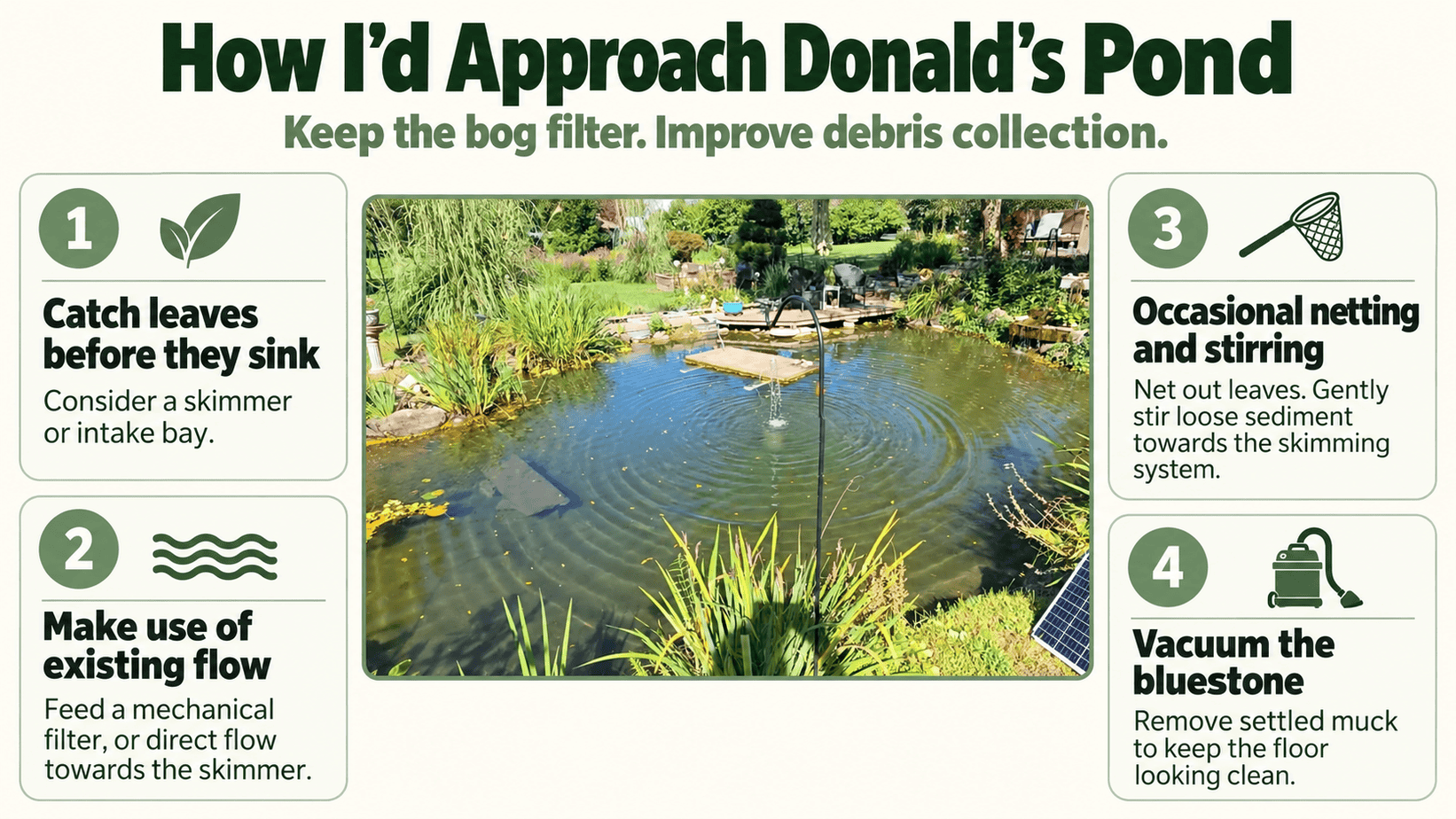
That was the problem Donald showed me in a video of his pond in Rhinebeck, New York. His pond holds around 11,000–12,000 US gallons, or roughly 42,000–45,000 litres. It has a bog filter, several water returns and fountains, but an overhanging tree drops material into it throughout the season.
After three years, Donald removed a sizeable pile of debris. He wanted to know how to stop it building up again, especially with a bluestone floor planned for the pond.
I’d approach that in stages: reduce what enters the pond, collect what is floating, and then deal with what settles. Here’s how I do that in my own ponds.
Watch the video to see Donald’s pond and the cleaning methods I discuss.
Why the Pond Bottom Gets Dirty Even When the Water Is Clear
Leaves, dead plant material, dust and fish waste all have to end up somewhere. A filter can only collect solid material that reaches it. If debris settles in a quiet corner, adding more filtration won’t automatically move it out of that corner.
Donald’s water looked clear after cleaning and using a flocculant. The immediate problem he wanted to solve was the continuing input of leaves and the material collecting on the floor.
That distinction matters. Before buying another filter or treatment, look at where the waste enters, where it settles and whether your water movement carries it towards a collection point.
Catch Leaves Before They Sink
Use a Pond Net During Heavy Leaf Fall
A net over the pond can intercept falling leaves before they reach the water. If your main problem is a seasonal leaf drop, it can save a lot of work later.
My courtyard pond sits beneath a Japanese maple. I know when the leaves are going to fall, and I know a net would help. I just don’t like looking at one, so I prefer collecting the leaves after they land.
That’s a personal preference. If you’re happy to cover the pond during the worst of the leaf fall, prevention is a perfectly reasonable option.
Scoop Floating Leaves Out With a Skimming Net
On a small pond, a pool skimming net is a simple way to remove leaves from the surface. I use one on my courtyard pond when a lot of leaves drop at once.
It becomes less convenient on a large pond, especially when leaves are spread across areas you can’t easily reach. That’s where a skimming system can make a big difference.
Use a Skimmer or Intake Bay to Collect Surface Debris
A skimmer draws floating debris towards one collection point. Catching leaves there reduces the amount that sinks and breaks down on the pond floor.
On larger ponds, I like using an intake bay. It works on a similar principle to a skimmer, but uses a larger collection area that can blend into the pond.
In my intake-bay systems, the pumps sit in a protected area behind a shallow or narrow entrance. As water moves through that entrance to reach the pumps, it creates a surface current that carries floating material with it.
The collected leaves still need to be removed. You’re making them easier to reach and keeping more of them out of the main pond.
Skimming systems can also be added to existing ponds. My DIY pond skimmer guide shows one of the simple systems I use, and this article explains the differences between intake bays and pond skimmers.
A Negative Edge Is Another Option
A negative edge collects water that overflows from the pond into a separate reservoir. That overflow can carry surface debris with it, and the reservoir can provide additional water storage.
It is a different arrangement from an intake bay and generally involves more construction and expense. I’d consider it where the site and the wider pond design make it useful, rather than adding one just because a few leaves are sinking.
Make Your Water Movement Carry Debris Somewhere Useful
Lots of fountains and splashing don’t necessarily mean leaves are moving towards the skimmer. You want circulation that helps collect debris, as well as water movement that looks good.
Donald has several places where water returns to the pond. Those returns could help push surface water towards whichever skimming system he chooses.
Watch where floating leaves travel. Do they reach the intake, circle in one area or sit behind a shelf? That gives you a useful starting point for adjusting the direction of the returns.
When several pumps supply my main pond features, I generally like to draw their water through the skimming system. A separate pump used just to move water around a particular area can serve a different purpose.
Target the Places Where Debris Settles
In my courtyard pond, debris used to accumulate near the bog-filter return, on the opposite side from the skimmer. I added a solar-powered solids-handling pump to move water along the bottom in that area.
When the sun is shining, it pushes water across the floor and keeps that section visibly cleaner. I still use a net or vacuum elsewhere when needed.
That pump is supplementary circulation. It isn’t responsible for filtering the pond, so I don’t need it running continuously. I wouldn’t confuse that job with the pump supplying the main filtration system.
For more on positioning returns and avoiding poorly circulated areas, see my guide to pond circulation.
Remove the Material That Reaches the Bottom
Even with good skimming, some debris will settle. A bit of maintenance here and there is usually easier than waiting until you have a large amount to remove at once.
Use a Net for Leaves and Larger Debris
A net is often all you need to lift out accumulated leaves and larger pieces of plant material. It’s an inexpensive place to start, particularly if you can reach the affected area from the edge.
Use a Pond Vacuum for Concentrated Deposits
I find a pond vacuum useful for areas where waste repeatedly collects. You can target those patches without trying to clean every surface in the pond.
Choose an attachment that suits the floor. On my pebble-covered ponds, I use an attachment that helps prevent the pebbles being sucked up. For a flat bluestone floor like Donald is planning, a suitable brush attachment would make cleaning easier.
How often you vacuum depends partly on the finish you want. Keeping a floor looking spotless takes more regular attention than maintaining the sort of natural-looking pond I prefer.
Let the Filters Collect Loose Mulm
In warmer weather, I sometimes gently disturb loose, fluffy mulm in my own ponds. It clouds the water temporarily, but circulation carries some of that material towards the skimmer and filters. While doing this, I also remove what I can with a net.
The collection system needs to be working, and the captured waste needs to be removed when required. Simply stirring sediment into a poorly circulated pond can leave it to settle again.
This is about moving loose surface material. Deep, compacted or foul-smelling sludge is a different situation; remove it carefully in manageable sections instead of churning the whole deposit into the water.
Do Rocks and Pebbles Make a Pond Harder to Clean?
Rocks and pebbles can hold debris in the spaces between them. I still use them in my ponds because I like the appearance and the habitat they provide.
Some organic material supports microorganisms and small creatures that the fish forage among. I don’t try to remove every trace of it.
The trade-off is that a rock-covered floor won’t clean in exactly the same way as a smooth surface. Good circulation, access for a net or vacuum, and a realistic idea of how tidy you want it to look all matter.
A thin layer of mulm isn’t automatically a problem. A growing mass of decomposing leaves needs more attention.
My article on sludge, mulm and muck in an ecosystem pond explains how I think about that balance.
When Extra Mechanical Filtration or a Bottom Drain May Help
A suitable solids-handling pump can send debris to a dedicated mechanical filter, where it is captured for removal. Bottom drains are another option for collecting waste from the pond floor, though conventional bottom drains are much easier to plan into a new build than retrofit.
These approaches can suit people who want more frequent waste removal. Just remember that a filter collecting more waste will also need cleaning.
For my own ponds, I often prefer occasional netting or vacuuming to adding another fine filter that needs attention whenever it clogs. The right choice depends on your pond, its inhabitants and the maintenance you’re comfortable doing.
Will Bacteria Products or Flocculant Remove Pond Sludge?
Bacteria help break down organic waste, but I wouldn’t make a bottled product my first response to a pond receiving large amounts of leaf litter. Catching and removing the leaves directly tackles the incoming load.
Some products may help with organic-waste breakdown under suitable conditions. Results depend on the product and the pond, and they won’t remove grit, stones or every remaining residue.
Oxygen matters too. Aerobic decomposition consumes oxygen, and warm water holds less dissolved oxygen than cold water. That is why I emphasise aeration when there is a lot of organic material breaking down. The USGS explanation of dissolved oxygen covers this relationship.
Biological activity generally slows as the water cools. If the immediate job is removing a pile of leaves or sludge in cold weather, I’d reach for a net or vacuum.
A flocculant does a different job: it helps fine suspended particles clump together so they are easier to collect. It doesn’t stop leaves falling into the pond or remove an existing pile from the bottom.
If you want to investigate treatment options, start with my pond treatments page and check the chosen product’s instructions and suitability for your pond.
Where I Would Start With a Pond Like Donald’s
- Catch more leaves early. Use seasonal netting, manual surface skimming or a skimming system that suits the pond.
- Make the water returns help. Direct surface debris towards the collection area and look for places where it gets stranded.
- Remove existing accumulations. Use a net for larger debris and a vacuum for the patches that need it.
- Improve circulation where needed. Target persistent settling areas rather than simply adding more splashing.
- Maintain the collection points. Empty trapped debris so it actually leaves the system.
I’d see how those changes perform before deciding whether another filter or treatment is worth adding.
Get Help Improving Your Pond System
If you want to understand how I put the filtration, skimming and circulation together, the Pond Building Blueprint brings my formulas, diagrams and build videos into one place.
It also includes the pond ecology guide, Virtual Kev and our private DIY pond community. You can share your setup and ask other builders about practical changes or equipment available where you live.
For equipment ideas, you’ll find the pond products I use here.
My aim is a pond that stays enjoyable to maintain. Catching more waste in an easy-to-reach place goes a long way towards that.
Common Pond Bottom Cleaning Questions
Can I Clean the Pond Bottom Without Draining It?
Often, yes. A net or pond vacuum can remove accessible debris while the pond remains filled. Large or compacted accumulations may need a more careful cleanup, but routine bottom cleaning doesn’t automatically require emptying the whole pond.
Will a Skimmer Remove Sludge From the Pond Floor?
A skimmer mainly collects surface debris. Its biggest contribution is catching leaves before they sink. Fine material lifted into circulation may also reach it, but settled deposits often need a net, vacuum or another collection method.
Does a Bog Filter Keep the Bottom of a Pond Clean?
A bog filter can process waste and trap particles carried into it. It can’t directly collect leaves sitting in a quiet corner of the pond. Skimming, circulation and occasional physical removal help the whole system work together.
Should I Remove All the Mulm From My Pond?
I don’t aim to remove all of it from my ecosystem ponds. Some supports the pond’s food web. I remove excess accumulations and pay attention to circulation and oxygen, rather than treating every bit of sediment as a failure.
About to build a pond… or already have one?
Sign up for my email list and I’ll send you DIY-friendly pond tips, along with a few helpful tools like calculators, gear recommendations, and more.