
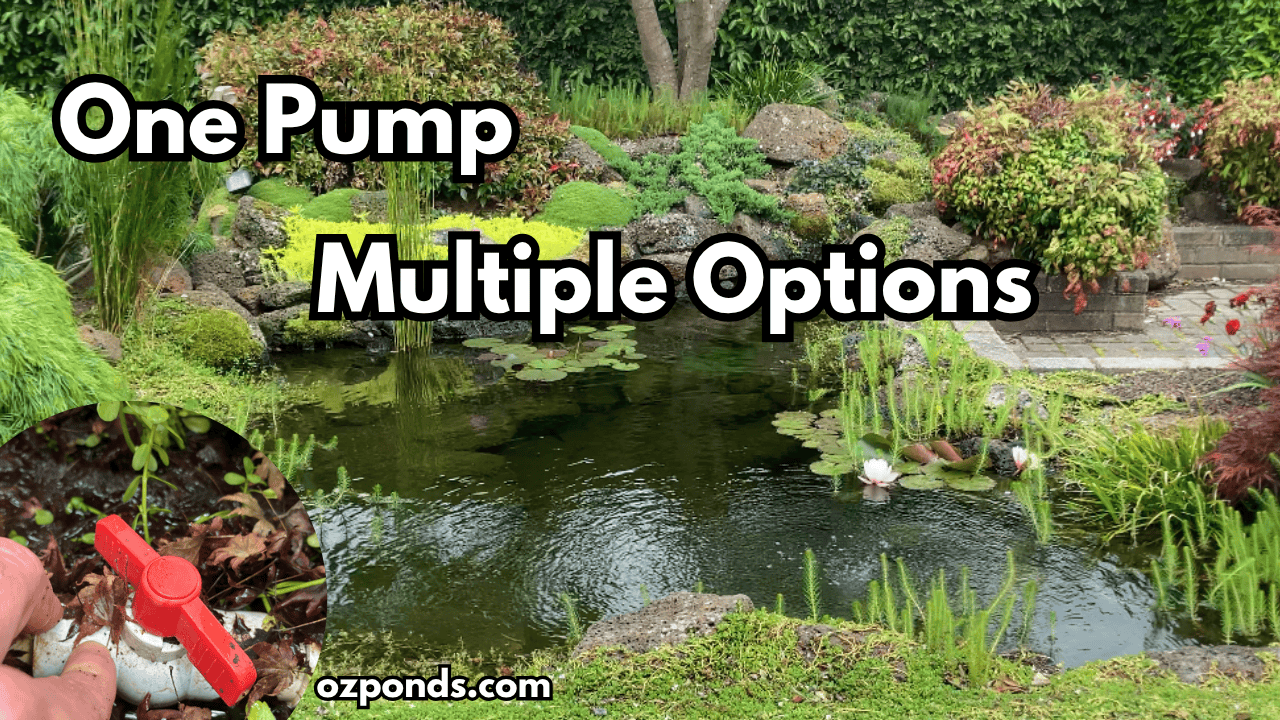
Most ponds can run from a single pump, but things get a little more complicated when that pump needs to supply several different parts of the pond.
You might want water going to a bog filter, a waterfall, a stream and perhaps some circulation jets at the same time.
The problem is that each of those features can require a very different amount of water.
A bog filter generally wants a relatively slow, steady flow, while a waterfall or stream may need considerably more water to look the way you want it to. Circulation jets may need another portion of the available flow to move water through dead spots or across the bottom of the pond.
So can you run all of these from one pond pump?
Yes, you can — provided the pump has enough capacity and your plumbing allows you to control the flow going to each feature.
If you’d prefer to watch a video rather than read heres a video I made:
Can One Pond Pump Run a Bog Filter and Waterfall?
Yes.
In many of my ponds I prefer using a dedicated pump for the main filtration system, particularly a bog filter. It makes it much easier to know roughly how much water is actually passing through the filter.
But there are plenty of situations where running everything from one pump can make sense.
If your bog filter forms the headwater for a stream or waterfall, for example, the pump needs to provide enough flow for both.
The bog itself may only need a modest flow, while the waterfall might need substantially more. Rather than forcing all of that water through the bog, you can split the pump discharge and send some of the water directly to the waterfall or stream.
That is where valves become important.
The Most Important Part: Control the Flow
Water doesn’t automatically divide itself evenly between two plumbing lines.
Water under pressure tends to follow the route offering the least resistance. Pipe length, fittings, elevation, pipe diameter and the layout of the plumbing can all affect where the water goes.
That means simply adding a tee fitting and hoping half the water goes each way isn’t a particularly good plan.
Instead, install valves so you can adjust each branch independently.
For example:
Pump → manifold or tee → valve → bog filter
and
Pump → manifold or tee → valve → waterfall
With a valve on both lines, you can progressively open or restrict each branch until you get the balance you want.
I sometimes think about it like the hot and cold taps in your house. Having control over both sides lets you adjust the final result much more precisely.
Should Every Pond Plumbing Branch Have a Valve?
If you want proper control over the flow, I generally recommend it.
One mistake I see is putting a valve on one branch but leaving the other completely unrestricted.
That can work in some situations, but it removes much of your ability to fine-tune the system.
If you have valves on both branches, you can adjust both sides independently.
This becomes even more useful as the system gets more complicated.
For example, one pump might supply:
- a bog filter
- a waterfall
- a stream
- circulation jets
- an aquaponic grow bed
Rather than hoping the plumbing naturally divides the flow correctly, valves allow you to decide where the water goes.
Put the Valves Somewhere You Can Reach Them
This sounds obvious, but it is surprisingly important.
Don’t bury your flow-control valves somewhere inaccessible.
You may want to alter the flow later as plants grow, plumbing changes, the pump ages or you simply decide you want a different-looking waterfall.
A valve isn’t much use if you have to dismantle half the pond to reach it.
I generally like PVC ball valves because they can be incorporated easily into PVC plumbing.
Why Bog Filters and Waterfalls Often Need Different Flow Rates
This is one of the main reasons people end up splitting their pump discharge.
A bog filter doesn’t need a raging torrent of water.
I’m generally looking for a reasonably slow and steady movement of water through the filter.
A waterfall is completely different.
The visual appearance of a waterfall is heavily influenced by how much water is travelling over it. A wider waterfall generally needs considerably more flow if you want a nice sheet or energetic cascade.
So if your pump has been sized to create the waterfall you want, forcing all of that water through the bog filter may be unnecessary.
Instead, some water can go through the bog while the excess bypasses the filter and feeds the stream or waterfall.

Design Your Pond Using The Same System I Use
- A simple system that has helped people around the world design clear, low-maintenance ponds without spending a fortune.
- Includes access to the Private Ozponds community and Virtual Kev, a tool that helps you plan your pond step-by-step.
Example: Bog Filter and Stream From One Pump
I have one pond where a barrel bog filter feeds a small stream.
The filter itself doesn’t need quite as much flow as I want in the stream.
In that setup, some excess water is allowed to bypass through the breather arrangement, with a valve controlling how much water bypasses the filter and how much is forced through it.
Because I still want most of the water travelling through the bog, the plumbing arrangement is fairly simple.
If I were using a much larger pump to create a bigger stream or waterfall, however, I’d want more control over both branches.
That illustrates an important point:
The more different your required flow rates are, the more useful independent valves become.
One Pump Running Two Different Filters or Grow Areas
Another pond I built uses one pump to supply two separate areas.
One line feeds an aquaponic-style bog filter above the pond, while another feeds PVC grow pipes containing plants.
Both lines have valves.
That lets me adjust the amount of water flowing to each section independently.
The important part happened before the plumbing was built: the pump was selected with enough capacity to lift the water to the required height while still providing enough total flow for both areas.
And that brings us to possibly the most important design consideration.
Your Pump Must Be Big Enough
Valves can restrict water.
They cannot create more water flow.
If your bog filter needs a certain amount of flow and your waterfall needs another amount, your pump needs to provide enough usable flow for both — after allowing for head height and plumbing losses.
An undersized pump cannot be fixed by clever plumbing.
Before choosing the pump, work out approximately how much flow each component requires.
Then add those requirements together.
For example, if you need:
Bog filter: 6,000 L/hr
Waterfall: 8,000 L/hr
Circulation jets: 2,000 L/hr
You potentially need around 16,000 L/hr of usable flow at the operating head of the system.
The pump’s advertised maximum flow isn’t necessarily what you will actually get once it has to push water uphill and through pipework.
That’s why pump sizing should always account for head height and friction losses.
Using One Pump for Multiple Circulation Jets
The same principle applies to underwater circulation jets.
If one plumbing line feeds several jets, the water may not divide evenly between them.
In one of my ponds, each jet has its own valve.
That lets me decide where I want the strongest circulation.
Without those valves, much of the water would naturally favour the easiest route through the plumbing. By individually restricting the outlets, I can balance the system and direct more flow toward areas of the pond that need it.
This can be particularly useful for moving debris away from shallow areas, beaches or stagnant zones and towards your skimmer or intake area.
Is One Pump Better Than Multiple Pumps?
There isn’t one correct answer.
Personally, I often prefer a dedicated pump for the bog filter.
The main advantage is simplicity.
If the filter has its own pump, I have a much better idea of how much water is actually moving through it. Measuring flow through several different branches can quickly become tedious.
Separate pumps also give you flexibility.
You might run the filtration pump continuously while only running a large waterfall when you’re outside enjoying the pond.
On the other hand, one pump can mean:
- less equipment
- less wiring
- fewer pumps to maintain
- simpler intake arrangements
- potentially lower upfront cost
So I wouldn’t automatically choose one approach over the other.
It depends on the pond.
Variable-Speed Pond Pumps Make This Easier
I’m a big fan of variable-speed pumps.
They give you another layer of control.
Instead of only regulating individual branches with valves, you can adjust the total amount of water entering the plumbing system as well.
That makes it much easier to experiment.
You can increase or decrease the pump speed and then fine-tune each outlet using the valves.
For a bog filter, I don’t generally need an absolutely perfect laboratory-measured flow rate. I’m trying to get into a useful range with a nice, steady flow through the filter.
How Do You Measure Pond Pump Flow?
If you really want to know how much water is coming from a particular outlet, there are a couple of simple options.
One is the bucket test.
Direct the outlet into a container of known volume and measure how long it takes to fill.
You can then convert that into litres per minute or litres per hour.
For example, if a 20-litre bucket fills in 10 seconds:
20 litres × 6 = 120 litres per minute
120 × 60 = 7,200 litres per hour
You can also install a flow meter if you want more accurate ongoing measurements.
Personally, I don’t obsess over exact numbers once the pond is operating.
I’ll often get the flows approximately where I want them, adjust the valves and then watch how the pond performs.
If the bog is working properly, the waterfall looks right and circulation is doing what I want, that’s usually more important to me than knowing the exact flow to the nearest litre. That practical approach is also what I describe in the video.
A Simple Pond Pump Manifold
For many DIY ponds, the plumbing can be surprisingly simple.
You might have:
Pump
↓
Main pipe
↓
Tee or manifold
↙︎ Valve → Bog filter
↘︎ Valve → Waterfall
And if you want another feature:
Valve → Circulation jets
The important idea isn’t the exact layout.
It’s that every major outlet requiring independent control should have some way of regulating its flow.
Common Mistakes When Running Several Pond Features From One Pump
A few problems come up repeatedly.
Choosing the pump before calculating the required flow
Work out what the pond needs first, then choose the pump.
Assuming a tee fitting will split the flow evenly
It probably won’t.
Only putting a valve on one branch
Sometimes this works, but valves on each important branch give you much more control.
Forgetting about head height
Pump flow falls as the pump has to push water higher.
Making valves inaccessible
You will probably want to adjust them later.
Trying to force waterfall-level flow through a bog filter
Split the flow if necessary rather than making every litre travel through the filter.
Design Your Pond Using The Same System I Use
- A simple system that has helped people around the world design clear, low-maintenance ponds without spending a fortune.
- Includes access to the Private Ozponds community and Virtual Kev, a tool that helps you plan your pond step-by-step.
Frequently Asked Questions
Can one pond pump run both a waterfall and a filter?
Yes. The pump needs enough usable flow for both components, and ideally the plumbing should allow you to regulate the amount of water sent to each.
Can I split the outlet from my pond pump?
Yes. You can use tees or a manifold to create multiple plumbing branches. Adding valves to the branches allows you to balance the flow.
Do I need a valve on both sides of a pond pump tee?
You don’t always need one on every line, but adding valves to both branches gives you considerably more control over how the available water is divided.
Can one pump run a bog filter and circulation jets?
Yes, provided the pump has enough flow for both. Use separate branches with valves so the bog and jets can be adjusted independently.
Why is most of the water going down one branch of my pond plumbing?
Water follows the path offering the least resistance. Differences in pipe length, elevation, fittings and pipe diameter can cause one line to receive far more flow than another. Valves allow you to rebalance the system.
Should I use one big pond pump or several smaller pumps?
Both approaches can work. I often prefer a dedicated pump for the main filter because it makes flow easier to manage, but a single pump can work very well where space, cost or simplicity favour it.
The Main Thing to Remember
Running multiple pond features from one pump isn’t particularly complicated once you stop expecting the water to divide itself exactly where you want it.
First, work out how much flow your pond needs.
Make sure your pump can provide that flow at the required head height.
Then give yourself control.
If one pump feeds several different components, install valves so you can adjust the flow going to each one.
From there, you can experiment until the bog filter, waterfall, stream or jets are all operating the way you want them.
That’s generally far more useful than trying to design a plumbing system that is mathematically perfect before you ever switch the pump on.
About to build a pond… or already have one?
Sign up for my email list and I’ll send you DIY-friendly pond tips, along with a few helpful tools like calculators, gear recommendations, and more.