
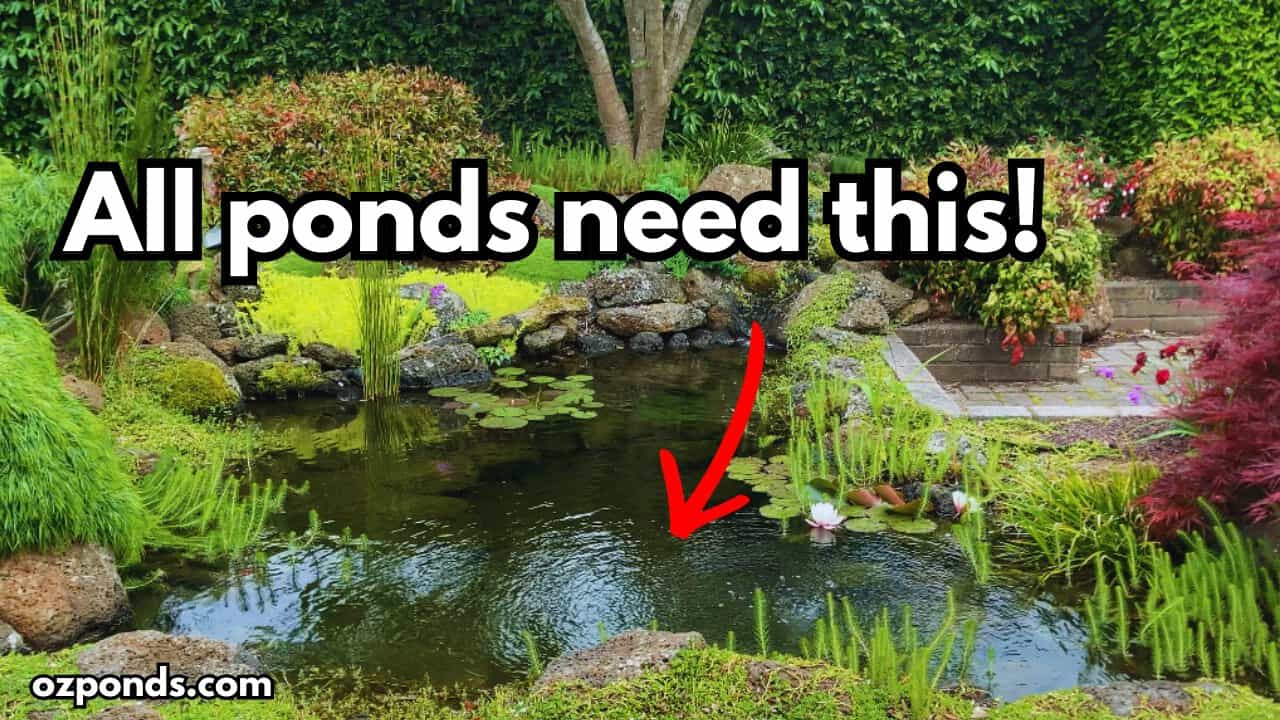
Most people think pond filtration is all about removing sludge, cleaning water, and keeping things spotless.
But in reality, every pond is running a constant balancing act between carbon, oxygen, bacteria, and waste.
That’s true in backyard ponds, aquariums, fish farms, and even large-scale wastewater treatment plants.
Once you understand how these natural processes work together, pond maintenance becomes much simpler — and often much lower maintenance too.
If you’ve ever wondered:
- Why mature ponds often become more stable over time
- Why some sludge can actually help a pond
- How bog filters process waste naturally
- Why oxygen is critical in pond design
- Why “sterile” ponds often require constant maintenance
…then this article should help.
The Two Types of Carbon in a Pond
In simple terms, ponds contain two main forms of carbon:
1. Organic Carbon
This includes things like:
- Fish waste
- Dead leaves
- Sticks and twigs
- Sludge
- Decaying plant material
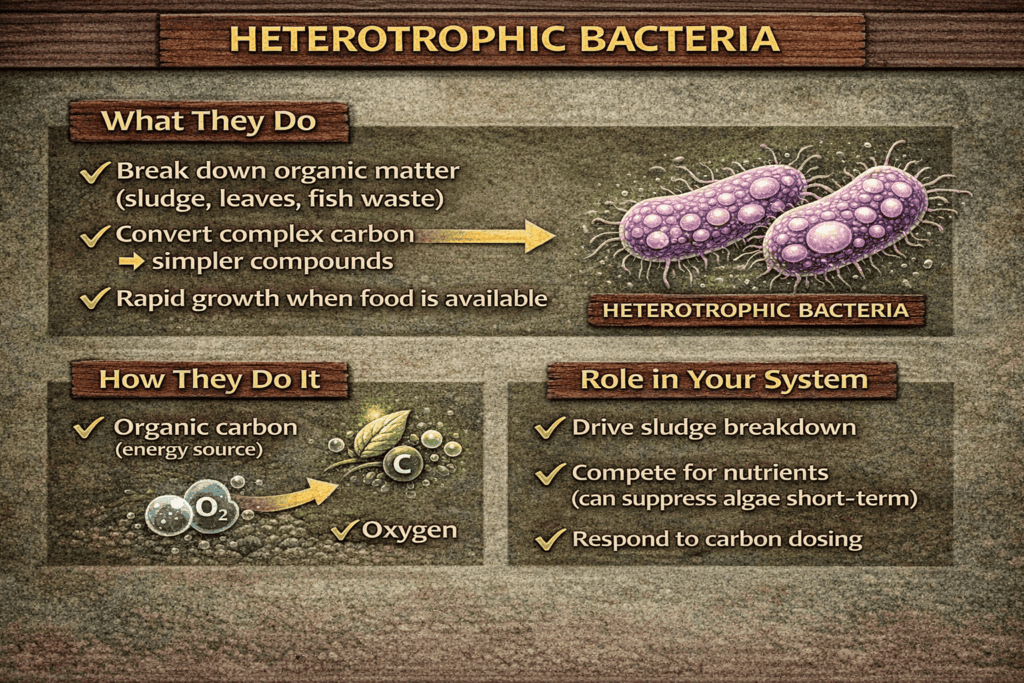
This organic material feeds heterotrophic bacteria — the fast-growing bacteria responsible for breaking down waste.
A simple way to think about it:
- Sugar = fast food for bacteria
- Leaves and sludge = slow-release food
Just like humans process sugar quickly and vegetables slowly, bacteria also process different carbon sources at different speeds.
2. Inorganic Carbon
This includes:
- Carbon dioxide (CO₂)
- Bicarbonate
- Carbonate
These compounds help stabilize pond water and buffer pH.
They’re also used by:
- Plants
- Algae
- Nitrifying bacteria
That’s why materials like limestone, shell grit, and crushed coral are commonly added to ponds.
Why Some Fish Farms Add Molasses to Water
Here’s where things get interesting.
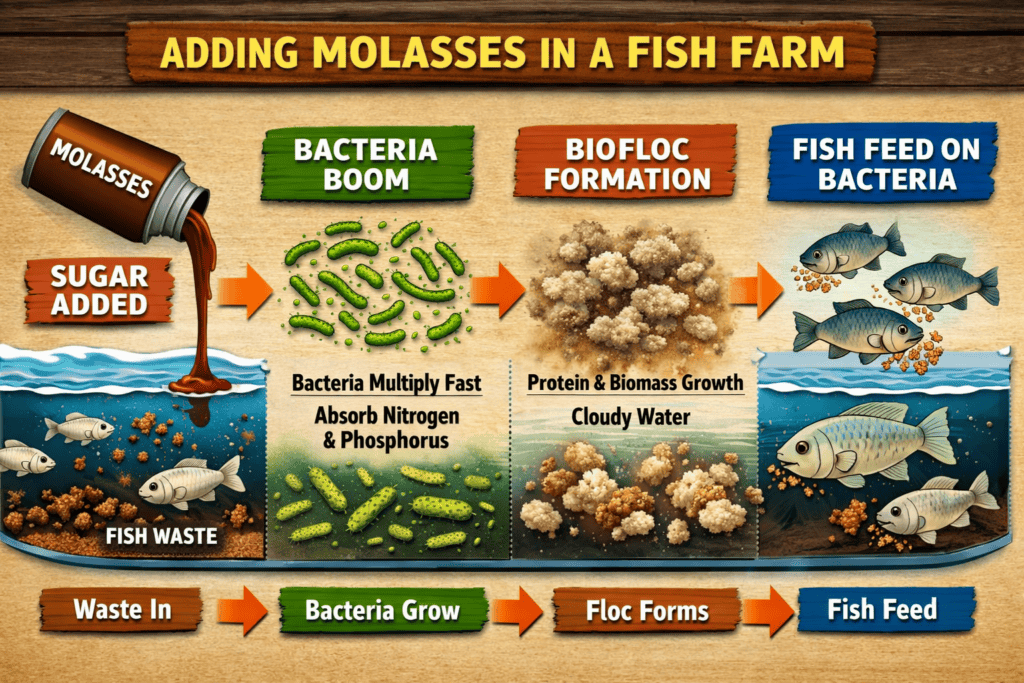
In some aquaculture systems and wastewater treatment setups, operators intentionally add carbon sources like molasses to stimulate bacterial growth.
Why?
Because when easy carbon enters the water:
- Bacteria multiply rapidly
- They absorb nitrogen and phosphorus
- They consume organic waste
- The bacterial biomass can even become food for fish
Essentially, waste gets recycled back into the food chain.
Pretty clever.
But there’s a catch.
The Problem With Rapid Bacterial Blooms
Fast bacterial growth also means rapid oxygen consumption.
If pushed too far, carbon dosing can cause:
- Cloudy water
- Oxygen depletion
- System instability
- Large bacterial die-offs
That’s why commercial fish farms constantly monitor:
- Oxygen levels
- Feeding rates
- Water quality
- Waste accumulation
These systems are highly managed.
Reef aquariums often handle this by using protein skimmers, which physically remove excess bacterial biomass from the water. Wastewater plants use settling tanks to remove sludge.
Is Pond Sludge Always Bad?
This is where many backyard pond owners get things backwards.
Not all sludge is harmful.
In fact, a mature pond often becomes more stable because it develops:
- Established microbial life
- Nutrient reserves
- Natural buffering capacity
- Diverse bacterial populations
That’s one reason older ponds frequently behave more predictably than brand-new ponds.
Natural Ponds Already Use These Principles
If you look at natural aquarium methods like the Walstad Method, they intentionally create a nutrient-rich base layer using dirt beneath sand.
That layer acts as:
- A microbial habitat
- A nutrient reservoir
- A slow-release carbon source
Leaves, sticks, and organic debris also slowly feed the system over time.
This doesn’t mean ponds should become stagnant swamps.
It just means there’s a balance between:
- Allowing natural biological processes
- Exporting excess waste when necessary
Why I Prefer Bog Filters for Pond Filtration
Some pond systems aim to remove every bit of waste using:
- High-end mechanical filters
- Constant flushing
- Heavy maintenance
- Oxidisers
- Sterile filtration
For me, that’s too high maintenance.
At the opposite extreme, completely unmanaged ponds may eventually become overloaded with nutrients and go eutrophic.
My preference sits somewhere in the middle.
I like using:
- Intake bays or skimmers
- Pumps positioned to collect floating debris
- Bog filters
- Waterfalls, streams, jets, and aeration
This allows the pond to:
- Export much of the waste naturally
- Maintain strong oxygen levels
- Support microbial life
- Remain relatively low maintenance
Why Oxygen Is So Important in a Pond
Oxygen drives nearly every important biological process in a pond.
Good circulation and aeration support:
- Waste breakdown
- Beneficial bacteria
- Fish health
- Water clarity
- System stability
Without oxygen, waste tends to accumulate anaerobically, leading to foul smells and poor water quality.
That’s why I often use:
- Waterfalls
- Streams
- Air pumps
- Pond jets
- Moving water
These help keep oxygen levels high while also moving debris toward filtration areas.
The 3 Main Types of Pond Bacteria
Understanding pond filtration becomes much easier once you understand the roles of different bacteria.
Heterotrophic Bacteria
These are the fast recyclers.
They break down:
- Sludge
- Leaves
- Fish waste
- Organic debris
They grow quickly when food is available and dominate most pond systems.
Their role includes:
- Breaking down organic waste
- Recycling nutrients
- Competing with algae
- Responding to carbon sources
Nitrifying Bacteria
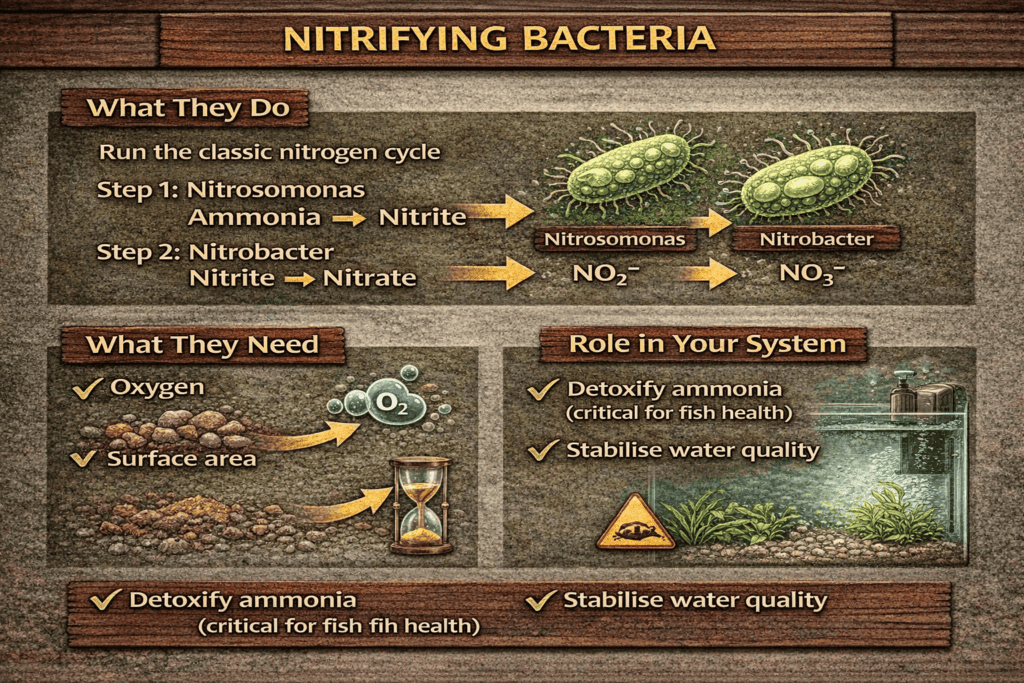
These bacteria process toxic fish waste.
They convert:
Ammonia → Nitrite → Nitrate
They require:
- Oxygen
- Surface area
- Stable conditions
- Time to establish
Their primary role is protecting fish from ammonia toxicity.
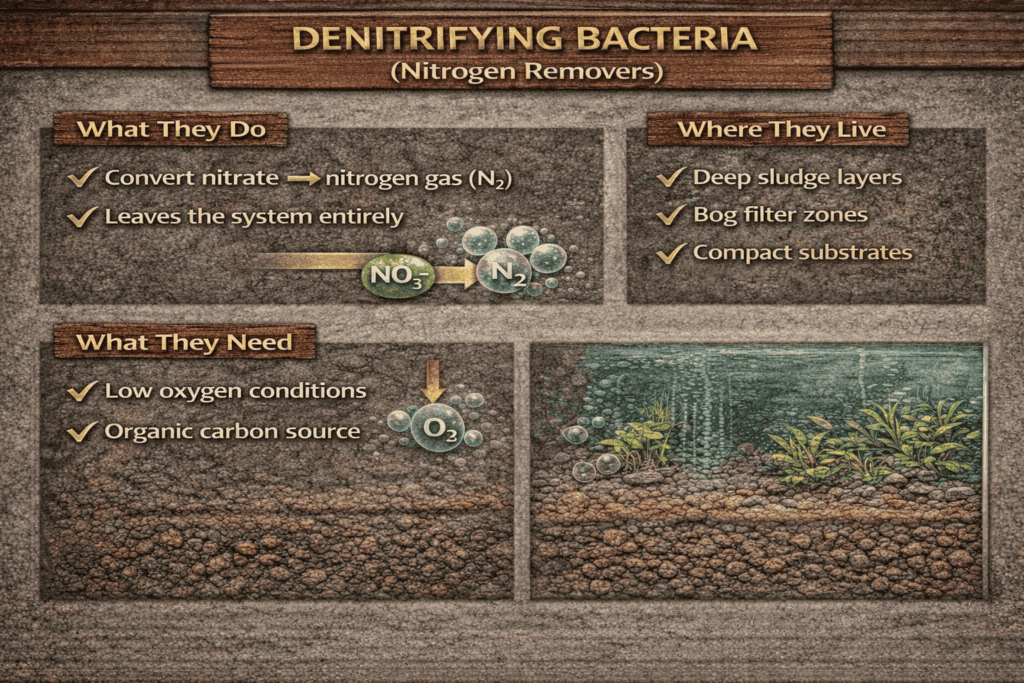
Denitrifying Bacteria
These bacteria operate in low-oxygen zones.
They convert nitrate into nitrogen gas, which leaves the system entirely.
This is one of the few true nutrient export mechanisms in natural ponds.
These bacteria often live:
- Deep in sludge layers
- Inside compact substrate
- In low-oxygen sections of bog filters
Plants Don’t Truly Remove Nutrients Unless You Remove the Plants
This is an important distinction.
Plants absorb nutrients while growing.
But when plants die and decay in the pond, those nutrients are usually released back into the system again.
True nutrient export happens when:
- You trim and remove plants
- You remove sludge
- Waste leaves the pond system entirely
My Preferred Pond Philosophy
For me, the goal isn’t to create a sterile system.
It’s to create habitats and zones where natural biological processes can happen efficiently.
That means:
- Plenty of oxygen
- Areas for microbes to thrive
- Easy waste collection
- Simple maintenance access
- Stable biological processes
I still like having filtration that’s easy to clean when needed, but I don’t want to constantly fight the pond.
I want a system that works with natural processes instead of against them.
Final Thoughts
There are many ways to filter water.
But nearly all successful pond systems rely on the same core relationship between:
- Carbon
- Oxygen
- Bacteria
- Waste processing
Understanding that balance is one of the keys to building a pond that stays healthier, clearer, and easier to maintain long term.
If you want to learn the exact system I use to design my ponds — including bog filters, intake bays, circulation, filtration sizing, and low-maintenance design principles — you might like the Ozponds Pond Formulas Blueprint.
It walks through the same design principles I use in my own ponds and the same system people around the world are now using in theirs.
About to build a pond… or already have one?
Sign up for my email list and I’ll send you DIY-friendly pond tips, along with a few helpful tools like calculators, gear recommendations, and more.