
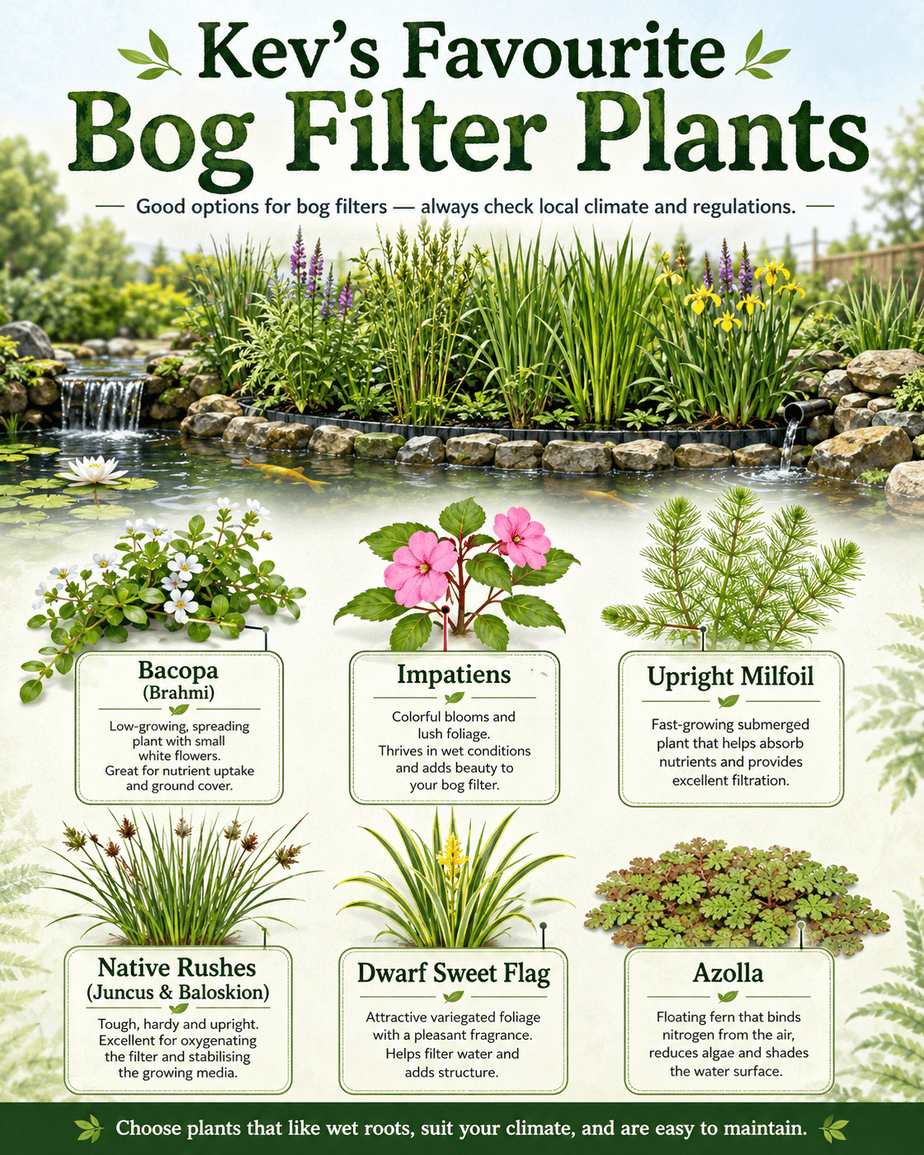
The best plants for a bog filter are plants that tolerate wet roots, suit your climate and water depth, and are easy to trim or thin out.
In my ponds in south-east Australia, I use plants such as brahmi, impatiens, upright milfoil and native rushes. But the right choice for my pond won’t necessarily be the right choice for yours.
A plant that grows brilliantly here might struggle through your winter. Another might grow so well that removing it becomes the hardest job in the garden.
So rather than just giving you another list of the “10 best bog plants”, I want to explain what makes a plant useful in a bog filter. I’ll share what I use, how I manage it, and how water level, algae and the rest of the filter influence those choices.
What makes a good bog filter plant?
For me, a useful bog filter plant needs to do more than grow quickly. It needs to fit the pond and the amount of maintenance I’m prepared to do.
I usually look for plants that can have their roots in the wet media while most of their foliage grows above the water. That gives the roots access to nutrients and makes the leaves and stems easy to reach when it’s time for a trim.
However, liking moist soil isn’t the same as tolerating permanent submersion. Check the plant’s preferred conditions, especially the water depth around its crown—the point where the roots and shoots meet.
I also consider how much sun the filter receives, how cold it gets in winter, and how large the plant will become. A plant that works around the edge of a large in-ground bog might be completely impractical in a small barrel filter.
And always check the exact species against your local weed guidance. Being recommended online—or even offered for sale—doesn’t necessarily mean a plant is suitable or permitted where you live.
How do bog filter plants help clean pond water?
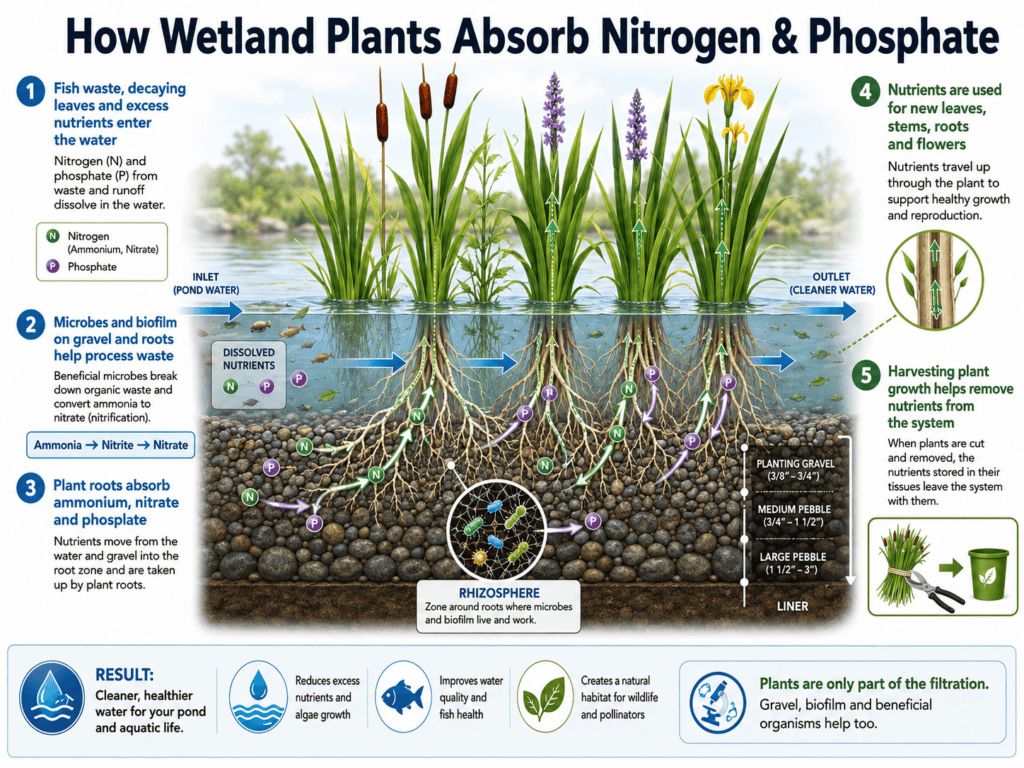
Plants absorb nutrients as they grow. Nitrogen and phosphorus are two important nutrients in ponds, and both can contribute to excessive algae growth. Plant uptake is one way of capturing some of those nutrients in leaves, stems and roots.
But there’s an important second part to this: removing some of that plant growth removes the nutrients it contains.
When leaves and stems die and decompose in the filter, some of their nutrients can return to the water. Trimming a plant and leaving the clippings in the bog doesn’t achieve the same thing as taking those clippings out.
That’s why I like plants that are easy to trim, thin or harvest. I’m not simply looking for the plant that produces the biggest possible root system.
Can plant roots clog a bog filter?
Vigorous plants can develop thick mats of roots and rhizomes through the rock and pebble. Along with accumulated solids and other material, that growth can reduce the space available for water to move and make maintenance more difficult.
Even before water movement becomes a problem, removing an established plant can become a substantial job.
For my own filters, being able to manage the plant easily matters more than getting the fastest possible growth. I’d rather do a little thinning than eventually have to wrestle a huge clump out of the filter.
My favourite plants for bog filters
When I talk about a small bog filter, I generally mean one of my container systems. My larger bog filters are the in-ground systems, often with open water above the rock and pebble.
These are examples from my ponds, not a universal shopping list.
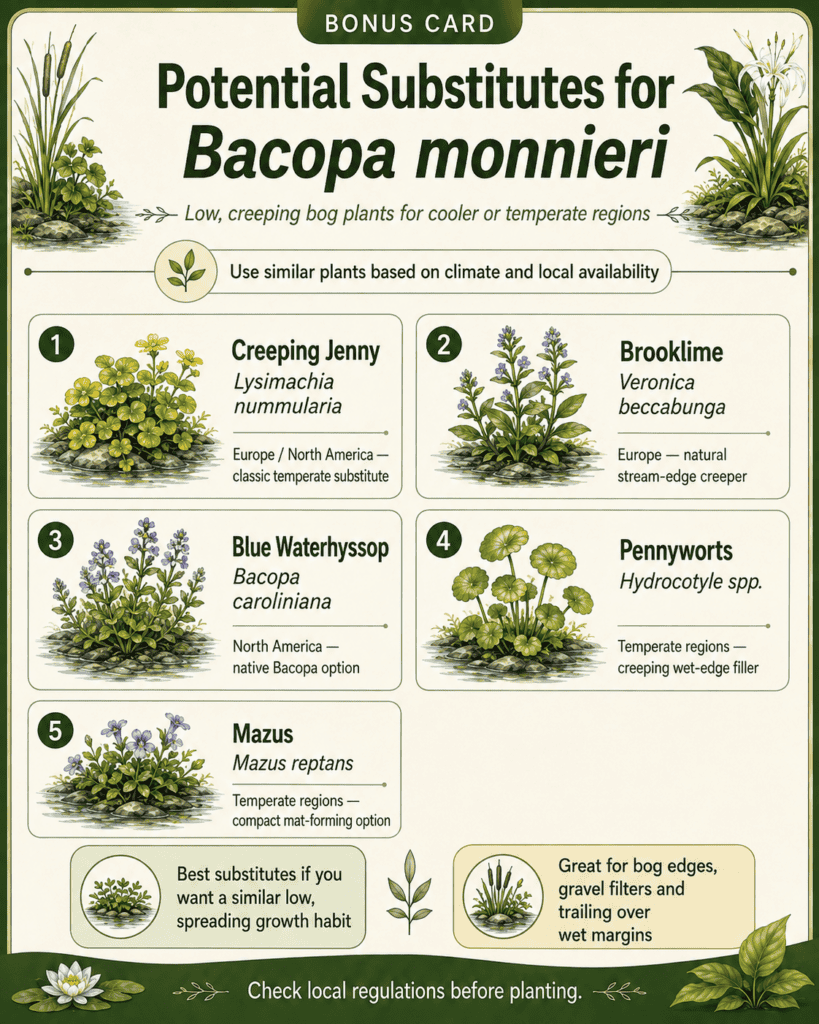
Brahmi — Bacopa monnieri
Brahmi is probably the plant I use most often. I grow it in small and large bog filters, and extensively around my pond margins.
It’s a low-growing, spreading plant suited to wet conditions and shallow water. Check the botanical name, Bacopa monnieri, rather than relying on the common name alone.
What I particularly like is how easy it is to thin out and maintain. It also produces pretty little flowers during the warmer months.
My climate is a bit cooler than it would probably prefer. It yellows off somewhat through winter, but in my ponds it hasn’t completely died back.
That’s my experience here, though—not a promise that it will handle your winter.
Impatiens for colour in sheltered, shady filters
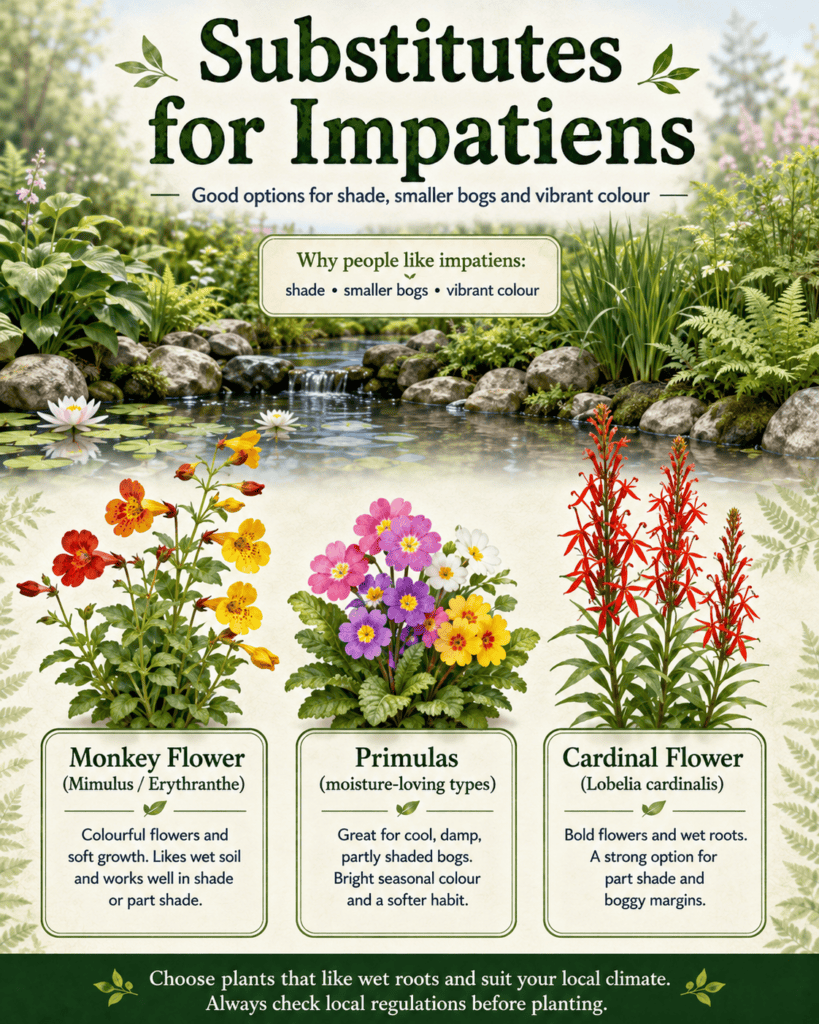
I like impatiens in smaller bogs and shady positions because they give me plenty of colour.
In a sheltered spot with full shade and no frost, I can sometimes keep them going from one year to the next. Expose them to frost and I tend to lose them.
Sometimes I get lucky and seedlings appear elsewhere the following season.
For me, they’re a useful example of choosing a plant for a particular position. I wouldn’t expect the same result from a cold, exposed filter as I get in a protected, shady one.
Upright and red-stemmed milfoil
I also like the upright and red-stemmed milfoils I grow, particularly in my larger bog filters.
Most of their foliage sits above the water. I plant them around the margins and allow them to spread into the open water, where the extra growth is easy to break off and remove.
That’s part of their appeal: I can remove a useful amount of plant material without digging through the pebble.
Check the species carefully before buying milfoil. I wouldn’t buy a plant simply because its label says “milfoil”. Confirm its identity and check your local weed guidance first. Don’t assume that a plant sold under a similar name is the same one you’ve seen in someone else’s pond.
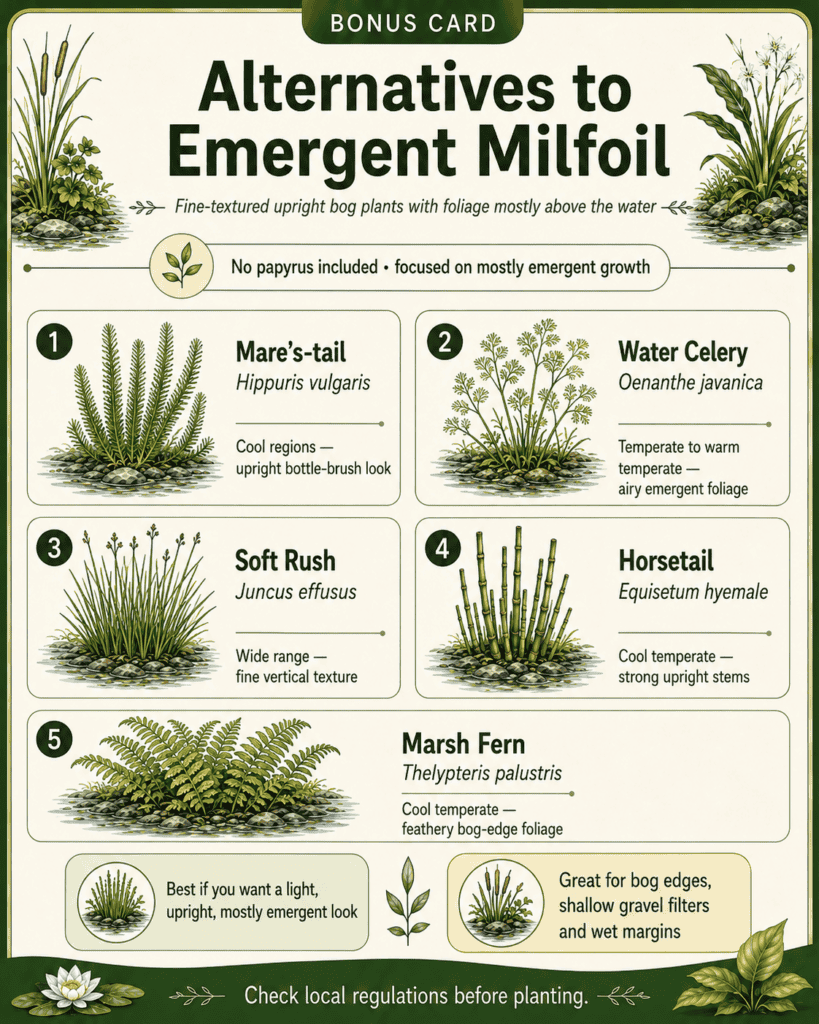
Native rushes, including Juncus and Baloskion
In my larger filters, I’ve used various native rushes, including Juncus and Baloskion.
I generally position them around the margins rather than in the deeper, open-water areas. With the plants I grow, I avoid keeping their crowns deeply submerged for long periods.
They add height and structure, but I still think about access. I want to be able to get to the outlet, the clean-out points and the plants themselves.
“Native rush” isn’t a single set of growing requirements, either. Match the particular species to the depth and conditions where you intend to plant it.
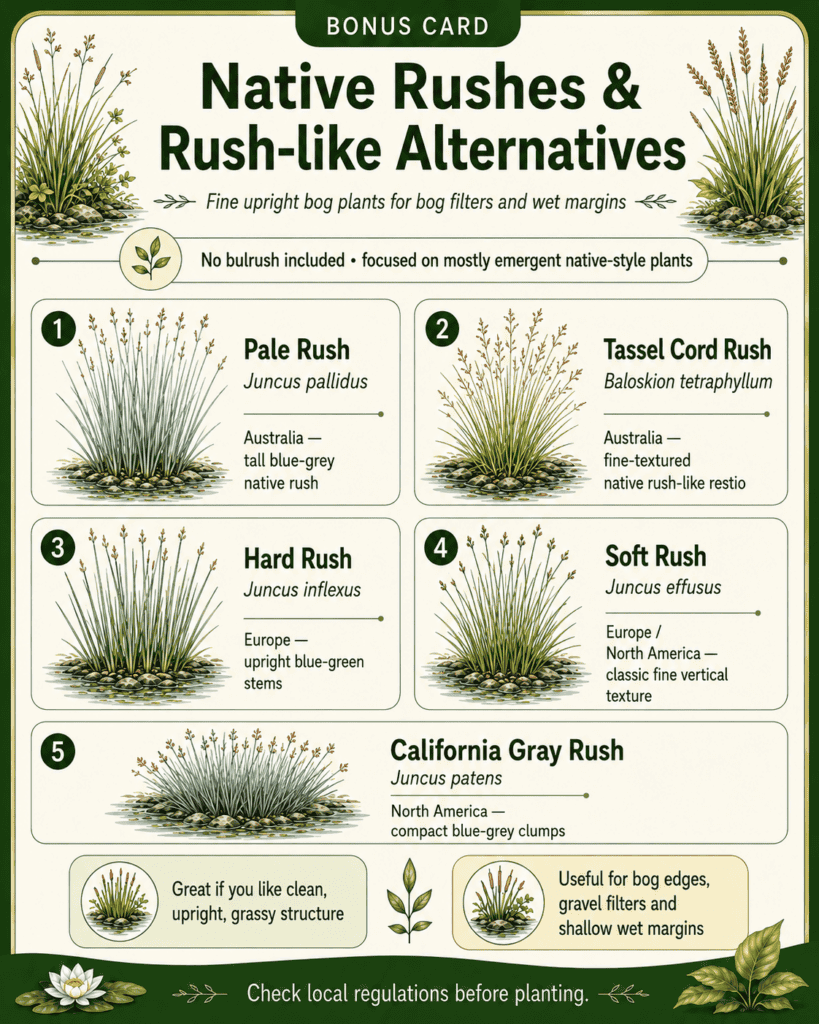
Floating plants, including the azolla that arrived by itself
Floating plants offer another option when you have open water in the bog. They don’t need their roots anchored in the pebble, which makes excess growth much easier to scoop out. Many floating plants obtain nutrients directly from the water.
I didn’t deliberately add azolla to my bog filters. The ducks appear to have taken care of that for me.
It can multiply quickly, but I find it straightforward to remove when it gets carried away. That makes it a useful contrast to plants whose roots become firmly established throughout the filter.
The important design consideration is the outlet. Keep floating plants away from it with a suitable barrier that allows plenty of water through. Check that barrier regularly: something intended to stop plants escaping can also trap debris and become a blockage.
The last thing you want is water backing up and escaping over the side of the filter.
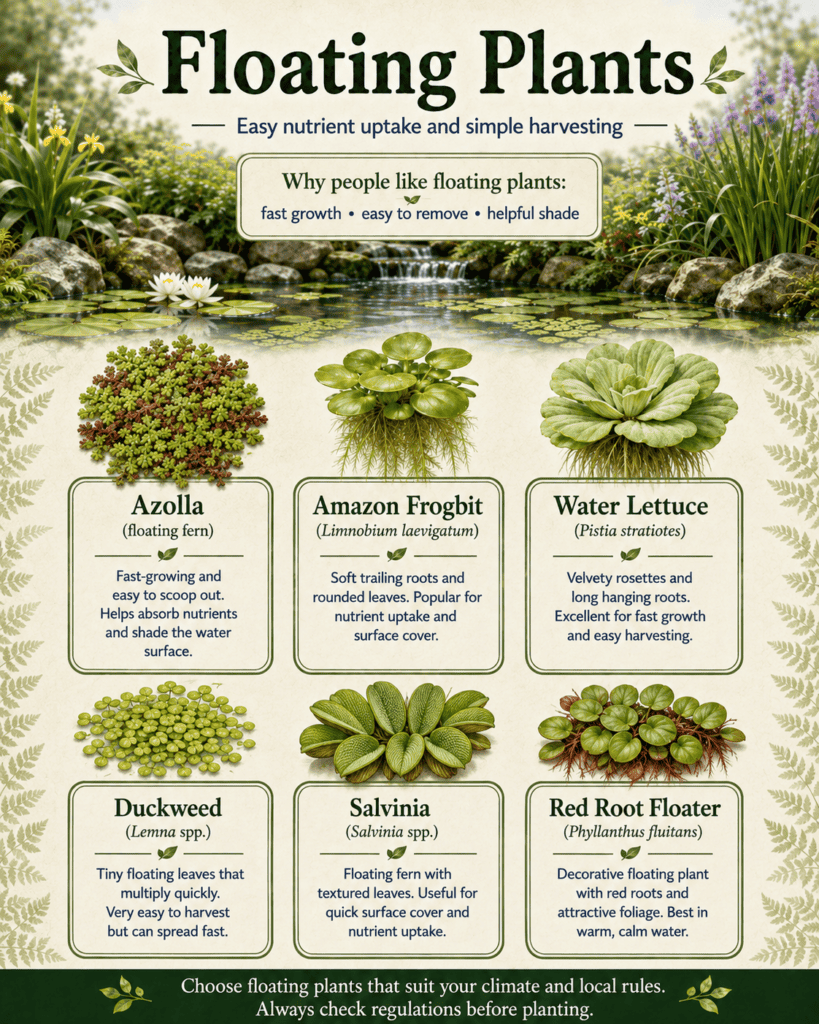
Plants that find their own way in
I’ve also had small native ferns and some bracken colonise damp areas around my larger bog filters.
That’s an observation rather than a recommendation to put any fern—or bracken—into your filter. I still judge anything that turns up by where it is growing, how it spreads and whether it will be manageable.
What can you grow in a different climate?
You don’t need to track down the exact plants I use. Start with the conditions in your own filter and look for locally suitable plants that fill the same role.
For example, marsh marigold (Caltha palustris) is an option to investigate for cooler-climate pond margins and wet planting positions. It produces yellow spring flowers and needs consistent moisture.
Cardinal flower (Lobelia cardinalis) is another possibility for a moist marginal position, with red flowers and a preference for consistently moist conditions. It tolerates brief flooding, but that is not an invitation to bury its crown under deep water.
These are alternatives to investigate, not plants I’m claiming to have tested in my own bogs. Check local suitability, mature size, water-depth requirements and weed status before buying.
The principle stays the same wherever you live: choose the plant for the position, not just because it appears on a bog-filter plant list.
How do you plant a bog filter?
In my filters, I plant directly into the upper layer of pebble. The pebble supports the plant while its roots reach the water moving through the filter.
I position plants according to their needs rather than burying every crown at the same depth. Around a larger bog, that can mean using shallower margins for some plants while leaving open water elsewhere.
Give yourself room to maintain the planting. Don’t crowd the overflow, bury access points or pack every available space with something that will soon become much larger.
For the construction side, my bog filter diagrams show the container and in-ground arrangements I use.
Should the water level be above or below the gravel?
Both arrangements can work. The choice affects which plants you can grow and how you use the surface of the bog. Whichever arrangement you choose, the planting depth needs to suit the plants.
Water above the rock and pebble
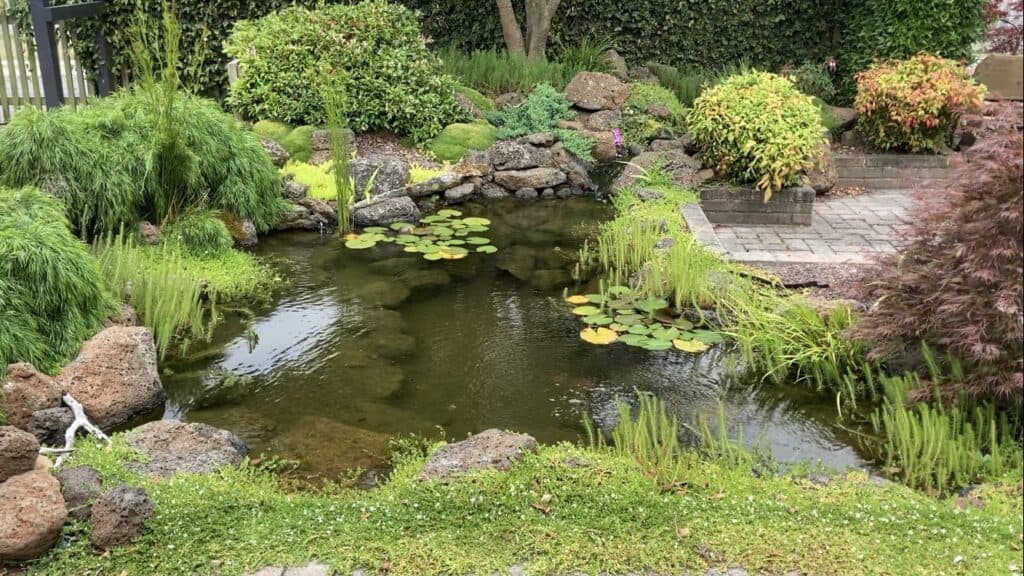
In my larger bog filters, I like having water over the media. It makes them feel like little ponds feeding the main pond, rather than a filter I need to hide.
It also gives me room for floating plants. Fish breed in some of these areas, and I can grow different plants around the shallower edges.
I don’t try to fill the entire surface with densely rooted planting. The open water is part of what I like about these filters.
Pebble at or slightly above the water level
In smaller container filters, I generally have the pebble at or slightly above the water level.
The roots still need access to the wet part of the filter, but there is less exposed water at the surface. I keep the overflow area open so water can return freely to the pond.
The aim isn’t to keep the whole filter dry. It’s to choose a surface arrangement that suits the plants and the design.
Will a bog filter attract mosquitoes?
A bog filter doesn’t have to become a mosquito nursery, but it isn’t automatically mosquito-proof either.
In my larger bogs, fish can eat mosquito larvae. In smaller filters, keeping the pebble near the water level reduces exposed water, and I keep the overflow clear and moving.
However, mosquitoes can develop in sheltered pockets of still or slow-moving water. Clear water alone doesn’t rule them out, and having a pump doesn’t mean every part of the filter is circulating well.
In a fishless pond, other aquatic predators can contribute, but I wouldn’t rely on predators alone. Check for larvae, remove excessive decaying vegetation and investigate stagnant pockets. Persistent problems are worth discussing with your local mosquito-control service.
The useful question is not simply “Is there water above the gravel?” It’s “What conditions have I created in that water?”
Is algae in a bog filter a bad thing?
Not necessarily. A sunny, shallow area of water may grow algae, particularly while the other plants are establishing or growing slowly.
The stringy, hairy algae people often dislike also takes up nutrients as it grows. Removing some of it takes those nutrients out of the system, just as removing plant growth does.
In my ponds, I often see more string algae during winter when the plants aren’t doing much. As the weather warms and the plants begin growing again, it tends to become less noticeable.
Given the choice, I’d generally rather have that algae growing somewhere accessible in the bog than spread through the main pond.
That doesn’t mean I let it cover everything. I remove excess growth when it starts crowding plants or getting near the overflow. Some algae isn’t proof that the filter has failed, but more algae isn’t automatically better.
I’ve written more about these seasonal changes in why your pond changes in cold weather.
The plants aren’t doing all the filtration
The rock and pebble aren’t just there to hold plants upright. They provide surfaces for beneficial bacteria and biofilms, and spaces where other small organisms can live. Biological processes on and around the media are an important part of filtration.
That’s why I don’t judge a bog filter only by how impressive the planting looks.
Plants contribute nutrient uptake, but the whole filter matters: how water moves through it, how much waste it receives, and how easily accumulated waste can be removed. A beautiful plant collection doesn’t compensate for a poorly planned filter.
My bog filter sizing calculator is a useful starting point for planning the filter rather than relying on plants to make up for insufficient capacity.
Design Your Pond Using The Same System I Use
- A simple system that has helped people around the world design clear, low-maintenance ponds without spending a fortune.
- Includes access to the Private Ozponds community and Virtual Kev, a tool that helps you plan your pond step-by-step.
About to build a pond… or already have one?
Sign up for my email list and I’ll send you DIY-friendly pond tips, along with a few helpful tools like calculators, gear recommendations, and more.
Bog filter plant FAQs
Do I need lots of different plants in a bog filter?
No. I like variety, but I also have simple filters planted mainly with bacopa. The visible planting isn’t the whole ecosystem. There can still be considerable biological diversity on the media and among the roots.
How many plants should I put in a bog filter?
I wouldn’t give one plant count for every filter. A small cutting and a mature clump take up very different amounts of space. Plan around mature size, allow room for growth and keep the overflow and maintenance access clear.
How often should bog filter plants be trimmed?
That depends on the species, season and growth rate. I’d watch the plants rather than follow a rigid schedule. Thin them before they crowd the outlet or become difficult to manage, and take the removed growth out of the pond system.
Can you grow vegetables in a bog filter?
Growing plants using nutrients from fish is the principle behind aquaponics. Some people use suitable edible crops rather than ornamental plants. But an ornamental pond is not automatically a food-production system: water quality, pond treatments and food safety need separate consideration.
Choose plants that help, rather than create more work
For me, the best bog filter plants are the ones that grow well in the conditions I can give them and are easy to keep under control.
Brahmi is a favourite, impatiens gives me colour in sheltered shade, and larger bogs give me room for upright milfoil, native rushes and open water. None of that means you need to copy my planting exactly.
Start with suitable plants, leave room to maintain them, and remember that the rock, pebble and life beneath the surface matter too.
For help putting the whole pond together, my Pond Building Blueprint explains the step-by-step system I use to plan and build my ponds. It also includes access to Virtual Kev and the private Ozponds community.
You’ll find more helpful resources, calculators and videos throughout Ozponds to help you build and maintain a pond without spending a fortune.