
If someone asked me:
“Kev, can I use a bathtub as a bog filter?”
I’d say yes.
The plug hole gives you a ready-made drain. You can drill an overflow. You could even tilt it slightly so the water returns to the pond.
It can work.
But that’s not where most bog filter problems come from.
The biggest mistake people make with bog filters isn’t the container they use.
It’s getting the size wrong.
Can a Bog Filter Be Too Small?
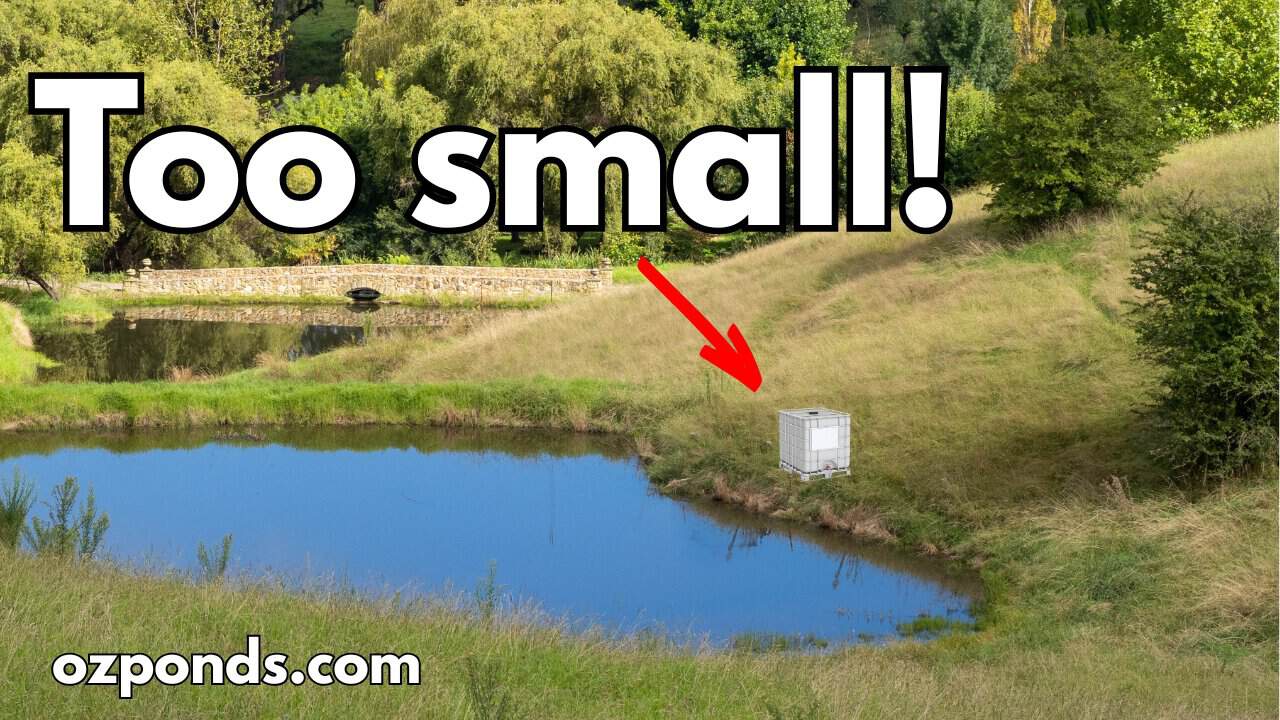
I had someone message me recently about a large pond of roughly 40,000 gallons. They wanted to connect a single IBC tote as the bog filter.
The problem wasn’t the IBC.
The problem was the size.
Click here to use the free bog filter sizing calculator.
A bog filter only works when there is enough surface area and enough volume for beneficial bacteria, plant roots, and other microorganisms to process waste.
When the filter is too small, you’re asking a tiny biological system to handle a huge amount of water.
Eventually, it gets overwhelmed.
Why Bog Filters Work
Many people think a bog filter is just gravel and plants.
It’s actually much more than that.
As water slowly moves through the gravel, it comes into contact with:
- Plant roots
- Beneficial bacteria
- Fungi
- Algae
- Other microorganisms
Together, these organisms help break down waste and lock up excess nutrients before they become a problem.
The more surface area available, the more biological activity the system can support.
That’s why properly sized bog filters are so effective.
Why Bigger Is Usually Better
One of the most common questions I get is:
“How long will it take for my pond to clear?”
The answer depends on the cause of the problem.
If the water is cloudy because of suspended clay particles, a bog filter may not solve the issue immediately. Those particles often need a flocculant or another treatment to clump together and settle out.
But for ongoing nutrient management and long-term water quality, a bog filter can make a huge difference.
The catch?
It needs to be large enough.
A bigger bog filter provides:
- More gravel surface area
- More plant root mass
- More biological capacity
- Better nutrient processing
- Greater system stability
In most cases, larger bog filters require less maintenance and produce better long-term results.
What About Water Flow?
Flow rate matters too.
If water moves too quickly through the bog, it has less contact time with the gravel and plant roots.
If it moves too slowly, parts of the system can become stagnant.
Click here to use the bog filter pump flow rate calculator.
The goal is to create even water distribution throughout the bog so the entire filter is working, not just a small section.
This is one reason proper pipe layout and sizing are important.
The Advantage of a Clean-Out Drain
One thing I like about containers such as bathtubs is that many already include a drain.
A drain makes it much easier to remove accumulated sediment over time.
Whether you use:
- A bathtub
- A stock tank
- An IBC
- A spa shell
- A custom-built bog
Having a way to flush sediment from the bottom is a huge advantage.
It can be as simple as a valve, a siphon point, or a pipe connected to a pump.
The Real Question to Ask
Instead of asking:
“What container should I use?”
Ask:
“What am I trying to achieve?”
Once you understand the job the bog filter needs to do, you can choose materials that fit your budget and your project.
I’ve seen people build successful bog filters from all sorts of materials.
The principles stay the same.
The container matters far less than understanding the system.
How I Size Bog Filters
Every pond I build follows the same basic sizing principles.
The exact numbers vary depending on whether you’re building a wildlife pond, goldfish pond, koi pond, or something more heavily stocked, but the process is always the same.
That’s why I created the Pond Formulas Blueprint.
It isn’t about copying my pond.
It’s about understanding the principles behind the design so you can apply them to your own project.
Final Thoughts
The biggest mistake people make with bog filters is focusing on the container instead of the capacity.
A bathtub can work.
An IBC can work.
A stock tank can work.
But if the bog filter is too small for the pond, you’ll always be fighting an uphill battle.
Get the size right first.
Everything else becomes much easier.
About to build a pond… or already have one?
Sign up for my email list and I’ll send you DIY-friendly pond tips, along with a few helpful tools like calculators, gear recommendations, and more.