
Thinking about building a pond but worried about the cost?
You’re certainly not alone.
One of the most common questions I receive is:
“Kev… how much does a pond actually cost?”
The honest answer is…
Anywhere from under $50 to tens of thousands of dollars.
I’ve built tiny patio ponds from recycled containers and I’ve also built large natural ecosystem ponds that would have cost tens of thousands of dollars if I’d hired a contractor.
The good news?
You don’t need a massive budget to build a beautiful pond.
The secret is understanding where your money makes the biggest difference—and where you can save thousands by doing things a little differently.
How Much Does a Backyard Pond Cost?
There isn’t a single answer because every pond is different.
Your final budget depends on several factors including:
- Pond size
- Pond style
- Whether you build it yourself
- Whether you hire contractors
- Your choice of materials
- Whether you want fish, wildlife or simply a water feature
I’ve seen people build wonderful ponds using recycled bathtubs, whiskey barrels and stock tanks.
I’ve also seen professionally built koi ponds cost well over $50,000.
Neither is automatically “better.”
It simply depends on what you’re trying to achieve.
Before buying a single pump or liner, ask yourself:
- Do I want fish?
- Do I want frogs and wildlife?
- Do I want crystal-clear water?
- Do I want a formal pond or a natural-looking ecosystem pond?
- How much maintenance am I willing to do?
Once you know the goal, budgeting becomes much easier.
The Biggest Cost Is Usually the Pond Liner
If you’re building a natural-looking liner pond, this is usually where most of your money goes.
For my own ponds I generally use:
They’re not cheap.
But after building multiple ponds over the years, they’re still what I trust most.
For example:
- My largest pond cost roughly $10,000, with approximately $6,000 spent on the liner and underlay alone.
- My courtyard pond cost around $2,000, with roughly $1,200 going into the liner system.
That sounds expensive…
…but replacing a failed liner underneath tonnes of rock and gravel is even more expensive.
That’s why I personally don’t try to save money here.
Can You Use Cheaper Pond Liners?
Absolutely.
There are plenty of cheaper liner options available.
If I’m building a formal pond with exposed liner and very little rock, I’m much happier using a less expensive liner because it’s relatively easy to replace if something goes wrong.
Natural ponds are different.
Once you’ve buried the liner beneath hundreds of kilograms of rock and pebble, replacing it becomes a huge job.
That’s why I generally recommend buying the best liner you can reasonably afford.
Are Clay Ponds Cheaper?
Sometimes.
If your property naturally contains suitable clay, they can be incredibly affordable.
I actually have a large clay pond that cost around $500 to excavate.
It’s almost as large as my biggest liner pond.
The downside?
It leaks.
Fortunately, that’s acceptable because it’s simply a wildlife pond with lots of plants and aeration.
If your goal is a natural wildlife habitat rather than a perfectly sealed ornamental pond, a clay pond may be worth considering.
Just remember that not every property has suitable clay soils, and some projects require imported clay, which can quickly increase costs.
Why Are Pond Rocks So Expensive?
Interestingly…
The rocks often aren’t the expensive part.
Transport usually is.
Large trucks, machinery, fuel and delivery costs add up very quickly.
If you’re building a large pond, buying directly from a quarry can sometimes save money.
For smaller ponds, don’t overlook:
- Marketplace listings
- Landscaping businesses
- Garden renovations
- Demolition projects
People often give away perfectly good rock simply because they want it removed.
I’ve seen plenty of Ozponds community members save hundreds—or even thousands—of dollars this way.
Do You Even Need Rocks?
No.
Rock and pebble are completely optional.
Some people prefer clean formal ponds with exposed liner below the waterline.
Others (like me) prefer a more natural appearance.
Rock and pebles can also provide additional surface area for beneficial biofilm and bacteria.
The trade-off?
They also trap leaves and sediment.
Neither approach is right or wrong.
It simply comes down to the type of pond you want.
Don’t Forget the Hidden Costs
Many new pond builders focus entirely on the visible materials.
But hidden costs can quickly surprise you.
These include:
- Excavation
- Electrical work
- Plumbing
- Labour
- Machinery hire
- Drainage
- Overflow systems
In some professionally built ponds, labour alone can cost more than all the pond materials combined.
That’s one reason I enjoy building my own ponds.
Even if it takes longer, I learn how every part of the system works.
DIY Pond Filters Can Save Thousands
This is probably one of the biggest opportunities to reduce costs.
Commercial filtration systems can be extremely expensive.
Over the years, I estimate my own DIY filtration systems have saved me well over $15,000 compared with buying equivalent commercial filters.
That doesn’t mean everyone should build their own.
But understanding the basics of pond filtration allows you to make much better decisions.
A pond filter really has two primary jobs:
- Capture waste.
- Provide surface area for beneficial bacteria.
There are many different ways to achieve those goals without spending a fortune.
Choosing the Right Pond Pump
Your pump isn’t just an upfront purchase.
It’s also an ongoing electricity bill.
Two pumps may move similar amounts of water while using very different amounts of power.
Over several years, those differences become significant.
When choosing a pump I look at:
- Flow rate
- Reliability
- Energy efficiency
- Long-term running costs
Buying the cheapest pump isn’t always the cheapest decision.
Can You Run a Pond on Solar?
Yes.
Modern solar systems make this far more practical than they used to.
However…
Solar isn’t free.
You’re simply moving more of the cost upfront through:
- Solar panels
- Batteries
- Controllers
- Larger solar pumps
I’ve built my own small solar system and really enjoyed the project.
For some situations—especially adding extra circulation during daylight hours—it makes excellent sense.
Plumbing Costs Add Up Quickly
This surprised me on my largest pond.
The plumbing ended up costing far more than I’d originally expected.
I personally prefer:
- Flexible PVC
- Rigid PVC
Rather than corrugated ribbed pond hose.
It’s generally easier to create reliable watertight joins and maintain good water flow.
Planning your plumbing before construction can save a surprising amount of money later.
Don’t Forget Running Costs
Building the pond is only the beginning.
For example…
My dream pond runs four pumps at approximately 50 watts each.
That works out to around:
- 4.8 kWh per day
- Around $2.40 per day (depending on electricity prices)
- Roughly $876 per year
Every pond is different, but it’s worth calculating these costs before purchasing equipment.
Understanding Your Pond Saves Money
One of the biggest long-term expenses isn’t equipment.
It’s paying somebody else every time something goes wrong.
If you understand:
- Your plumbing
- Your filtration
- Your pumps
- Your circulation
You’ll often solve many problems yourself.
That’s one of the main reasons I enjoy teaching pond building.
The more you understand your pond, the cheaper it usually becomes to own.
Expect Some Maintenance
Even low-maintenance ponds need occasional attention.
Over time you may need to:
- Clean filters
- Trim plants
- Remove sediment
- Top up water
- Solve algae outbreaks
Understanding what’s normal—and what’s actually a problem—helps avoid spending money on unnecessary chemicals or miracle cures.
Algae, for example, is a completely natural part of pond ecology.
Not every outbreak requires immediate treatment.
Sometimes the pond simply needs time to mature and rebalance.
Can a Pond Actually Save You Money?
This probably sounds strange…
…but mine did.
When I built my first pond, I never imagined it would eventually lead to:
- A YouTube channel
- Ozponds.com
- The Pond Formulas Blueprint
- Affiliate income
- A wonderful online pond community
That certainly wasn’t the plan.
I simply became fascinated by ponds and started sharing what I was learning.
Many other people have turned their passion into income too.
Some:
- Build ponds professionally
- Sell pond plants
- Breed fish
- Create aquaponics systems
- Maintain ponds
- Build holiday accommodation around water features
Not every pond becomes a business.
But sometimes hobbies have unexpected ways of paying us back.
The Real Value of a Pond
For me, the biggest return has never been financial.
It’s what the pond gives back every single day.
Watching birds visit.
Listening to running water.
Seeing fish cruising beneath the lilies.
Spending more time outside.
During the COVID lockdowns, my ponds became my favourite place to be.
I didn’t feel trapped.
I felt lucky.
And you don’t need a huge pond to experience that.
A small whiskey barrel pond or patio pond can provide just as much enjoyment as a much larger system.
Final Thoughts
Building a pond can be surprisingly affordable—or surprisingly expensive.
The biggest costs usually come from:
- Liner and underlay
- Rock and pebble
- Excavation
- Plumbing
- Pumps
- Labour
But with careful planning and a willingness to learn, there are also plenty of opportunities to save money without compromising the finished pond.
If you’d like a step-by-step guide to designing your own ecosystem pond, including bog filter sizing, circulation, plumbing layouts and pump selection, have a look at the Pond Formulas Blueprint. It’s the exact system I use when planning my own ponds and has already helped thousands of pond owners build simpler, lower-maintenance ponds.
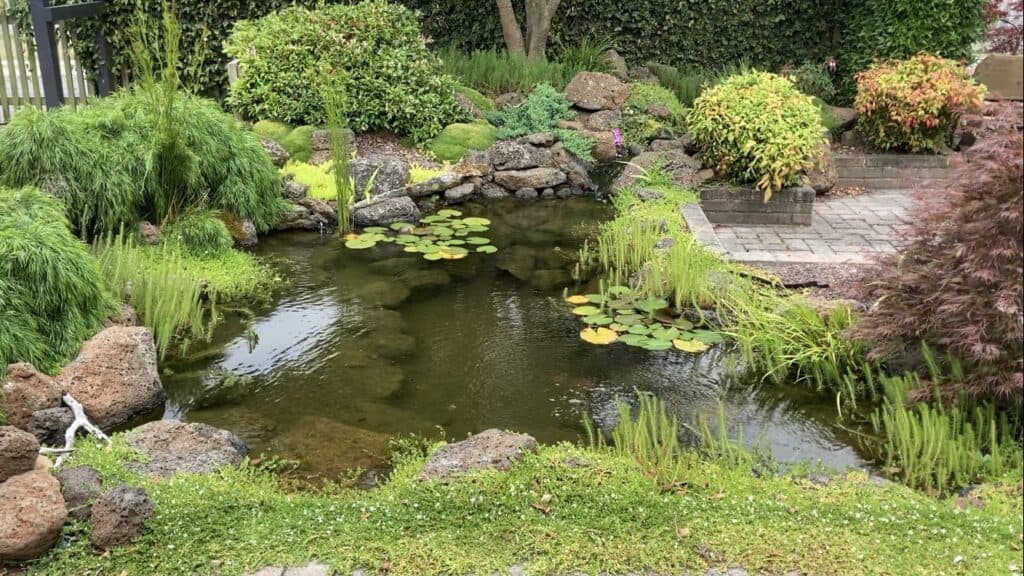
About to build a pond… or already have one?
Sign up for my email list and I’ll send you DIY-friendly pond tips, along with a few helpful tools like calculators, gear recommendations, and more.