

Over the last few weeks, this little pond of mine went… feral.
Algae everywhere. Water quality sliding. One of those slow “boom and bust” cycles where algae grows, starves, dies, releases nutrients back into the water… and then the whole mess repeats again.
To be honest, this one’s on me.
I got lazy with maintenance and hoped the system would rebalance itself if I just kept rinsing the filter sponges.
Sometimes that works.
This time, it didn’t.
So I decided to do a bigger-than-normal clean — with one important goal:
Remove excess nutrients without wiping out all the good biology that actually makes a pond stable.
This post walks through how I did that, what the “best practices” are, and where I knowingly bent the rules. If you prefer video you can watch the video below.
The Real Problem: Nutrient Boom–Bust Cycles
What I was seeing is pretty common in ponds:
- Algae blooms
- Algae runs out of nutrients
- Algae dies
- Nutrients get released back into the water
- Algae blooms again
This can loop endlessly if the system can’t export or process nutrients fast enough.
In a well-balanced pond, nutrients are:
- Locked into plant growth
- Processed by bacteria
- Exported via filtration or maintenance
In this pond, the system was overwhelmed.
Best Practice (and Why I Half Ignored It)
Best practice:
Preserve as much aged pond water as possible during a clean.
That water:
- Contains beneficial microorganisms
- Is stable and familiar for fish
- Helps the system rebound faster
What I actually did:
I drained most of the pond.
Why?
- I didn’t have a big enough vessel to store the water
- It’s summer, and the garden could use it
- My fish are hardy (no expensive or delicate species)
- I was topping up with rainwater
Is this ideal? No.
Does it always end in disaster? Also no — especially in simple backyard ponds with robust fish and natural setups.
Rain events in nature regularly replace large volumes of pond water anyway, and fish usually handle that just fine.
How I Cleaned the Pond (Step-by-Step)
1. Drain to the Bottom Shelf (Not Completely Empty)
This pond has shelves for plants and rocks.
I drained the water down to the lowest shelf so:
- Fish could stay in the pond
- I could clean the shelves above
- The bottom zone stayed wet and relatively stable
This lets you work around the fish instead of relocating them.
2. Rinse Rocks and Pebbles Gently
I used a garden hose – not a pressure washer.
Pressure washers:
- Save water
- But can blast off beneficial biofilms
Those slimy coatings on rocks and gravel are doing useful work:
- Locking up nutrients
- Feeding microorganisms
- Supporting the food web in your pond
My goal wasn’t spotless rocks.
It was to remove dead algae and sludge that was constantly re-releasing nutrients.
3. Leave the Plants In
I didn’t remove any plants during this clean.
Why?
- The system was already being shocked
- Plants help compete for nutrients
- Roots hold sediment in place
- Plants act as nutrient sinks after disturbance
Plants are your buffer when you stir things up.
4. Repeat Rinse & Drain Cycles
I rinsed the shelves, drained the dirty water…
Then did it again. And again. About 3–4 cycles.
Not aiming for perfection — just trying to:
- Reduce stored nutrient
- Stop the endless decay → nutrient release → algae loop
5. Protect the Filter Biology
I removed the biomedia from the waterfall filter and kept it submerged in another pond while I cleaned.
This prevents:
- Bacteria drying out
- Total loss of filtration capacity
Some bacteria loss is inevitable, but the goal is damage control, not total sterilisation.
6. Refill + Dechlorinate (If Needed)
I refilled with rainwater.
If you’re using tap water:
- Chlorine/chloramine will harm beneficial bacteria
- Always use a water conditioner before restarting pumps
- Then return your filter media
I also added some bottled bacteria I had on hand.
Not magic — but it doesn’t hurt when a system’s been disturbed.
What I Expect to Happen Next
I fully expect some algae to return.
That’s normal.
But the difference now is:
- I’ve removed a chunk of stored nutrient
- I preserved as much biological processing as I reasonably could
- The system has a better chance of stabilising instead of looping endlessly
Right now:
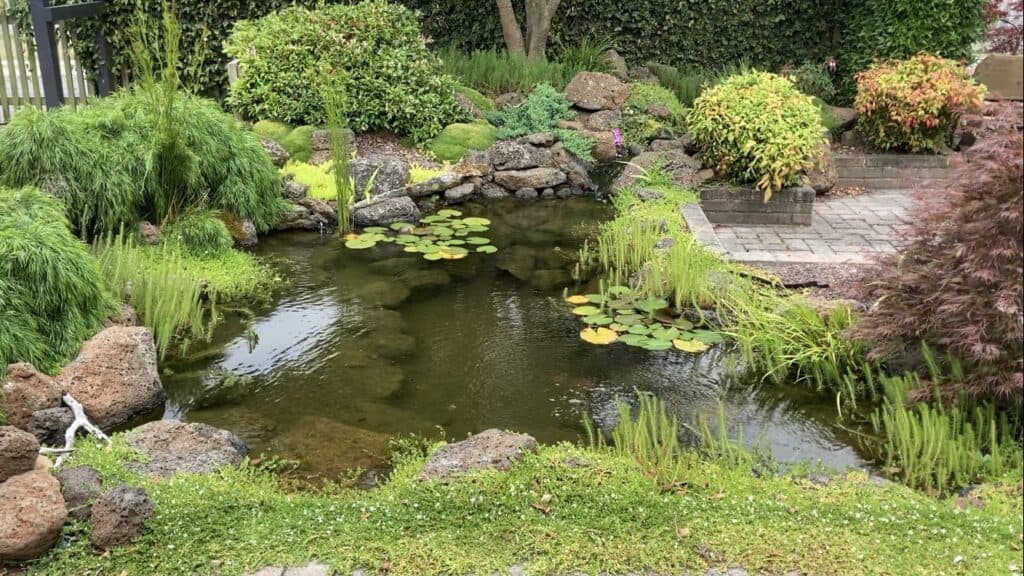
- Water is clear
- Pebbles are clean
- Fish look fine
In 3–4 weeks?
Could be crystal clear… or green again. Every pond behaves differently.
The Bigger Lesson (and Why I Like Bog Filters)
If I’d been on top of regular maintenance, this reset probably wouldn’t have been necessary.
This is one of the reasons I like:
They:
- Absorb way more waste before becoming overwhelmed
- Give you modular cleaning options
- Spread biological processing over a larger area
It’s not about zero maintenance.
It’s about designing ponds that forgive laziness.
Key Takeaways
- Algae cycles are usually nutrient problems, not “dirty pond” problems
- You can clean a pond without destroying all the biology
- Don’t aim for sterile — aim for balanced
- Preserve filter bacteria wherever possible
- Plants are your allies during resets
- Design matters more than gadgets
Want to Build a Pond That’s Harder to Break?
If you want to design ponds that:
- Stay clearer for longer
- Handle waste better
- Don’t need constant “rescues”
- And don’t cost a fortune
If you want to use the same system I use to build my ponds on a budget click here.
This system has been used all over the world. Real People, Real results.
Anyway, I hope this is useful.
About to build a pond… or already have one?
Sign up for my email list and I’ll send you DIY-friendly pond tips, along with a few helpful tools like calculators, gear recommendations, and more.