
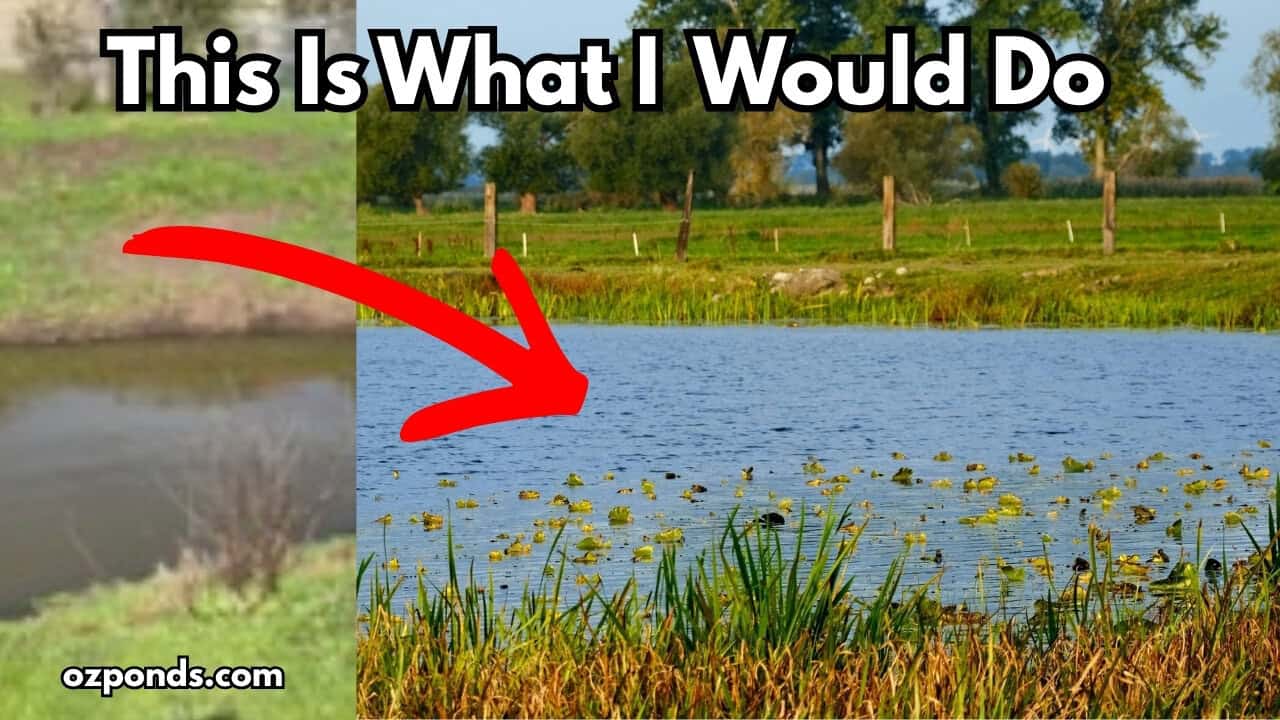
If you’ve bought a rural property with an old farm dam, you might look at it and wonder whether it could become something more.
Could you turn it into a healthy natural pond? Could you keep fish in it? Add ducks or yabbies? Maybe even swim in it one day?
I recently received a question from Janey, who has bought a three-quarter-acre property that she plans to turn into a food forest and eventually retire on.
The property already has an old farm dam. It’s around 4 metres deep at one end, but it leaks. Janie would like to rehabilitate it and eventually use it for fish, yabbies, perhaps ducks and possibly swimming.
There’s a lot to think about with a project like this, but the first decision probably isn’t what pump or filter to buy.
It’s working out why the dam is leaking and whether it is worth repairing at all.
Can a Farm Dam Be Turned Into a Pond?
Yes. An existing farm dam can potentially be developed into a natural pond, wildlife pond or productive water ecosystem.
But an old earth dam is very different from the lined backyard ponds I normally build.
A farm dam may be filled by:
- surface runoff
- groundwater
- natural drainage
- springs
- or a combination of these
Before making major changes, you need to understand how water naturally enters and leaves the dam.
If the existing dam can reliably hold water, you may be able to improve it with aeration, plants, safer edges and better management of incoming runoff without installing a conventional pond filtration system at all.
Is a 4 Metre Deep Pond Too Deep?
Not at all!
I often build backyard ponds around 600 mm (2 feet) deep, but that doesn’t mean deeper ponds are bad.
In fact, deeper ponds have some useful advantages.
More stable water temperatures
A large volume of water changes temperature much more slowly than a small volume.
Small ponds can heat rapidly during hot weather and cool quickly overnight. A much larger and deeper pond generally experiences slower changes.
More stable water conditions
The greater water volume can also help buffer rapid changes within the pond.
That doesn’t mean a large pond can’t develop water-quality problems, but things usually happen more slowly than they would in a tiny backyard pond.
Sediment can remain undisturbed
Organic material will naturally settle to the bottom of most ponds.
In a deep pond, much of that sediment may remain below the actively mixed surface water rather than constantly being disturbed.
Over time, some organic matter becomes incorporated into the bottom sediment where it may be less available to immediately feed algae than material continually suspended through the water column.
So the 4-metre depth itself wouldn’t be my biggest concern with Janie’s dam.
The steep banks would worry me more.
Make Steep Farm Dam Banks Safer
Very steep-sided dams can be difficult for people, wildlife and livestock to climb out of.
If I were rehabilitating a dam like this and earthworks were practical, I’d consider reshaping sections of the bank to create gentler slopes, shelves or broad steps.
These can provide:
- easier exit points for animals
- safer access for people
- shallow habitat for wildlife
- planting zones for rushes and sedges
- more diversity around the pond edge
You don’t necessarily need to reshape the entire dam.
Even strategically creating a few shallow areas can make a substantial difference.
Before Doing Anything Else, Find Out Why the Dam Leaks
This is probably the most important part of the whole project.
Before buying a pond liner, pump, filter or anything else, I’d investigate why the existing dam doesn’t hold water.
If it’s fundamentally a clay dam and the leaking area can be identified and repaired, keeping it as an earth pond may be considerably more practical than lining the entire thing.
There are also products and specialist techniques used to seal leaking dams, although whether they are suitable depends entirely on the cause of the leak and the soil conditions.
For a project this large, I’d want someone experienced with earth dams to assess it before spending serious money.
Should You Put Pond Liner Into an Old Farm Dam?
You can line large ponds, but I wouldn’t automatically assume liner is the best answer.
Most of my backyard ponds use liner because I live somewhere where water is precious and I don’t want to continually lose it into the surrounding soil.
An old farm dam is different.
If groundwater or a natural spring influences the dam, placing an impermeable liner over the bottom can potentially create another problem.
Water can build up underneath the liner.
If enough pressure develops, the liner can lift or form large bubbles beneath the pond.
There are engineering solutions for managing groundwater under liners, but once we’re talking about something 4 metres deep and the size of a farm dam, it stops being a simple backyard pond project.
That’s why I would diagnose the leak first.
If the dam can sensibly be repaired as an earth dam, that’s probably the option I would investigate before lining it.
The First Upgrade I’d Make: Aeration
Once I knew the dam could reliably hold water, one of the first things I’d consider is aeration.
I use aeration in almost every one of my ponds above roughly 2,000 litres.
Oxygen supports many of the processes we want happening in a healthy pond.
It benefits:
- fish
- aerobic microorganisms
- decomposition of organic waste
- circulation through the water column
For a pond around 4 metres deep, however, I wouldn’t use one of the small diaphragm air pumps I commonly use in shallow backyard ponds.
I’d investigate a higher-pressure aeration system, such as a rocking piston compressor designed to push air to greater depths.
Diffusers positioned within the pond release bubbles that rise towards the surface. The rising column of bubbles also moves water, helping circulate deeper water towards the surface.
Don’t Suddenly Aerate an Old Pond at Full Capacity
If an old dam has been sitting stagnant for years, I wouldn’t install a large aerator and immediately run it 24 hours a day.
The existing ecosystem has adapted to its current conditions.
Deep water may have very different oxygen levels and chemistry from surface water, particularly if the pond has been stratified.
Suddenly mixing everything together can cause rapid changes.
I would introduce aeration gradually.
For example, you might begin with a short period on the first day and progressively increase the operating time over several days until the pond is continuously aerated.
The exact approach should depend on the pond, its condition and what already lives in it, but the important point is don’t aggressively mix a long-established pond overnight without thinking about what you’re doing.
Should You Stop Runoff Entering a Farm Dam?
Janey also asked whether she should block the small gully that currently sends runoff into the dam.
For a backyard liner pond, I’m usually cautious about allowing surface runoff to enter.
Runoff can carry:
- soil
- fertilisers
- animal waste
- organic matter
- pesticides
- other contaminants
But once again, a farm dam is different.
Runoff may be the main reason the dam exists in that location.
If the incoming water is clean and there isn’t something concerning upstream — such as a septic system, chemical contamination or polluted drainage — I would probably keep the runoff.
Instead of trying to eliminate it, I’d look at improving it.
Turn the Incoming Gully Into a Natural Sediment Filter
Rather than allowing stormwater to rush directly into the pond, I’d try to slow it down.
That could mean adding:
- larger rocks
- rushes
- sedges
- shallow pools
- small level changes
- wider vegetated areas
The idea is simple.
Slow the water down before it reaches the pond.
When water slows, heavier suspended material has an opportunity to settle.
Plants can also stabilise the soil around the drainage channel and create valuable wildlife habitat.
You’re effectively turning the incoming gully into a little wetland rather than treating it like a drain.
Does a Farm Dam Need a Pump and Filter?
Not necessarily.
This is where people familiar with my backyard ponds might expect me to recommend an intake bay, pump and bog filter.
I love bog filters.
But I don’t think every body of water automatically needs one.
If Janeys dam remained a natural clay-bottomed pond, I would probably begin with:
- repairing the leak
- improving the banks
- adding aeration
- planting the margins
- slowing and naturalising incoming runoff
Then I’d give the pond time.
I’d want to see how it behaved before adding a complicated mechanical filtration system.
Would the water necessarily be crystal clear?
Probably not.
But crystal-clear water isn’t the only measure of a healthy pond.
It could potentially develop into a beautiful natural pond supporting fish, yabbies, ducks, insects, frogs, plants and other wildlife without functioning like an oversized backyard aquarium.
What If You Decide to Line the Dam?
If repairing the existing clay dam isn’t practical and you decide to build a fully lined pond, the design changes considerably.
At that point, I’d start considering the same principles I use on large ecosystem ponds.
Intake bay
I’d likely position the intake bay towards the lower end of the property where floating debris can naturally be encouraged to collect.
The intake bay protects the pump while helping collect leaves and floating debris before that material sinks.
Overflow
I also like positioning the pond overflow near the intake bay when possible.
As the pond rises and overflows, surface water moves towards that location, which can help transport floating debris towards the intake.
Bog filter
I’d position the bog filter higher than the main pond so that filtered water can return by gravity.
The required size would depend on the pond volume and biological load.
A pond containing ducks, for example, needs considerably more filtration capacity than a lightly stocked wildlife pond.
For anyone planning a system like this, my Pond Formulas Blueprint contains the sizing formulas I use for pumps, bog filters, plumbing and other parts of the pond system.
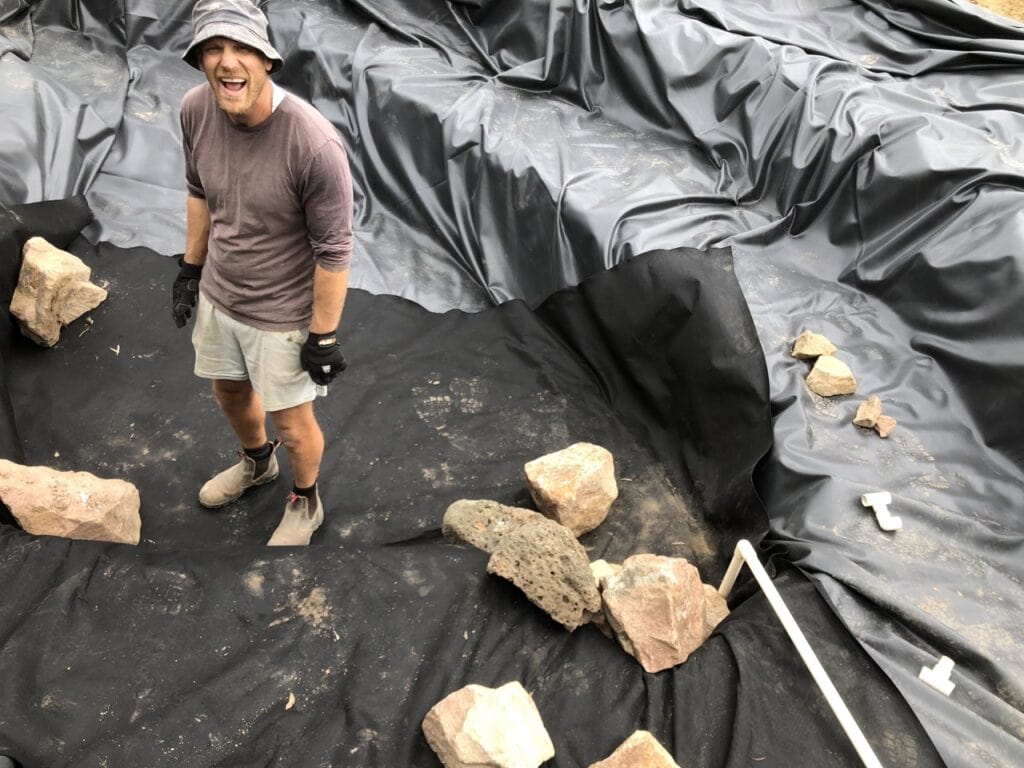
Design Your Pond Using The Same System I Use
- A simple system that has helped people around the world design clear, low-maintenance ponds without spending a fortune.
- Includes access to the Private Ozponds community and Virtual Kev, a tool that helps you plan your pond step-by-step.
What About Fish, Ducks and Yabbies?
These can all change how the pond behaves.
Fish
Fish add nutrients through food and waste.
How heavily the pond can be stocked depends on its size, oxygen levels, water quality and the species being kept.
If you’re raising fish specifically for food, you’ll also need to research the particular species, local regulations and husbandry requirements rather than treating the pond simply as an ornamental fish pond.
Ducks
Ducks can place a surprisingly large nutrient load on a pond.
They stir sediment, damage vegetation and contribute plenty of organic waste.
A huge farm dam can tolerate things that a small backyard pond cannot, but duck numbers still matter.
Yabbies
Yabbies are well suited to many Australian farm dams, although local regulations and environmental restrictions should always be checked before introducing aquatic animals.
They can also burrow, so this may be another consideration when you’re dealing with an earth dam that already has leakage problems.
Can You Swim in a Natural Farm Dam?
Potentially, but this isn’t something I’d give a blanket recommendation on.
Natural water always comes with some level of risk.
Water quality can be affected by animals, runoff, microorganisms, algae and many other factors that don’t exist in properly treated swimming pools.
There may also be local planning, fencing, safety or water-quality requirements depending on where you live and how the pond is being used.
If swimming is an important goal, treat it as a separate design and safety question rather than simply assuming that a healthy-looking pond is automatically safe to swim in.
Repair the Dam or Build a New Pond?
This might ultimately be the biggest decision.
An existing hole in the ground can feel like an obvious starting point because much of the excavation has already been done.
But don’t let that force you into spending a fortune solving problems that wouldn’t exist if you started somewhere else.
If the existing dam can be repaired economically, I’d probably use what is already there.
If repairing or lining it turns into a major engineering project, I’d start comparing that cost with building a new pond somewhere else on the property.
A purpose-built pond could be located and shaped specifically around:
- water collection
- access
- safety
- filtration
- planting
- fish
- swimming
- views from the house
- future landscaping
Sometimes fixing what you’ve already got is the cheapest option.
Sometimes it isn’t.
My Approach to Rehabilitating an Old Farm Dam
If this were my property, I wouldn’t begin by shopping for pumps and pond liners.
I’d work through the project in this order:
1. Find out why the dam leaks.
Determine whether the existing earth dam can realistically be repaired.
2. Understand where the water comes from.
Look at runoff, groundwater, drainage and anything upstream that could affect water quality.
3. Decide whether to repair or rebuild.
Compare the real cost of rehabilitating the old dam with creating a new pond somewhere better suited.
4. Improve the banks and shallow areas.
Add safer slopes, shelves and planting areas where practical.
5. Add aeration carefully.
For a deep established pond, introduce aeration gradually rather than immediately mixing the entire water column.
6. Naturalise incoming runoff.
Slow the water with vegetation, rocks and shallow settling areas before it reaches the pond.
7. Let the ecosystem develop.
Don’t install equipment simply because you think a pond is supposed to have it.
Watch what happens first.
Then solve the problems that actually exist.
Frequently Asked Questions
Can you turn a farm dam into a wildlife pond?
Yes. Existing farm dams can make excellent wildlife ponds, particularly when shallow margins, aquatic plants, clean incoming water and good habitat are provided.
Do farm dams need filtration?
Not always. Large earth ponds can often function as natural ecosystems without conventional pond filters. Aeration, plants, appropriate stocking levels and good management of incoming nutrients may be more important.
Can you put a liner in an old farm dam?
Yes, but you need to understand groundwater conditions first. Water trapped underneath an impermeable liner can create hydrostatic pressure and potentially lift the liner.
Is a deep farm dam bad for fish?
Depth itself isn’t necessarily a problem and can provide greater thermal stability. However, very deep ponds can stratify and develop low-oxygen water near the bottom, which is one reason aeration may be useful.
How do you make an old farm dam safer?
Where practical, reshape sections of very steep bank into gentler slopes, shelves or steps so people and animals have easier exit points. The exact safety requirements will depend on the property and how the pond is used.
Should runoff enter a natural pond?
Runoff can be useful in a farm dam if it is clean, but polluted or nutrient-rich runoff can create serious water-quality problems. Slowing incoming water through rocks, vegetation and settling areas can help capture sediment before it reaches the pond.
Start With the Problem You Actually Have
It’s very easy to look at an old farm dam and immediately start designing waterfalls, pumps, bog filters and planting areas.
I’d resist that temptation.
First find out why it leaks.
Then understand how water moves through the property.
Once you know the existing dam is worth saving, you can start turning it into something much more interesting.
And in some cases, the best natural pond may need far less equipment than you imagined.
If you’re planning a pond and want the formulas I use for sizing pumps, bog filters, plumbing and other parts of the system, you can find the Pond Formulas Blueprint here on Ozponds.
And if you’ve rehabilitated an old farm dam yourself, I’d love to hear what worked — and what you would do differently next time.
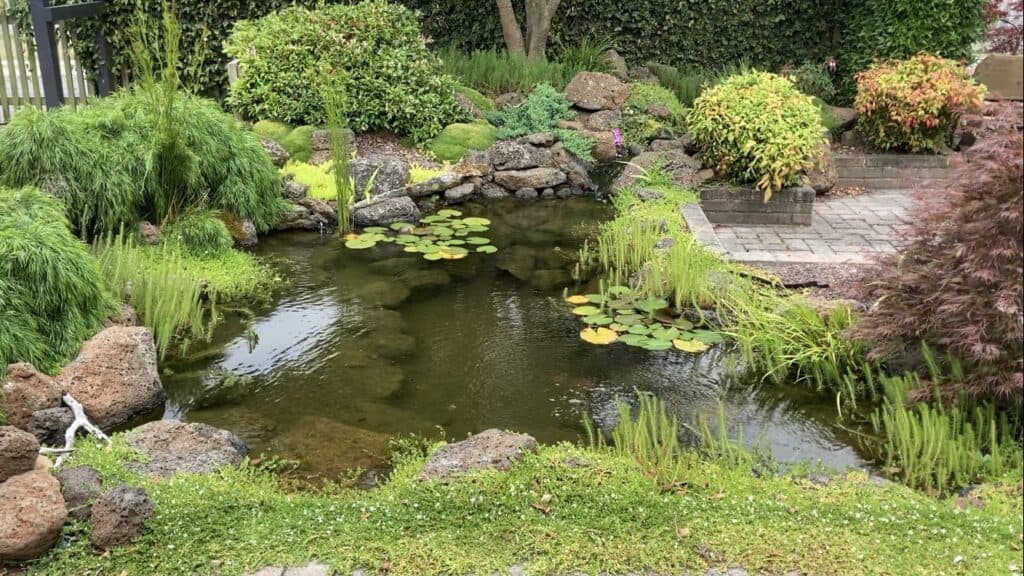
About to build a pond… or already have one?
Sign up for my email list and I’ll send you DIY-friendly pond tips, along with a few helpful tools like calculators, gear recommendations, and more.