
Some people swear by it — “just fill your pond with lilies and reeds and you’ll never need a filter.”
Others say that’s a recipe for green water and headaches.
The truth?
Well, I’ve run ponds both ways — some with no pumps at all and others with full filtration systems.
Here’s what really works.
Why We Need Filtration
Anything that lives in your pond adds nutrients to the water.
Fish produce waste. Uneaten food breaks down. Leaves blow in. Even plants themselves add nutrients when they die back.
All of that contributes to what we call the nutrient load — mainly nitrogen (ammonia, nitrite, nitrate) and phosphate.
These are essentially plant foods. Without plants or a proper filter system, those nutrients fuel algae growth.
A little algae is fine, but no one wants pea-soup water or string algae taking over.
How Algae Works (and Why It’s Not a True Plant)
Algae aren’t technically plants. They don’t have roots or leaves, but they still photosynthesize — using light, nutrients, and carbon dioxide to grow.
There’s always some CO₂ in the pond from fish breathing and organic matter breaking down.
But it’s not usually the carbon dioxide that limits algae — it’s the nutrients and light.
Control those, and you can control algae.
How Plants Help Keep Water Clear
Plants take up the same nutrients algae crave and use them for growth. That’s why healthy plant life helps keep algae in check.
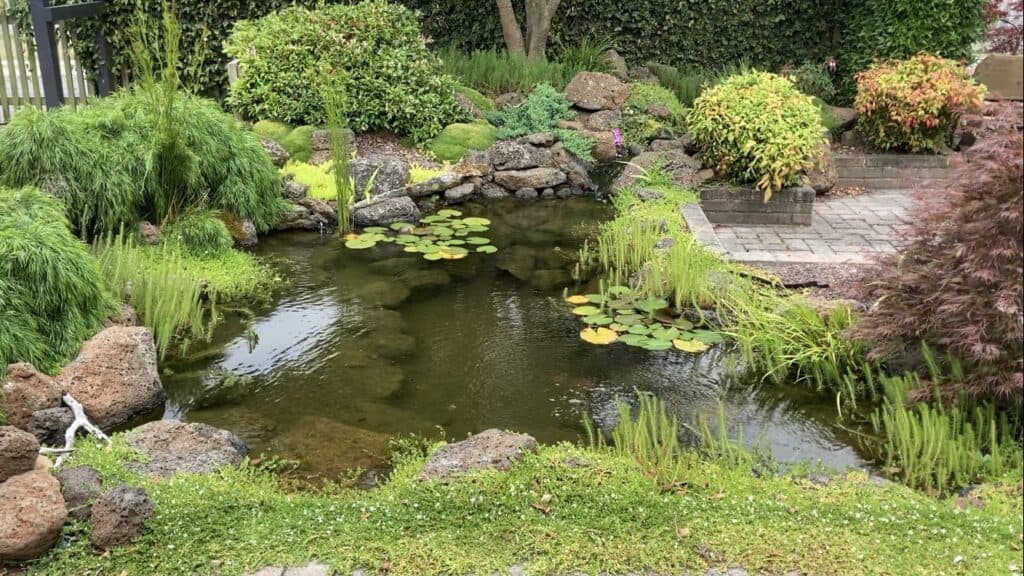
- Floating plants and water lilies provide shade, keeping the water cooler and slowing algae growth.
(Alt text: Floating lilies shading a backyard pond surface) - Marginal plants with big root systems trap fine particles and give beneficial bacteria a place to live.
(Alt text: Marginal pond plants filtering water near the edges) - Submerged oxygen plants help balance oxygen levels during the day.
Shade helps, but it’s not a silver bullet — some types of algae (like string algae or blue-green algae) can still thrive in low light if nutrients are high. So shade is just part of the solution.
Why “Plant-Only” Ponds Can Work (Sometimes)
I’ve got quite a few small ponds at home that don’t use pumps or filters at all.
They’re little self-contained ecosystems — and they work beautifully.
But it’s not just the plants doing the work. The substrate (gravel or soil at the bottom) traps nutrients and houses bacteria, fungi, and tiny critters that recycle waste.
The key is balance — these setups only work with small fish in low numbers.
I hardly feed them. They live mostly on mosquito larvae, aphids, daphnia, copepods, and ostracods — all the natural pond bugs that thrive in these environments.
If you tried that with koi or ducks, though, it would fall apart fast. More waste means more filtration is needed to keep things in balance.
Why I Still Use Filters on Larger Ponds
For my bigger ponds, I always run moving water through a filter — usually a bog filter.
A bog filter works just like a wetland. Water moves slowly through substrate full of beneficial bacteria, fungi, and plant roots that strip out nutrients before the water returns to the pond.
The big advantage is that it’s separate from the main pond, leaving plenty of open water for fish, swimming, or simply enjoying the view.
Without a filter, large ponds quickly fill with plants — fine on a small scale, but a lot to manage as the pond gets bigger.
The Sweet Spot: Plants + Filter
Yes, you can filter a pond with just plants. You could even do it with just rock or sand if the balance is right.
The tricky part is keeping that balance — it’s never static and changes with the seasons.
Dedicated filters give you room for error. They’re a safety net that lets you enjoy your pond without constantly worrying about it tipping out of balance.
Plants are amazing — they:
- Soak up nutrients
- Shade the water
- Provide cover for fish
- Create habitat for beneficial critters
- Trap sediments with their roots
But when they stop growing (like in winter), they also die back and decompose, adding more waste.
So for a crystal-clear, low-maintenance pond, the winning combo is simple:
👉 Plants + Filter = The Sweet Spot.
Want to Design Your Own Dream Pond?
You can grab my free Pond Planning Bundle, which includes:
- Pond Planning Checklist
- Bog Filter Size Calculator
- Pump Flow Rate Calculator
And if you’re ready to take it further, check out my Pond Formulas Blueprint — it’s everything you need to design and build a clear, healthy pond that lasts.
About to build a pond… or already have one?
Sign up for my email list and I’ll send you DIY-friendly pond tips, along with a few helpful tools like calculators, gear recommendations, and more.