

I wanted to share a pond build that really stood out to me — not because it’s flashy or over-engineered, but because it’s thoughtful, well-planned, and built the right way from the start.
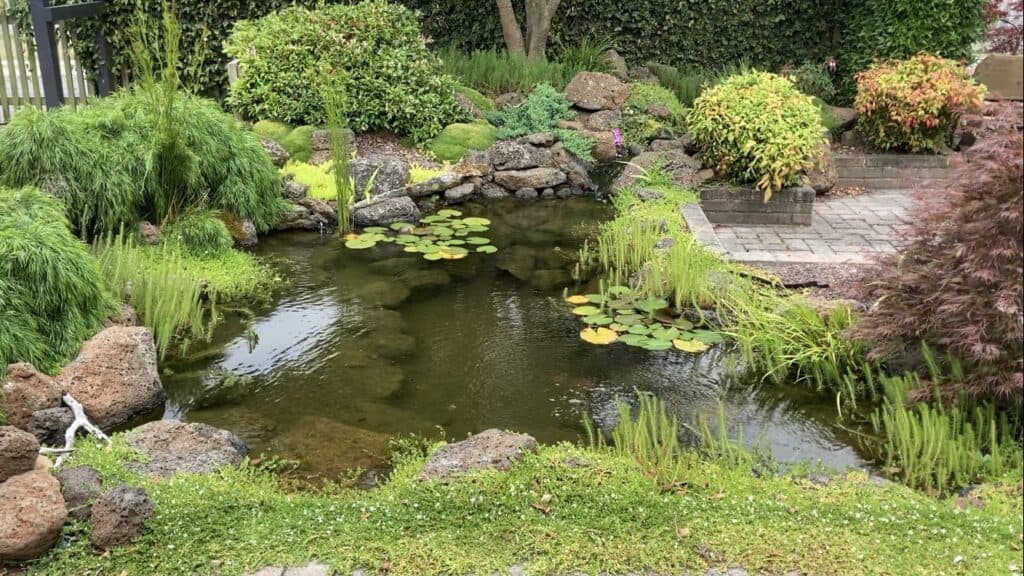
This is Tré’s very first pond, built entirely by hand, and the results speak for themselves.
Location & Context
My name is Tré and I live in western Sonoma County, California, USA — roughly 70 miles (100 km) north of San Francisco and about 12 miles from the Pacific Ocean.
The Pond Build
I dug the entire pond by hand with a single shovel.
The pond is an oval shape, approximately 21 feet long x 15 feet wide x 2 feet deep, designed as a wildlife pond.
Alongside it, I built an in-ground bog filter, measuring 5 feet x 3 feet x 2.5 feet deep.
For circulation, I’m running an Anjon Monsoon 3000 pump, positioned at the west end of the pond. The pump sends water across the pond to the bog filter at the east end.
Ground Conditions & Liner Protection
The digging was challenging — the ground here is mostly small rock. My yard sits on a floodplain of the Russian River, so I had to account for both rocky soil and groundwater movement.
Before installing the underlayment and liner, I placed several 8 ft x 8 ft moving blankets directly on the soil for extra protection.
On top of that, I installed:
Stone & Natural Edging
For the rockwork, I used Sonoma fieldstone, including:
- Head-sized boulders
- Baby-head stones
- Cobble
- ¾” gravel
- Pea gravel
I placed the rocks in natural clumps and groupings, rather than evenly spacing them, to help the pond blend into the landscape and feel more organic.

Bog Filter Performance
The plants will be going in soon — likely late February or early March.
Even without plants yet, the bog filter has already impressed me.
The water was slightly murky yesterday from placing the baby-head sized stones. By the next morning, the water was crystal clear.
This is my first pond ever, and I honestly think it turned out great.
A Lesson Learned: Groundwater Management
One unexpected challenge was groundwater.
There’s a creek just west of our property that backs up during heavy conditions and creates intense groundwater pressure.
This compromised my first intake bay wall, so I had to redesign and rebuild that section.
To solve the problem, I installed a French drain system to manage the groundwater and relieve pressure behind the pond walls. Since then, everything has been solid.
Final Thoughts
Thanks for all your help — you’re a big part of why this turned out so well.
A Quick Note from Kev
Stories like this are why I’m such a big believer in simple, oversized bog filters and good water movement.
If you’re planning your first pond — or fixing an existing one — having a clear design and understanding how all the parts work together makes a huge difference.
If you’d like to see the same approach I use and teach step-by-step, that’s exactly what I’ve put together in the Pond Formulas Blueprint. No pressure — just there if you want a clear path to follow.
And if you’ve built a pond you’re proud of, I’d love to see it. You can share your project with me through the contact page.
About to build a pond… or already have one?
Sign up for my email list and I’ll send you DIY-friendly pond tips, along with a few helpful tools like calculators, gear recommendations, and more.