
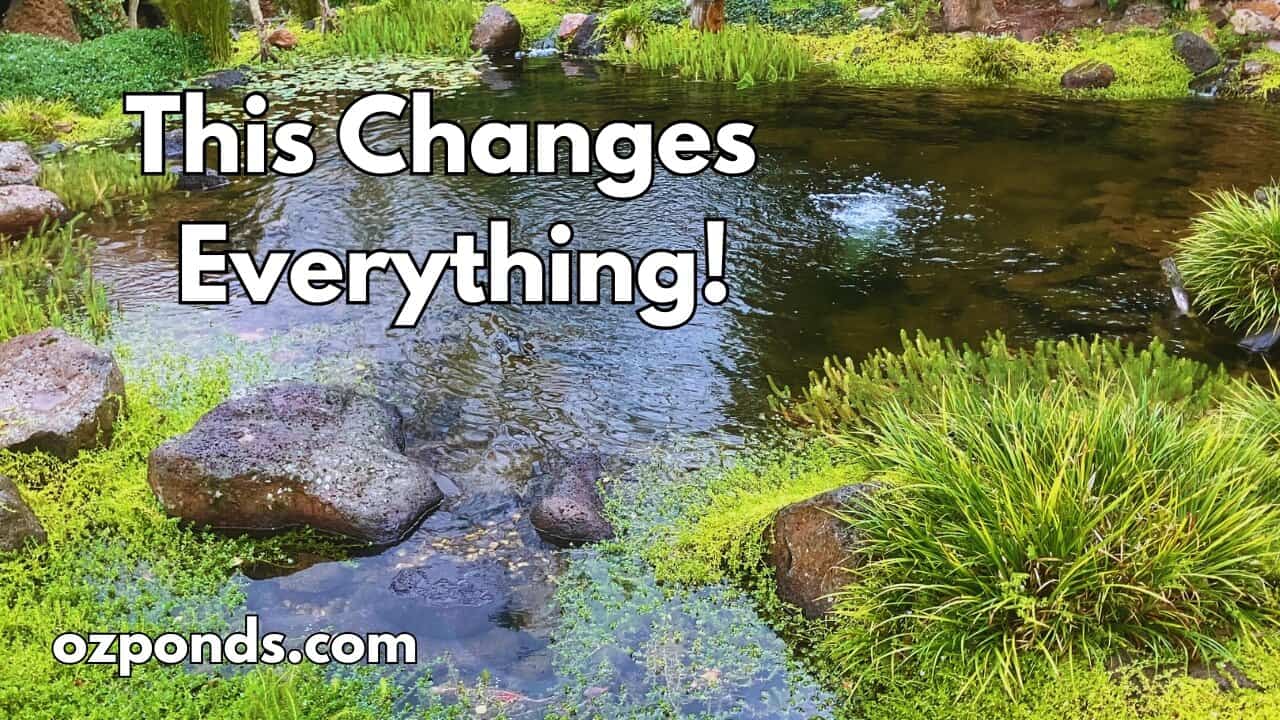
Have you ever noticed that the dirtiest-looking ponds often seem to have the most life in them?
Tadpoles everywhere.
Insects buzzing around.
Birds visiting.
Fish cruising through the water.
Plants growing wild.
Meanwhile the crystal-clear pond or river nearby sometimes looks almost… empty.
So what’s actually going on here?
In this article we’re going to look at why nutrient-rich ponds often explode with life, why that can become a problem in backyard ponds, and how thoughtful pond design keeps everything balanced long term.
Watch the Video
“Dirty” Doesn’t Always Mean Unhealthy
One of the biggest misconceptions in pond keeping is that a pond that looks dirty must be unhealthy.
But in nature, that’s often not true.
Many of the most biologically active wetlands and ponds are full of:
- leaves
- sediment
- algae
- plant material
- microorganisms
All of this supports a huge food web.
Ecologists describe ponds and lakes on a nutrient spectrum:
Oligotrophic
Low nutrients, very clear water, slower biological activity.
These systems often have:
- high oxygen levels
- lots of water movement
- limited plant growth
Mesotrophic
Moderate nutrient levels.
These systems support a healthy balance of plants, algae, and animal life.
Eutrophic
High nutrient levels.
These ponds are often packed with:
- algae
- plant growth
- bacteria
- insects
- fish
- amphibians
When a pond becomes eutrophic, nutrients flood the system. These nutrients might come from:
- fish waste
- uneaten food
- decomposing leaves
- soil runoff
- fertilisers
- organic debris
All of that feeds algae, plants, bacteria, insects and the entire food chain.
That’s why these ponds often look incredibly alive.
The Problem With Eutrophic Backyard Ponds
The tricky part is that eutrophication is a double-edged sword.
Yes, you often get:
- huge amounts of life
- rapid plant growth
- busy food chains
But you also tend to get:
- green water
- blanket algae
- thick sludge build-up
- low oxygen levels
- unpleasant smells
- and sometimes fish deaths
Large natural wetlands can remain stable even when they’re nutrient-rich because they are massive systems with constant water exchange.
Backyard ponds are very different.
They are small closed systems.
Once nutrients start building up, a feedback loop can begin:
More nutrients
→ more algae and plant growth
→ plants die and decompose
→ even more nutrients
→ even more growth
Round and round it goes.
So while nutrient-rich ponds may look “alive,” they often become unstable and high maintenance.
Most backyard pond owners want to stay closer to the oligotrophic or mesotrophic end of the spectrum, where water remains clearer and the system is easier to manage.
How Pond Design Pushes a Pond Toward One End of the Spectrum
This is where good pond design makes a huge difference.
A pond slowly drifts toward eutrophic conditions when nutrients keep entering the system but nothing removes them efficiently.
Common causes include:
- too many fish
- overfeeding
- leaves decomposing in the pond
- poor waste removal
- limited biological filtration
- low oxygen levels
- poor circulation
When those things combine, nutrients accumulate and the pond slowly slides toward nutrient overload.
But the opposite is also true.
A pond stays clearer when the system is designed to manage nutrients from the beginning.
The Ozponds Approach to Pond Balance
In my ponds, I try to design systems that naturally manage waste and nutrients.
Remove debris before it sinks
Floating debris is easiest to remove before it settles into the pond.
I like to use:
These collect leaves and solids before they sink and also help move water through the system.
Create strong biological filtration
Once water leaves the skimmer or intake bay, I often send it through a bog filter.
Bog filters provide an enormous surface area for:
- beneficial bacteria
- algae
- microorganisms
These tiny organisms are the real workhorses of pond filtration.
They break down fish waste, organic debris and other nutrients in the water.
Use plants strategically
Plants play a big role in nutrient control.
I like to place plants in:
- bog filters
- streams
- pond margins
Marginal plants are particularly useful because they:
- absorb nutrients
- release oxygen into the substrate through their roots
- stay contained along the pond edges
They also make maintenance easier because they can be trimmed or thinned when needed.
Design systems that are easy to clean
Even in well-balanced ponds, some sediment will accumulate.
That’s normal.
So when I design features like:
- intake bays
- skimmers
- bog filters
I make sure they can be cleaned easily.
Pumps should be accessible and sediment should be removable without tearing the whole system apart.
When ponds are designed this way they tend to be:
- easier to maintain
- cheaper to build
- more stable over time
- more enjoyable to interact with

Design Your Pond Using The Same System I Use
- A simple system that has helped people around the world design clear, low-maintenance ponds without spending a fortune.
- Includes access to the Private Ozponds community and Virtual Kev, a tool that helps you plan your pond step-by-step.
Practical Steps If Your Pond Is Struggling
If you’re dealing with green water, sludge buildup or a stagnant pond, here are some practical steps that can help.
Reduce nutrient inputs
Look at where nutrients are coming from.
Common issues include:
- overfeeding fish
- too many fish
- large amounts of plant material decomposing in the pond
Remember that ponds full of algae and plant growth already contain huge amounts of microscopic life feeding the food chain.
Often, fish need far less feeding than people think.
Improve water circulation
Moving water improves oxygen levels and helps beneficial bacteria break down waste.
Good circulation can also help export debris before it settles.
This is why systems like the skimmer + bog filter combination work so well.
They create a circulation loop that moves water through biological filtration.
Add oxygen to the system
Anything that agitates the water helps oxygen enter the pond.
Examples include:
- waterfalls
- fountains
- aerators
- streams
Higher oxygen levels support more efficient biological filtration.
Manage plant growth
Plants are incredibly useful for nutrient control.
But they still need management.
Remove excessive growth and avoid letting large amounts of plant material die and decompose in the pond.
Be clear about what type of pond you want
Sometimes people actually want a nutrient-rich pond.
For example:
- breeding fish
- wildlife ponds
- heavily planted ponds
In those situations, abundant plant growth and insect life can be beneficial.
I even keep a few ponds like this myself.
Like many things in life, pond design is about deciding what you want to achieve and then building a system that supports that goal.
The Ozpond System
If you’d like to build a pond using the same principles I use, you can learn the full framework inside the Pond Formulas Blueprint.
It walks you through:
- pond sizing
- bog filter design
- pump flow calculations
- creating a low-maintenance ecosystem pond
You’ll also get access to the private Ozponds community, where everyone is building ponds using the same system. That avoids the mixed advice you often see online.
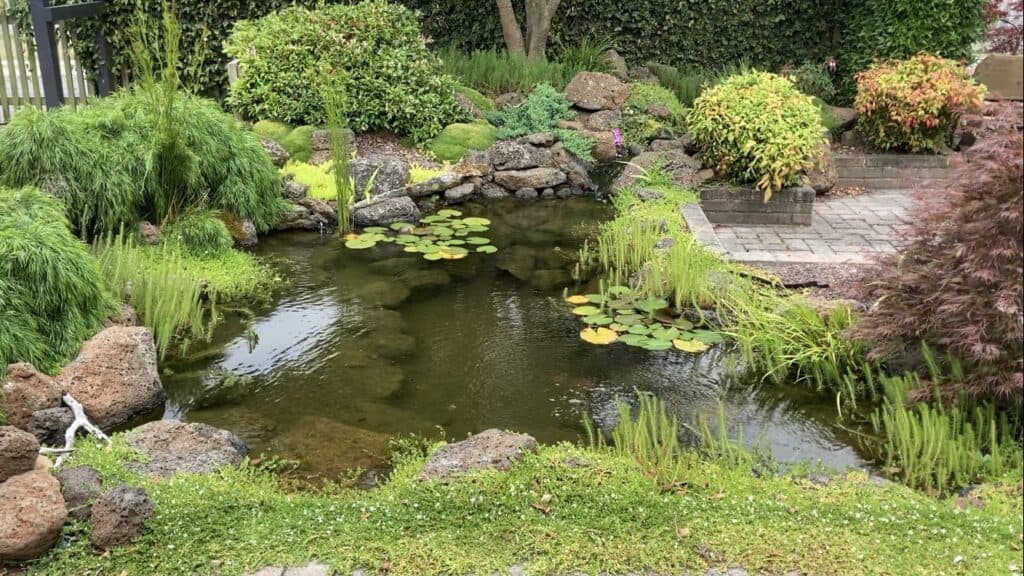
About to build a pond… or already have one?
Sign up for my email list and I’ll send you DIY-friendly pond tips, along with a few helpful tools like calculators, gear recommendations, and more.