
When most people first get into ponds, they hear a simple rule:
“Circulate the pond once per hour.”
On the surface, that sounds logical.
But it’s not the full story.
Because moving water for the sake of moving water doesn’t actually solve the problem. If your system isn’t capturing waste and cleaning the water, all you’re doing is pushing dirty water around.
And that’s where a lot of ponds go wrong.
It’s Not About Flow — It’s About Function
If someone tells me:
“My pump’s running fine… but my pond is still dirty”
The first thing I think is:
👉 It’s probably not the pump.
More often than not, the issue is somewhere else in the system.
- The filter might be too small
- The filter might already be full
- The system might not be designed to handle the waste load
And this is something people forget…
Filters fill up.
Sponges, chambers, media — once they’re full, they stop capturing anything. At that point, your system has basically hit capacity, even if the pump is still running perfectly.
Why I Prefer Bog Filters
Personally, I like bog filters for a few reasons:
- They’re large
- They have high capacity
- They can go long periods without maintenance
For a low-maintenance pond, they’re a no-brainer.
Instead of constantly cleaning filters, you’re building a system that can handle waste naturally over time.
Pump Placement Matters More Than You Think
One of the biggest mistakes I see is pump placement.
A lot of people drop the pump straight on the bottom of the pond thinking:
“Great, it’ll suck up all the sludge.”
But that comes with trade-offs.

1. You Remove Too Much of the Ecosystem
Some of that muck is actually beneficial.
It’s full of:
- Microorganisms
- Detritivores
- Natural food sources for fish
Strip all of that away, and the pond becomes more sterile — which can actually work against you.
2. Maintenance Becomes a Nightmare
Unless your pump is designed to handle solids:
- It will clog
- It will need constant cleaning
- It becomes frustrating fast
Most standard submersible pumps aren’t built for that.
A Better Option: Intake Bays & Skimmers
Instead of putting the pump on the bottom, I prefer:
These act as a pre-filter:
- Capture large debris before it hits the pump
- Pull water from the surface (which keeps things looking clean)
- Make maintenance easier (they’re accessible at the edge)
- Can be hidden so the pond still looks natural
It’s a much cleaner, more controlled way to manage flow.
Small Ponds Still Need Pre-Filtration
For smaller ponds (under ~1,000L), you don’t need a full intake bay.
But you still want something.
Even something simple like:
- A bucket
- A plant pot
- A coarse sponge
…can act as a basic pre-filter.
A Simple Safety Trick
Even in small setups, I never place the pump directly on the bottom.
Why?
If something fails (hose pops off, leak, etc.), the pump will keep running and can drain the entire pond.
But if the pump is lifted slightly:
👉 You leave a safety buffer of water behind
That can save your fish.
The Real Job of a Pump
A pump only has one job:
👉 Move water through a system that actually cleans it
That means:
Pond → Filter → Back to Pond
If that loop isn’t working properly, the pond won’t stay clean.
Water Needs a Journey — Not Just Movement
This is where a lot of setups fall apart.
Water needs a clear path:
- Into the filter
- Through the filter
- Back into the pond in a way that promotes circulation
That might include:
- Waterfalls
- Streams
- Return jets
The goal is to avoid dead zones and keep the entire pond active.
Matching Flow to Your Filter
Not all filters work the same way.
High Flow Systems
- Designed to move large volumes quickly
- Often used for mechanical filtration or oxygen-heavy systems
Slow Flow Systems (like bog filters)
- Designed for settling and biological processing
- Need time for bacteria and organisms to do their job
If you push water too fast:
👉 Waste just blasts straight through
If you go too slow:
👉 You risk stagnation
So it’s not about having a big pump…
It’s about matching the flow to the system.
A Real Example: Where It Went Wrong
One of the first ponds I built followed the “once per hour” rule.
- Basic pump
- Off-the-shelf filter
- No real system design
The result?
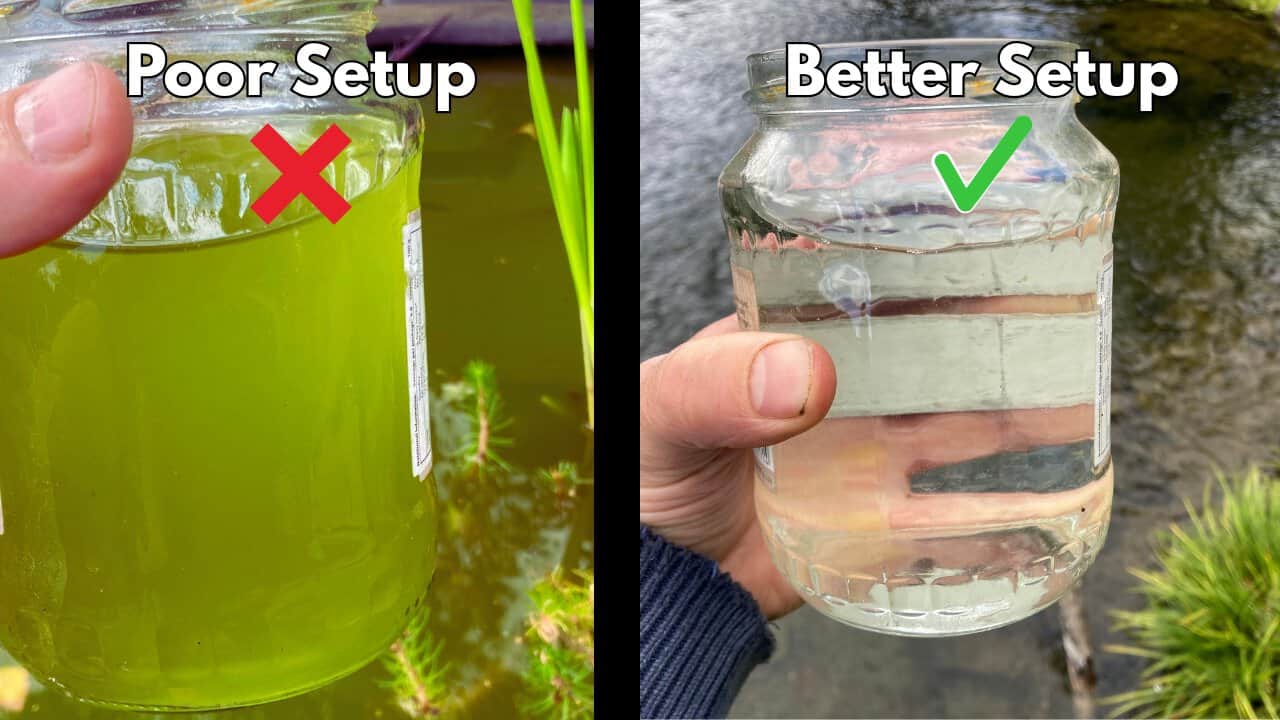
👉 Green water.
The fish were fine — but it didn’t look great.
What Fixed It
At the time, I had some experience with aquaponics.
One thing stood out:
👉 Those systems always had crystal clear water.
Why?
Because the grow beds act like a bog filter.
So I built one into the pond.
Within about 4 weeks:
👉 The water went from completely green to crystal clear.
The Big Takeaway
When it comes to pump setups:
👉 It’s not about the pump.
It’s about:
- Where it’s placed
- What the water flows through
- How the system is designed
- Whether the loop is actually doing something useful
Because most pond problems:
- Green water
- Algae
- Sludge buildup
- Constant maintenance
…aren’t pump problems.
👉 They’re design problems.
From Kev
Every pond I build follows the same basic principles.
It’s not about copying my ponds — it’s about understanding the thinking behind them so you can apply it to your own setup.
If you want the full system I use – that’s what the Pond Formulas Blueprint is for.
Click the button below to learn more.
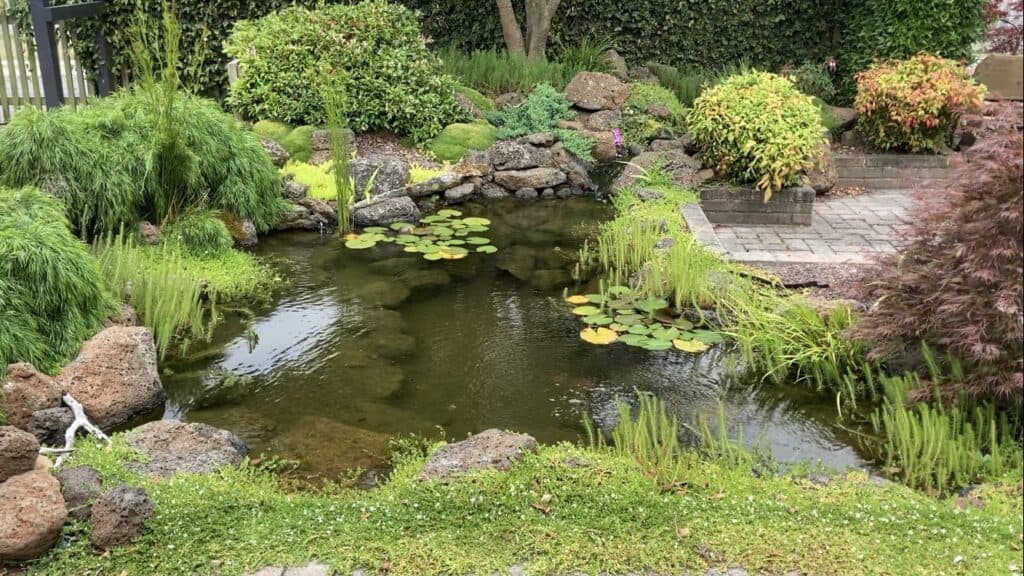
About to build a pond… or already have one?
Sign up for my email list and I’ll send you DIY-friendly pond tips, along with a few helpful tools like calculators, gear recommendations, and more.