Lately, I’ve been going down a bit of a rabbit hole trying to understand something…
Do those bacteria products actually help reduce sludge in a pond?
Because I’ve used them myself — and I do think they make a difference.
But I couldn’t quite explain why.
When I reached out to a few brands, I got a lot of conflicting answers.
“Just keep adding it,” they say.
But that didn’t sit right with me.
If bacteria process waste…
and there’s already waste in the pond…
Then shouldn’t the bacteria just multiply naturally and handle it?
So I started digging deeper.
What’s Actually Breaking Down Waste in a Pond?
What I found is that it’s not just bacteria doing the work.
There’s actually a chain of processes happening inside your pond — and it happens in three stages:
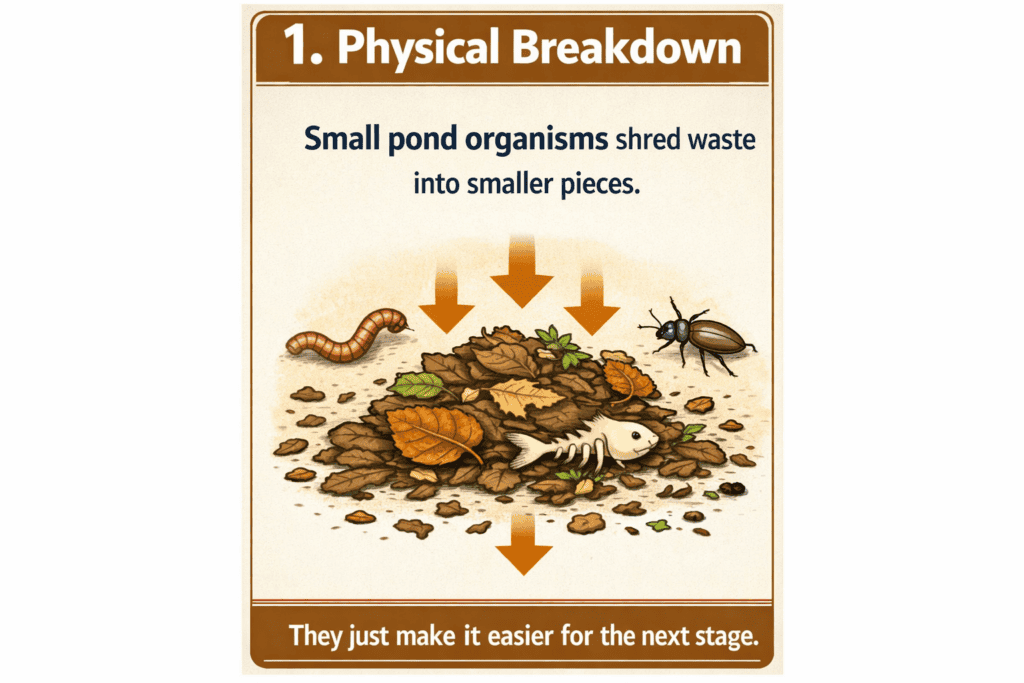
1. Physical Breakdown
This is done by small organisms.
They shred larger waste (like leaves, fish waste, etc.) into smaller particles.
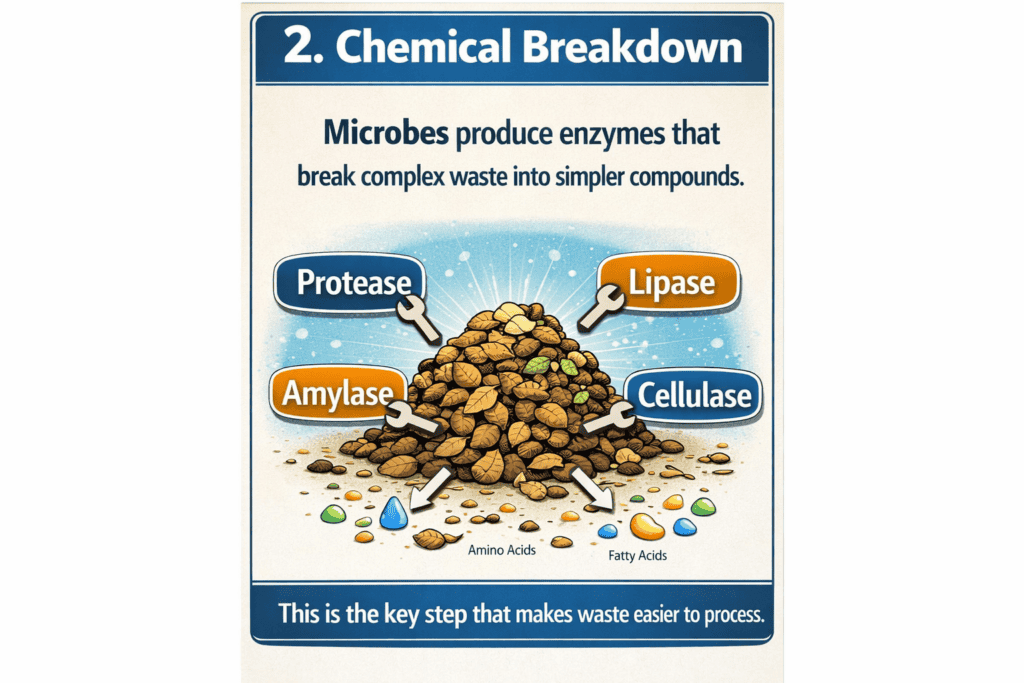
2. Chemical Breakdown (Enzymes)
This is where enzymes come in.
They’re produced by microbes and act like tiny tools — breaking complex organic material into simpler compounds.
Different strains produce different enzymes, and they all work at different speeds.
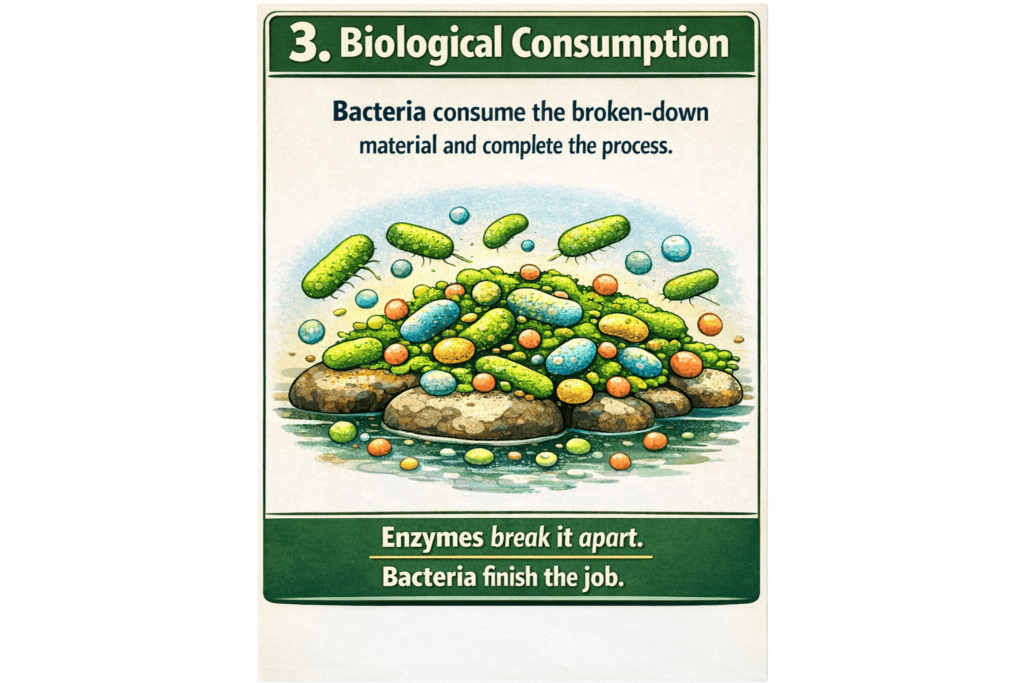
3. Biological Consumption (Bacteria)
Finally, bacteria consume what’s been broken down.
They finish the process.
So… Why Do Bacteria Products Seem to Work?
Here’s where I was getting stuck.
If your pond already has:
- bacteria
- microorganisms
- fungi
- enzymes
…then why does adding more seem to make a difference?
Shouldn’t everything already be self-sustaining?
The Key Realisation
It’s not just about having these organisms.
It’s about how fast waste is being broken down… compared to how fast it’s building up.
What These Products Are Actually Doing
When you add bacteria products, you’re not just “adding bacteria.”
You’re effectively:
- Adding enzymes directly
or - Boosting the microbial population that produces those enzymes
Which means:
👉 Faster breakdown of organic waste
👉 Less chance for sludge to build up
👉 Cleaner water (less foam and surface film)
Natural vs Boosted Systems
Your pond already produces enzymes naturally:
- Bacteria
- Fungi
- Plant roots
But that process is:
- Slow
- Localised
When you add a product, you’re increasing that activity across the entire pond instantly.
Why Ponds Look Better in Summer
This also explains something I’ve noticed for years…
My ponds always look their cleanest in summer.
That’s likely a combination of:
- Increased bacterial activity (warmer water)
- More plant growth
- More oxygen
- More interaction (netting debris, moving water, etc.)
Everything speeds up.
What About Oxidation?
There’s also another pathway worth mentioning: oxidation.
Oxidation breaks down organic waste using oxygen.
- It’s chemical
- It can be fast and aggressive (especially with oxidisers)
Compared to:
- Enzymes → biological, targeted, slower
- Bacteria → consumption stage
So you’ve essentially got two different systems:
- Biological breakdown (enzymes + bacteria)
- Chemical breakdown (oxidation)
My Current Take
Right now, this is how I see it:
In a well-designed pond system, things already work.
But…
👉 Boosting enzyme and bacterial activity can speed everything up
👉 Especially when it comes to sludge and organic buildup
The Bigger Picture (This Still Matters More)
Even with all this…
The system still comes first.
You still need:
- A place for bacteria to live (filters, surfaces, biofilm)
- Good water movement
- A way to export waste
Because if waste isn’t leaving the system…
it’s just getting processed and staying there.
Where I’m At With It
I’m still very much down the rabbit hole on this one.
I’ve tried to keep it simple — but I’m really curious about it.
If you’ve experimented with these products…
or understand the science behind it better than I do…
I’d genuinely love to hear your thoughts.
Want to Go Deeper Into Pond Design?
Every pond I build follows the same basic principles.
It’s not about copying my pond — it’s about understanding how the system works so you can apply it to your own.
If you want the full breakdown — sizing, flow, filtration, and how it all fits together — that’s what I cover in my Pond Formulas Blueprint.
About to build a pond… or already have one?
Sign up for my email list and I’ll send you DIY-friendly pond tips, along with a few helpful tools like calculators, gear recommendations, and more.