
I love bog filters.
I use them in most of my own ponds, I talk about them constantly on YouTube, and I’ve even built a bog filter calculator to help people work out how big their filter should be.
But does that mean a bog filter is always the best choice?
No.
A viewer recently emailed me about a series of very large ponds he was planning for rainbow trout. Each pond would be around 800 square metres, with a maximum depth of about 1.8 metres.
He had watched some of my videos and then used the bog filter calculator here on the Ozponds website.
The result?
An absolutely enormous bog filter.
His question was basically:
Surely the bog filter doesn’t really need to be that big? Is there a better way?
And in his situation, I think there probably is.
The important thing is understanding what the pond is being designed to do.
Are Bog Filters Good for Large Ponds?
Bog filters can work extremely well on large ponds, but pond size alone isn’t what determines whether a bog filter is the right choice.
You also need to consider:
- how many fish the pond will contain
- how heavily those fish will be fed
- how much waste the system will produce
- whether fresh water is continually entering the pond
- how much maintenance you’re prepared to do
- whether the pond is primarily ornamental or being used to produce fish
A lightly stocked, large ecosystem pond is very different from a heavily stocked trout-production pond.
That’s where the problem with simply scaling up a backyard bog filter begins.
What Is a Bog Filter Designed to Do?
My bog filter formulas and calculators are primarily designed around ecosystem-style ponds on a backyard scale.
In these ponds, we’re trying to create something that functions a little like a natural ecosystem.
There are fish, plants, bacteria, insects, microorganisms and all sorts of other life interacting with one another.
The bog filter becomes part of that ecosystem.
Water moves through gravel and around plant roots, providing huge amounts of surface area for microorganisms to colonise. Plants take up nutrients as they grow, while bacteria and other organisms help process waste.
A well-designed bog filter can provide:
- biological filtration
- nutrient uptake
- plant habitat
- additional ecosystem habitat
- water circulation
- some trapping and processing of organic material
All in one relatively simple system.
That’s exactly why I like them.
For the types of ponds I build, they’re simple, reliable, attractive and, when sized appropriately, can require very little maintenance.
But an intensive trout pond has a completely different job.
Why a Trout Pond Produces So Much More Waste
The biggest difference is the amount of material going into the pond.
In one of my backyard ponds, fish numbers are relatively low and I’m not trying to grow the maximum possible quantity of fish.
That means relatively small amounts of food enter the system and waste accumulates slowly.
And that suits me because I’m lazy.
In aquaculture, the aim may be to produce as much fish as practical from the available space.
That can mean:
More fish → more food → more fish waste → more nutrients that need to be dealt with.
This is one of the most important principles in pond filtration.
Filtration is really about managing inputs and outputs.
Food doesn’t simply disappear when you throw it into a pond.
Some becomes fish.
Some becomes carbon dioxide through respiration.
Some becomes solid waste.
Some ends up as dissolved nutrients such as ammonia.
Eventually the system has to deal with all of it.
In a lightly stocked ecosystem pond, nature can do much of that work relatively slowly.
In a heavily stocked aquaculture system, everything happens much faster.
How Traditional Trout Farms Deal With Waste
One way of dealing with all this waste is not to continually recycle the same water.
Traditional trout farms have often used flow-through systems.
Fresh water from a suitable river, stream, spring or other water source continuously enters the fish-growing system and water continuously leaves.
The incoming water provides clean, oxygen-rich water containing relatively low concentrations of fish waste.
As the trout are fed, they produce ammonia, carbon dioxide and solid waste.
Rather than asking one filter to continually process everything, the flowing water helps carry waste away and continually replaces old water with new water.
You can think of the fish ponds or raceways almost like artificial sections of a river.
Solid material can still accumulate and needs to be removed, but dissolved wastes are continually diluted and exported with the outgoing water.
Of course, that wastewater still has to go somewhere.
Depending on the system, location and regulations, effluent may need treatment before discharge, or water and nutrients may potentially be reused elsewhere.
The important point is that a flow-through trout farm isn’t operating like a closed backyard pond.
What About a Closed Trout Pond?
Things become much more complicated if most of the water is being reused.
Now the system needs to continually deal with what the fish are producing.
This is where modern recirculating aquaculture systems, often called RAS, take a very different approach to the ecosystem ponds I normally build.
Rather than asking one big natural filter to do almost everything, the jobs are separated.
A commercial recirculating system might include equipment for:
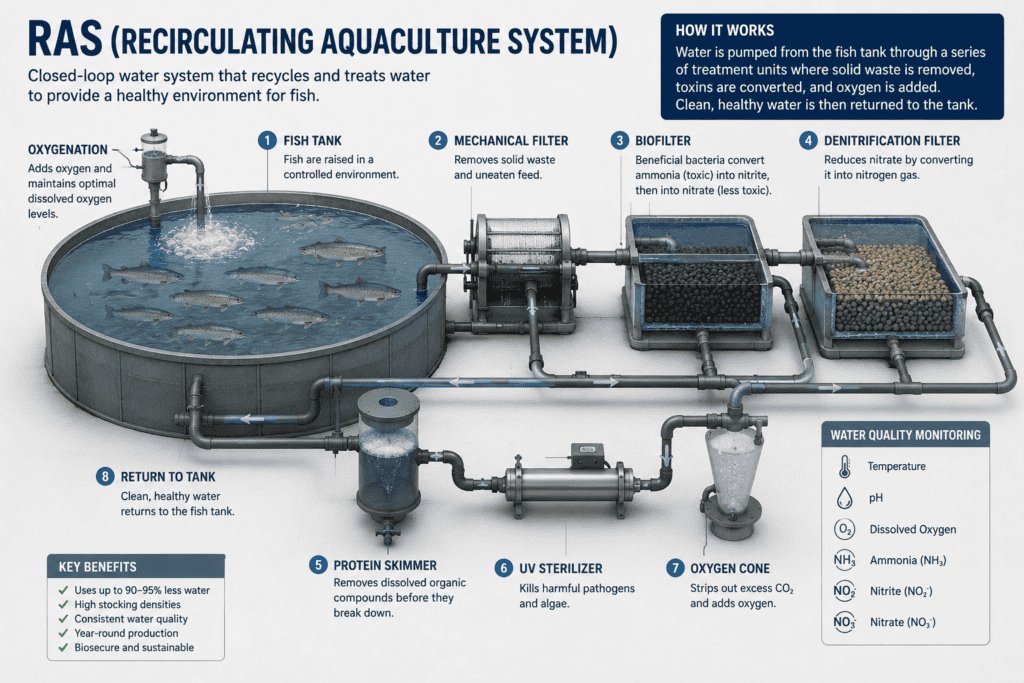
Mechanical filtration
This removes fish faeces, uneaten food and other solid material before it has a chance to break down further.
Drum filters, screens, settlement systems and other mechanical filters can be used for this job.
Biological filtration
Fish excrete ammonia, which can become dangerous at elevated concentrations.
Biofilters provide enormous amounts of surface area for nitrifying microorganisms that convert ammonia through the nitrogen cycle into less immediately toxic forms.
Aeration and oxygenation
Trout have significant oxygen requirements, particularly when large numbers of fish are being kept and fed.
Oxygen therefore becomes a critical part of the system.
Carbon dioxide removal
Fish and microorganisms consume oxygen and produce carbon dioxide.
In intensive recirculating systems, equipment may be used specifically to remove accumulated carbon dioxide from the water.
Water-quality monitoring
Temperature, dissolved oxygen, ammonia, nitrite, pH and other parameters may need to be monitored far more closely than they would in a lightly stocked ornamental pond.
Instead of one large ecosystem doing most of the work, you’ve essentially built a water-treatment plant for fish.
Could You Use a Bog Filter for Trout?
Absolutely.
This is an important distinction.
The problem isn’t that a bog filter won’t work.
A large enough planted wetland or gravel filter can process an enormous amount of nutrients.
Nature is incredibly good at doing this.
Constructed wetlands are used for wastewater treatment, agricultural runoff and all sorts of other water-quality applications.
The problem is practicality.
If you have very high fish densities and continually add large amounts of food, the bog filter required to deal with that load may become enormous.
And that’s exactly what the calculator was showing in this particular example.
The calculator wasn’t necessarily saying:
“This is how you should build your trout farm.”
It was effectively saying:
“If you want to apply this ecosystem-pond filtration approach to that amount of pond, you’re going to need a lot of filtration.”
At some point, specialised mechanical and biological filtration may become smaller, easier to control and more practical.
Why Not Just Make the Bog Filter Smaller?
This is where I think people can get themselves into trouble.
If a filter calculation produces a number we don’t like, it’s tempting to simply make the filter smaller.
But the waste doesn’t care what size filter we wanted to build.
If we reduce the filter capacity, something else about the system may need to change.
For example, you could potentially:
- reduce the number of fish
- reduce the amount of feed entering the pond
- bring more fresh water into the system
- mechanically remove more solids
- add additional biological filtration
- increase aeration or oxygenation
- export nutrients through water changes or plant harvesting
- accept more frequent maintenance
There’s rarely one magic filtration number that works independently of everything else.
Pond filtration is a system.
Change one part and it can change what you need from all the others.
When Is a Bog Filter a Good Choice?
For the ponds I normally talk about on Ozponds, I still think bog filters are one of the best filtration options available.
They’re particularly well suited to people who want:
- a backyard ecosystem pond
- relatively low fish stocking
- plants incorporated into the filtration
- simple DIY construction
- low ongoing maintenance
- a natural-looking filtration system
- clean, clear, healthy pond water without spending a fortune
That’s the environment my bog filter calculator is intended to help with.
Design Your Pond Using The Same System I Use
- A simple system that has helped people around the world design clear, low-maintenance ponds without spending a fortune.
- Includes access to the Private Ozponds community and Virtual Kev, a tool that helps you plan your pond step-by-step.
When Might Another Filter Be Better?
I’d start looking beyond a traditional bog filter when the pond has very high and continuous waste production.
That could include systems with:
- extremely high fish densities
- very heavy feeding
- commercial fish production
- limited space for a large planted filter
- a need for rapid and predictable solids removal
- strict water-quality requirements
- intensive recirculation
That doesn’t make a bog filter a bad filter.
It simply means it’s not necessarily the best tool for that particular job.
A hammer isn’t a bad tool because it can’t tighten a bolt.
What Size Filter Does a Trout Pond Need?
There isn’t enough information in pond volume alone to answer this properly.
For a heavily stocked trout pond, I’d want to know things such as:
How many fish will be kept?
The total fish biomass matters enormously.
How much food will be added each day?
Feed rate is one of the best indicators of how much waste the filtration system will ultimately need to handle.
Is this an ecosystem pond or a production system?
A few trout in a large recreational pond is completely different from trying to maximise kilograms of trout produced per cubic metre of water.
Can fresh water continually enter the pond?
A flow-through system has very different filtration requirements from a closed recirculating system.
How will solid waste be removed?
Capturing waste before it breaks down can dramatically reduce the job required from the biological filtration.
How much maintenance are you prepared to do?
Low-maintenance systems generally need to be designed differently from highly managed production systems.
Those questions tell us far more than pond volume alone.
So, Is a Bog Filter the Best Pond Filter?
There is no single “best” pond filter.
There’s only the filter that best suits the pond you’re trying to create.
For the low-maintenance ecosystem ponds I build, bog filters make enormous sense.
They’re simple, inexpensive to build, provide fantastic habitat and can produce beautiful, clear water.
For intensive aquaculture, I’d be looking much more closely at dedicated solids removal, biological filtration, oxygenation and other specialised systems.
And that’s really the lesson from this viewer’s question.
Don’t start by asking, “What’s the best filter?”
Start by asking:
“What does my pond need the filter to do?”
Once you understand the amount of fish, food, waste, water exchange and maintenance involved, the right filtration system becomes much easier to work out.
About to build a pond… or already have one?
Sign up for my email list and I’ll send you DIY-friendly pond tips, along with a few helpful tools like calculators, gear recommendations, and more.
Frequently Asked Questions
Can a bog filter be used for a trout pond?
Yes. A sufficiently sized bog filter can provide biological filtration and nutrient processing for a trout pond. However, heavily stocked or intensively fed trout systems can generate so much waste that dedicated mechanical and biological filtration may be more practical.
Are bog filters suitable for large ponds?
Yes. Bog filters can work very well on large ponds. The required filter size depends not just on pond volume but also on fish stocking, feeding, nutrient input, water exchange and the type of pond you’re creating.
Why does my bog filter calculation seem so large?
A very large calculated bog filter can indicate that you’re asking an ecosystem-style filtration system to handle a very large pond or high biological load. Rather than simply reducing the bog size, consider the complete system—including fish numbers, feeding, solids removal, water exchange and additional filtration.
What is the best filter for a heavily stocked fish pond?
Heavily stocked ponds often benefit from separating filtration into different jobs. Mechanical filtration can remove solid waste, while biological filtration processes ammonia and nitrite. Aeration, oxygenation and water exchange may also become increasingly important as stocking and feeding increase.
Is a bog filter the same as a constructed wetland?
They use many of the same natural principles, including plant uptake, microbial activity and water passing through or around media. Constructed wetlands can, however, be designed on a much larger scale and for very different purposes, including wastewater and agricultural water treatment.
Do bog filters remove fish waste?
Bog filters can trap and process organic material, but they aren’t the same as a dedicated mechanical filter that physically removes waste from the system. In heavily stocked ponds, removing solids before they break down can become particularly important.
Want to Build a Low-Maintenance Ecosystem Pond?
If your goal isn’t commercial fish production but a beautiful backyard pond that’s simple to maintain, that’s exactly what I focus on here at Ozponds.
I’ve put together the Pond Building Blueprint containing the system I use to plan and build my own ponds—including pond sizing, bog filtration, pumps, plumbing, waterfalls, circulation and more.