

Why Algae Happens — Even in a “Perfect” Pond
If you own a pond, this will sound familiar.
One pond is crystal clear.
Another is full of string algae.
Another suddenly grows jelly-like slime on warm mornings.
And the confusing part?
All of them might be well designed ponds.
I want to talk about pond balance — what it really means, why it shifts, and why algae isn’t always a sign that something has gone wrong.
Because the truth is simple:
Your pond is alive.
And living systems go through cycles.
Some of those cycles are frustrating.
Some are fascinating.
And once you understand what’s happening beneath the surface, they make a lot more sense.
If you’re new here, my name’s Kev. I run Ozponds, where my aim is to help people build and maintain ponds without spending a fortune.
What’s Been Happening in My Own Pond
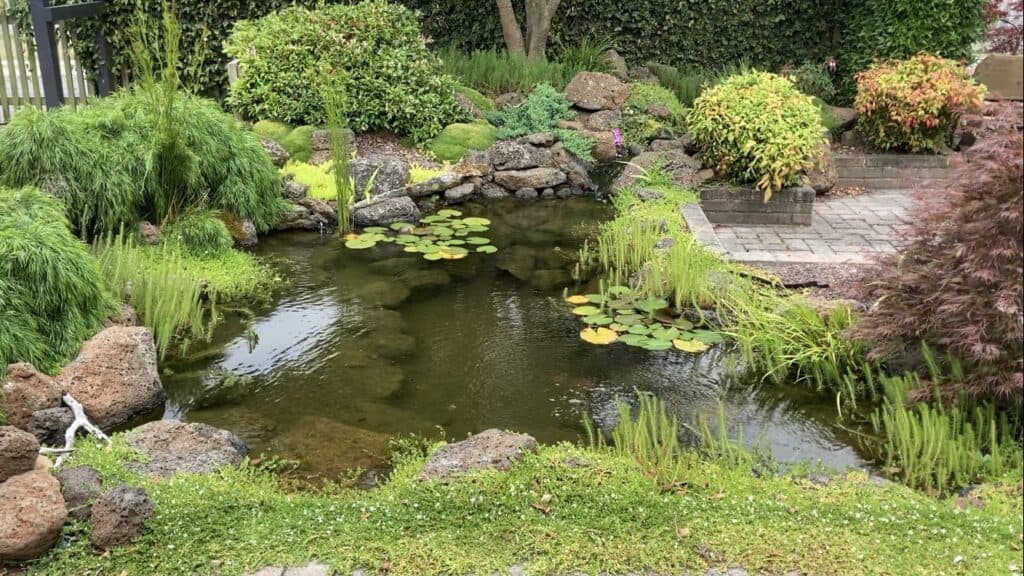
My main pond is about four years old now. It has:
- Two large bog filters
- A 17-metre stream
- An intake bay
- Strong mechanical filtration
- Loads of plants
- Small native fish — not overstocked
On paper, it should be bulletproof.
Most years, I get a bit of algae at the end of winter or early spring. Then it disappears.
This year, it didn’t.
I removed it… and it came back.
The water looked brownish, yet when I scooped some into a jar, it was perfectly clear.
Then suddenly — as the string algae really took off — the pond water went crystal clear, almost like tap water.
That might sound backwards.
But it’s actually a big clue.
Dissolved Organics: The Invisible Problem
That brown tint in pond water usually isn’t dirt or mud.
It’s dissolved organic compounds (DOC).
Things like:
- Tannins
- Humic acids
- Broken-down leaves
- Fish waste
- Proteins and carbon compounds
You can’t really filter DOC out with mechanical filters.
But here’s the interesting part:
String algae loves dissolved organics.
As it grows, it absorbs them.
So while algae looks ugly, it’s often polishing the water.
That’s exactly why my pond water cleared up as the algae exploded — the algae was consuming the dissolved organics.
Nature was doing what it does best.
How Over-Cleaning Can Cause More Algae
This year, I cleaned more aggressively than usual.
I:
- Removed a lot of sediment
- Cleaned filters
- Thinned plants heavily
- Lifted rocks
- Exposed surfaces
- Scrubbed biofilm
And without meaning to, I reset the system.
Sediment and biofilm aren’t just “muck” — they’re part of the pond’s stability. When you remove too much at once, you create open space and available nutrients.
Algae is very good at taking advantage of that.
Meanwhile, one of my other ponds — where I only lightly cleaned and used a bit of sodium percarbonate to lift the surface muck — has no algae at all right now.
Same weather.
Very similar design.
Totally different result.
That’s pond ecology in a nutshell.
The Biofilm Cycle (The Part Nobody Talks About)
Biofilm — that slimy layer on rocks, roots, and gravel — goes through a life cycle.
Roughly speaking:
- 0–30 days: young, fast, very hungry
- 30–60 days: peak efficiency and balance
- 60+ days: thickens, slows, becomes old biofilm
On warm days, old biofilm often sheds.
That jelly-like slime you sometimes see floating on the surface?
It’s usually old biofilm exfoliating, not a disaster and not new algae.
When I did my big clean, I wiped out a lot of mature biofilm — and restarted the clock.
Algae simply filled the gap until the system could rebuild itself.
Lesson learned:
Never reset everything at once.
The Aquarium Analogy That Explains Everything
Inside my house, I run dirted aquariums — the Father Fish style.
They use:
- Soil
- Sand
- Plants
- Microfauna
Those tanks balance incredibly fast.
Very little algae.
Very stable systems.
A pond works the same way — but outdoors.
Which means it also deals with:
- Temperature swings
- Seasonal plant die-off
- Wind and dust
- Rain dilution
- Wildlife
- Pollen and leaf fall
You can’t escape those cycles.
Even a perfectly designed pond will go through seasons of:
- Algae
- Brown water
- Biofilm shedding
- Plant explosions
- Sediment buildup
That’s not failure.
That’s rhythm.
And most of the time, it’s us trying to “fix” things that actually causes problems.
The Myth of the Magic Bullet
When algae shows up, we look for quick fixes.
Phosphate binders.
Bacteria products.
Algaecides.
I try them too — we all do.
They might help a little.
They might speed things up slightly.
But they rarely change the big picture.
What actually moves the needle in my ponds is:
- Healthy sediment
- Diverse biofilm
- A wide range of plants
- Microfauna
- No overfeeding
- No overstocking
- And most importantly… time
Natural processes always beat chemicals.
What I Actually Want From a Pond
I don’t want a pond I have to work on every weekend.
I don’t want to clean filters constantly.
I don’t want to do water changes like an aquarium.
I want a pond that mostly looks after itself.
That’s why everything I build — and everything I teach — is about embracing natural cycles, not fighting them.
My pond is going through a reset right now.
It’s annoying.
It’s interesting.
And honestly, it’s kind of exciting.
Because I know how this story ends.
The biofilm will mature.
The plants will take off.
And the system will settle back into that clear, low-maintenance balance — just like it has for years.
Final Thoughts
If you’re seeing string algae, brown water, jelly slime, or strange spring behaviour — you’re not alone.
Your pond isn’t broken.
It isn’t failing.
It’s alive.
If you’d like more help:
- I’ve got loads of free articles and videos over on Ozponds.com
- And if you want a step-by-step breakdown of how I design low-maintenance, natural ponds, my Pond Formulas Blueprint goes deep into the exact systems I use
Hope this helped you understand what’s happening in your pond — and mine.
Catch you in the next one. 🌿💧
About to build a pond… or already have one?
Sign up for my email list and I’ll send you DIY-friendly pond tips, along with a few helpful tools like calculators, gear recommendations, and more.