

“How big does my pond need to be?”
It’s one of the most common questions I get — and the short answer is:
it depends.
What many people don’t realise is that pond size quietly affects almost everything:
- Filtration
- Temperature
- Oxygen levels
- Fish health and selection
- Plant choice
- And how much work you’ll be doing long-term
Today I want to explain why pond size matters, and how water volume influences the entire system.
But first — if you don’t already know me — my name’s Kev.
My aim is to help people build and maintain ponds without spending a fortune.
What Do We Mean by “Small” and “Large” Ponds?
Before we go any further, let’s clear something up.
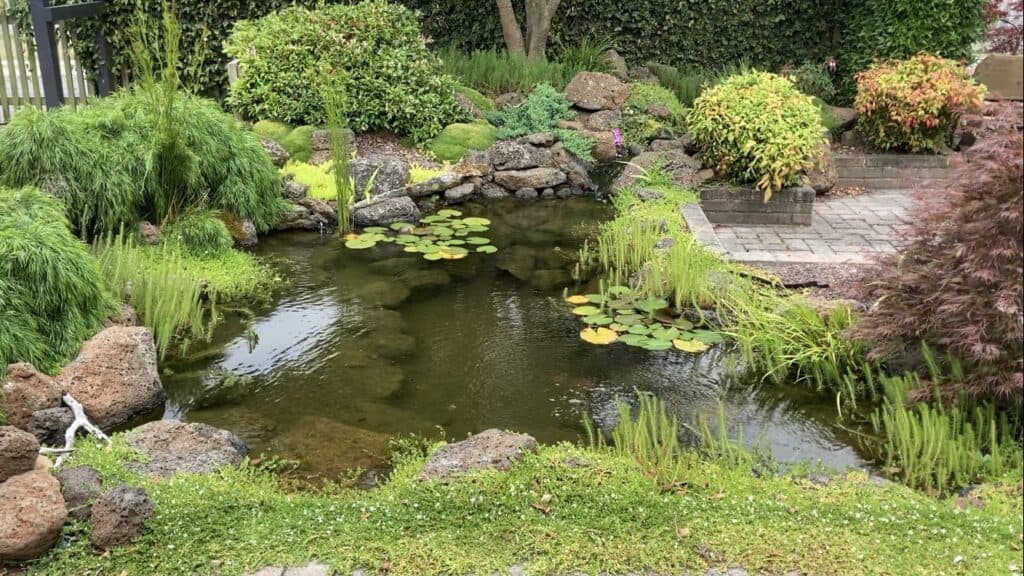
When I say small pond, I’m talking about backyard ponds.
That includes container ponds, courtyard ponds, and fairly typical suburban ponds.
When I say large pond, I’m not talking about a big backyard feature.
I’m talking about dams, lakes, or acreage ponds that cover a good chunk of land — sometimes acres — and hold hundreds of thousands or even millions of litres of water.
They behave very differently.
The Big Idea: Water Volume Is a Buffer
The simplest way to think about pond size is this:
More water = more stability
Less water = faster change
Small ponds:
- Heat up quickly
- Cool down quickly
- React fast to feeding, rain, leaves, and sunlight
Large ponds still change — but they change slowly.
And in nature, slow change usually equals stability.
Filtration: Why Size Changes Everything
Filtration is often where pond size matters most.
In backyard ponds:
- Waste builds up quickly
- Filters clog faster
In large ponds and dams:
- Sediments build up over long periods
- Water quality is strongly influenced by the surrounding catchment
Big ponds aren’t automatically perfect.
The quality of the water flowing into them matters a lot.
Runoff, nutrients, and what the water picks up from the surrounding environment all affect performance.
Also, just because a pond is large doesn’t mean it can’t be overstocked.
All water bodies need to be able to process the nutrients they produce.
If too many nutrients are created and not enough are consumed or recycled up the food chain, problems still occur.
Smaller ponds are often easier to design properly:
- Pumps are affordable
- Sediment capture is manageable
- You can deliberately create areas that grow beneficial bacteria and micro-fauna
That’s why I always size filtration based on water volume.
If you want help with that, I’ve created a step by step guide on how I design and build my ponds.
Temperature Stability and Oxygen: Small Water, Big Swings
Temperature is another quiet influencer.
In backyard ponds:
- Water heats and cools quickly
- Sudden changes stress fish and biology
Stability is important for all aquatic life.
Some species cope with rapid change better than others, which is why choosing animals suited to the environment you’re creating is critical.
A very common cause of fish death in small ponds is lack of oxygen.
Warm water holds less oxygen, and when temperatures rise:
- Fish require more oxygen
- Decomposition speeds up
- Bacteria multiply faster
- Plants and algae grow faster
All of this increases oxygen demand.
In backyard ponds, pumps, waterfalls, and circulation help mix water and air, allowing oxygen to dissolve into the water.
Shading also plays a big role in keeping water cooler.
I’ve shown small ponds without pumps — lots of plants, deep substrate, and low stocking — but in those systems I only keep very small, hardy fish in low numbers.
In colder climates, depth and volume matter for a different reason.
You want to avoid the entire pond freezing solid.
Surface ice is usually fine.
Some people move fish indoors over winter, which can be fun for serious fish keepers.
Personally, I prefer choosing species that can handle local conditions — it makes life much easier.
When Does a Pond Start Circulating Itself?
There isn’t a hard line — it’s a gradual shift.
As ponds reach larger scales:
- Wind pushes surface water
- Temperature differences create slow vertical movement
- Daily heating and cooling naturally mix layers
At that point, circulation becomes more about physics than pumps.
Backyard ponds — even fairly large ones — usually don’t reach this point.
They’re too shallow and too contained.
That’s why pumps and thoughtful circulation are so useful in backyard ponds.
Nature helps — but it doesn’t replace design at that scale.
It is possible to create a small backyard pond without pumps, but you’ll need:
- Heavy plant coverage
- Minimal open water
Fish Density and Learning Restraint
Fish need space.
In small ponds:
- Overstocking happens easily
- Feeding mistakes show up fast
- Waste can overwhelm the system quickly
And this is important:
I don’t think people should start with a big backyard pond.
I’ve built plenty of small container ponds — some with pumps and filters, some without.
Small ponds are great teachers.
They show you very quickly what works — and what doesn’t.
If you can make a small pond work, you can scale it up.
Keeping smaller, hardy fish helps you learn:
- How water chemistry changes
- How plants absorb nutrients
- How tiny organisms help maintain water quality
Biodiversity and Ecosystem Complexity
Ecosystems are complex — and diversity makes everything easier.
Plants, bacteria, insects, micro-organisms, fish — all interacting.
Watching how those relationships form and balance themselves is something I find genuinely fascinating.
Plants, Design, and Long-Term Maintenance
Plant choice is closely tied to pond size.
Large, unlined ponds can support aggressive plants that absorb large amounts of nutrients and improve water quality.
In backyard ponds, I’m much more selective.
I look for a balance between:
- Function
- Visual appeal
- Easy maintenance
That’s why I like bog filters — they use plants for filtration while still allowing large areas of open water.
I also like pairing them with a skimming system or intake bay to remove debris before it sinks.
This keeps the water clearer and reduces pump maintenance.
If you don’t care about open water, you can rely heavily on plants — I do this in very small container ponds where gardening is manageable.
As ponds get larger, I personally find that harder to maintain, but that’s just my bias.
A good DIY filtration system is cost-effective and gives me the results I want.
Final Thoughts
You can build a pond with:
- A few litres
- A few thousand litres
- Or millions
There is no “correct” size.
But water volume is the silent partner in every pond.
The more you understand that, the easier everything else becomes.
If you want help designing a pond that suits your space and budget, check out the full system I use to build my ponds, the Pond Formulas Blueprint walks through it step by step.
Thanks for reading — I hope this was helpful.
About to build a pond… or already have one?
Sign up for my email list and I’ll send you DIY-friendly pond tips, along with a few helpful tools like calculators, gear recommendations, and more.