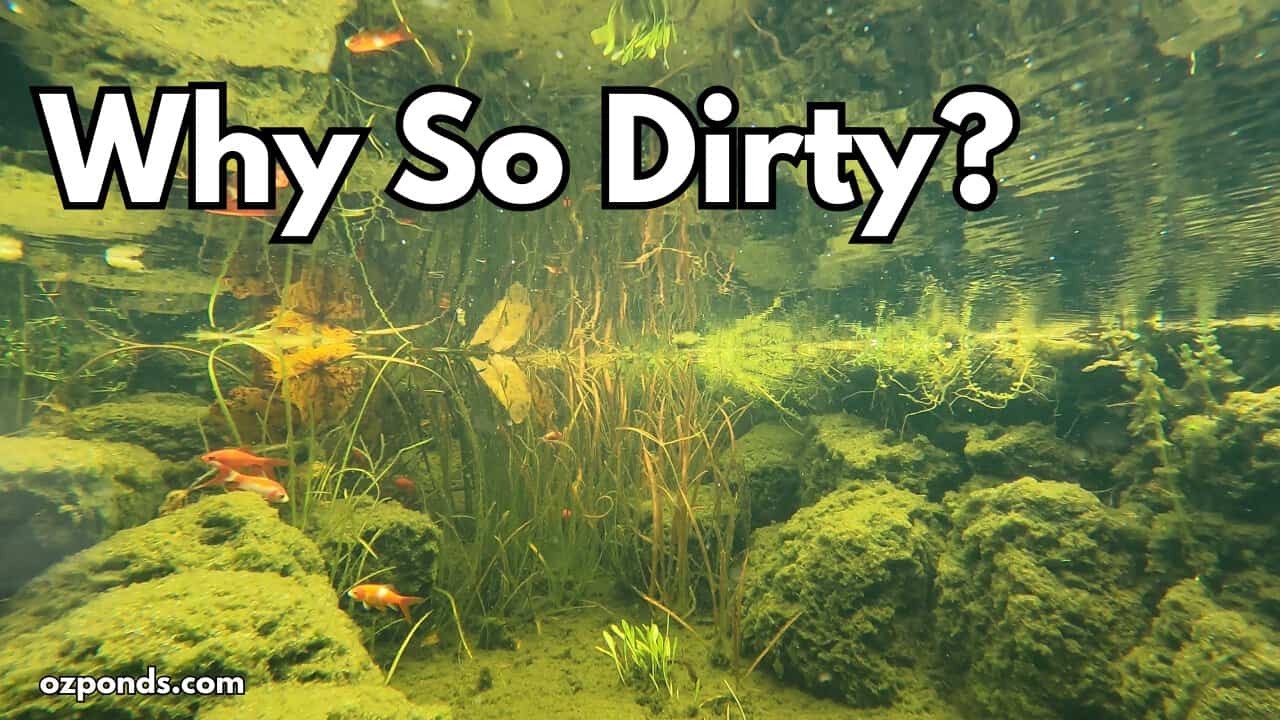
One of the most interesting comments I recently received came from someone with a 20,000-gallon (75,000-litre) koi pond.
Their pond had:
- A large skimmer
- A waterfall filter
- A bog filter
- A UV clarifier
Yet despite all that filtration, the pond only stayed clean for about two weeks before it started looking dirty again.
At first glance, it sounds like a filtration problem.
But does it really?
In my experience, one of the biggest mistakes pond owners make is asking:
“What filter do I need?”
Instead, I think we should be asking:
“How is my pond dealing with waste?”
What Does “Clean” Actually Mean?
Whenever someone tells me their pond isn’t clean, my first question is always the same.
What do you mean by clean?
Different pond owners mean completely different things.
Some people mean:
- Green water
- String algae
- Sludge on the bottom
- Murky water
- Floating debris
- Brown water
- Poor visibility
Those are all different problems with different causes.
Even more importantly…
A pond can look crystal clear and still have serious issues.
Likewise, a pond can have string algae growing in parts of the system and actually be functioning extremely well.
Appearance and pond health are not always the same thing.
Not All Algae Is the Enemy
Take string algae as an example.
Most pond owners hate it.
I understand why—it isn’t particularly attractive.
But biologically, string algae is doing some very useful work.
It absorbs nutrients.
It traps fine suspended particles.
It provides habitat for countless microorganisms that become part of the pond’s food web.
That doesn’t mean you should let it completely take over your pond.
It simply means its presence isn’t always a sign that your pond is failing.
The same applies to green water.
The microscopic algae causing green water is feeding on dissolved nutrients floating in the water column.
In other words, it’s doing exactly what nature designed it to do.
Understanding that changes how we approach pond problems.
Every Pond Is a Waste Management System
This is probably the single most important lesson I’ve learned over the years.
Every pond is constantly producing waste.
Fish eat food.
Fish produce waste.
Plants grow.
Plants die.
Leaves fall.
Dust blows in.
Algae grows.
Algae dies.
Nothing in a pond simply disappears.
Everything eventually becomes waste.
The real question isn’t whether waste exists.
The question is:
How is your pond processing that waste?
Follow the Waste
If I were standing beside that 20,000-gallon koi pond, I wouldn’t immediately recommend another filter.
I’d start by looking at the entire system.
I’d ask questions like:
- Where is waste being produced?
- Where is it settling?
- Where is it being trapped?
- Where is it breaking down?
- How is it eventually leaving the pond?
Those answers are usually far more valuable than simply buying another piece of equipment.
Bigger Fish Mean Bigger Responsibilities
This is where pond goals become incredibly important.
Personally, I enjoy relatively low-maintenance ponds.
I don’t keep extremely high fish loads because I like systems that largely look after themselves.
A heavily stocked koi pond is different.
Large koi produce enormous amounts of waste.
That’s perfectly fine—if the system is designed to handle it.
Eventually that waste has to leave the pond.
That may mean:
- Cleaning skimmer sponges more frequently
- Flushing the bog filter properly
- Vacuuming accumulated sediment
- Improving circulation
- Installing a bottom drain
- Adding a solids-handling pump
The solution depends on where the waste is accumulating.
Sometimes the Filter Isn’t the Problem
One thing I often see is bog filters that haven’t been cleaned for years.
People assume because plants are growing everything must be working perfectly.
Meanwhile the filter may contain years of accumulated roots, decaying organic matter and trapped sediment.
Eventually the filter itself starts becoming part of the problem instead of part of the solution.
Sometimes a proper backwash and thorough flush is exactly what’s needed.
Not simply draining it.
Actually flushing until the discharge water runs clean.
Wildlife Ponds and Koi Ponds Are Different Systems
One mistake I see regularly is people comparing completely different pond styles.
A lightly stocked wildlife pond may require very little maintenance.
A heavily stocked koi pond may require regular cleaning simply because it processes far more waste every single day.
Neither approach is wrong.
They’re simply designed with different priorities.
Nature can process an incredible amount of waste.
But every ecosystem has its limits.
Design Your Pond Using The Same System I Use
- A simple system that has helped people around the world design clear, low-maintenance ponds without spending a fortune.
- Includes access to the Private Ozponds community and Virtual Kev, a tool that helps you plan your pond step-by-step.
Before You Buy More Equipment…
The pond industry offers endless products.
New filters.
More UV clarifiers.
Bacteria additives.
Water treatments.
Sometimes they’re useful.
Sometimes they’re treating the symptom rather than the cause.
Before spending more money, ask yourself three simple questions:
- Where is the waste coming from?
- Where is it accumulating?
- How is my pond processing or removing it?
Those questions often reveal the real problem.
The Way I Design My Own Ponds
Every pond I build follows the same basic principles.
Not because it’s the only way to build a pond.
But because understanding how waste moves through a pond allows you to make better decisions from the very beginning.
When you understand waste movement, filtration, circulation and maintenance all become much easier to design.
That’s exactly the thinking behind the Pond Formulas Blueprint, where I walk through the same planning process I use in my own ponds.
Final Thoughts
If your pond only stays clean for a couple of weeks, resist the temptation to immediately buy another filter.
Instead, step back and look at the entire system.
Remember that every pond is constantly producing waste.
Healthy ponds aren’t the ones that magically avoid waste.
They’re the ones that process it efficiently.
Once you understand how waste moves through your pond, solving problems becomes much easier—and often much cheaper.
About to build a pond… or already have one?
Sign up for my email list and I’ll send you DIY-friendly pond tips, along with a few helpful tools like calculators, gear recommendations, and more.