
When it comes to pond rocks, I get asked the same questions over and over:
- What type should I use?
- How much do I need?
- Will they mess with my water chemistry?
The truth is, rocks can make or break your pond design. In this guide, I’ll walk you through the key things to know so you can choose wisely.
What Types of Rocks Can You Use in a Pond?
Honestly, nature doesn’t discriminate — you’ll find sand, limestone, granite, and all sorts in natural waterways. Most of them work fine in ponds too. The only thing I steer clear of is rocks that crumble or disintegrate over time, because that just makes extra work later.
Here’s how different rocks affect your water:
- Limestone – Raises pH and adds calcium carbonate, which makes your water harder.
- Granite – More inert, won’t really change your chemistry.
If you’re also adding plants or wood, they help buffer things out naturally.
Why Add Rock and Pebble to a Pond?
For me, there are four big reasons:
- Protecting the liner – Rocks shield the liner from UV damage and stop animals from clawing, biting, or puncturing it.
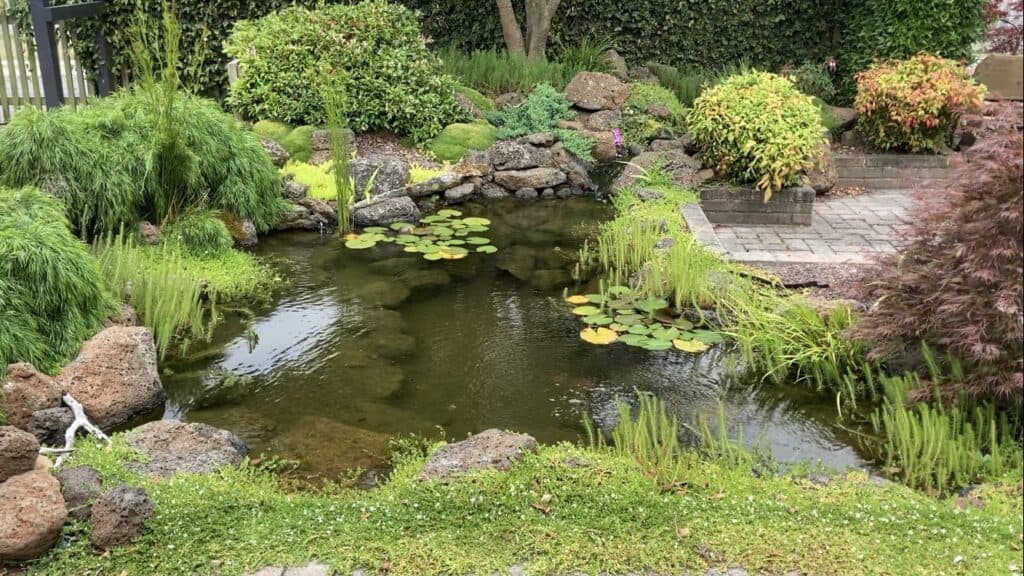
- Natural appearance – Bare liner looks… well, bare. Rocks blend the pond into the landscape and make it look like it belongs.
- Filtration power – Pebbles and cobbles provide surface area for beneficial bacteria and biofilms to grow. These help process nutrients and keep your water healthy.
- Habitat creation – Small crevices trap dirt and debris, which turns into food and shelter for insects and critters that form the base of your pond’s ecosystem.
⚠️ If you want a “swimming pool clean” pond and plan to vacuum it often, skip the rock and pebble. They’re better suited for a natural ecosystem approach.
Rock Sizes and Placement
The secret to a natural-looking pond is mixing sizes:
- Big rocks – Great for hiding vertical liner edges. Pull a few out into the surrounding landscape so the pond looks like it belongs.
- Medium cobbles – Bridge the gap between large boulders and small pebbles.
- Small pebbles – Add filtration surface area, backfill behind larger rocks, and create planting pockets for marginals.
Plants aren’t just decorative — they’re filtration machines in their own right.
Pro Tip: The “Liner Sandwich”
Sometimes I add an extra layer of protection under heavy rocks by using non-woven geotextile both underneath and on top of the liner — what I call a liner sandwich.
I don’t do it with every pond, but for bigger builds with serious rocks, it gives me peace of mind. You can also just place small pads of geotextile under the largest boulders.
👉 Check out the liner and geotextile I use here
Where to Source Rocks
I usually pick mine up from local garden supply centres — the same places you’d buy mulch, sand, or road base. They often have rock and pebble, or at least contacts at nearby quarries.
💡 Tip: Rock is heavy, and transport costs add up fast. Stick with what’s local to keep costs down.
How Much Rock Do You Need?
This one’s tricky. Aquascape has a rock calculator you can use as a starting point, but remember:
- Rock is often sold by weight.
- You’re thinking in terms of coverage and volume.
- Density differences can throw the numbers off.
So treat calculators as a guide, not gospel.
What If You Can’t Move Big Rocks?
You’ve got options:
- Rope in a few strong mates.
- Hire a machine operator.
When I built my dream pond, I got stuck shifting some giant rocks. I eventually hired a bloke with a machine — he had them set in 15 minutes flat. A good operator makes it look easy and saves you a lot of sweat.
Rocks in Bog Filters
I also use rocks in bog filters. They provide structure, surface area for bacteria, and help with flow. If you’d to see some diagrams click here, or watch the video below.
Final Thoughts
Rocks aren’t just decoration — they protect your liner, balance your water, create habitats, and make your pond feel like part of the landscape. With the right mix of sizes and some thoughtful placement, you’ll have a pond that looks natural and runs like a healthy ecosystem.
If you want more step-by-step help, check out my Pond Formulas Blueprint where I break down pond design so you don’t waste money or time.
About to build a pond… or already have one?
Sign up for my email list and I’ll send you DIY-friendly pond tips, along with a few helpful tools like calculators, gear recommendations, and more.