

For many years I had an upper pond spilling into a lower pond, full of very happy fish, frogs, and a couple of newts — too many fish technically, but they reproduced faster than I could give them away to friends!
I used a proprietary sponge-filled filter fitted with a neon tube, but it needed regular cleaning — a mucky, smelly job, no doubt made worse by the number of fish. Blanket weed was also a major problem, and an even bigger one was the local heron. The only way to stop it was by netting both ponds, which didn’t look great, even if it did save the fish.
Eventually (and inevitably) the pump expired, so I had a rethink after discovering the concept of a bog filter through Kev’s comprehensive instructions.
The Rebuild
The upper pond was removed, and the lower pond made a bit smaller to make way for a seating area. All of the fish were given away apart from six small blackish ones that were hard to see and dodged the net — these were moved into a temporary pond elsewhere in the garden along with three frogs and a newt.
One frog refused to accept his temporary change of address and took to sitting beside me while I worked on shortening the lower pond. As soon as the new pump arrived — sized to match the pond as per Kev’s advice — I filled it up so the frog might cheer up.
That turned out to be a premature decision. For speed, I had to use mains water rather than rainwater, and since the filter wasn’t built yet, the stagnant tap water quickly turned into a thick green soup!
Building the Bog Filter
I built the bog filter according to Kev’s sizing instructions but added an extra length of pipe to the tee-piece inside the bottom of the filter so the water starts its journey upward from both sides.
I put some broken bricks at the bottom and filled the filter with 20 mm limestone, which just happened to be what was available locally. That may have helped, since streams flowing over chalk and limestone tend to stay clear. I gave the stone a good rinse before adding it, as it was very dusty straight from the bags.
I didn’t have enough 25 mm hose to join the pump to the filter, so I combined it with some 18 mm hose and figured it would work fine with the 22 mm outlet pipe I’d installed at the top of the filter.
However, when I first fired it up, it filled faster than it could empty! I’m still not sure how that happened, but I clearly underestimated the outlet size. Kev’s advice is to make the outlet bigger than the inlet — lesson learned. I added a second 22 mm outlet pipe, and it’s been perfect ever since.
Both pipes discharge onto a piece of slate that forms a chute outlet through the timber sleepers.


The Result
The pump came with an optional fountain attachment, which I didn’t plan to use — I’m not a fan of plastic pipes sticking up out of the pond — but I switched the fountain valve on anyway. It creates a gentle, silent disturbance on the surface that keeps the water from stagnating.
It’s still early days, so the plants aren’t fully established yet. We’d like to add a water lily in spring, though I’m not sure how well it will fare with that bit of water movement — but nothing ventured, nothing gained.
The pond is no longer netted since I only have a few of those little blackish fish left, and the heron hasn’t spotted them yet. One has turned itself bright orange, though, so we’ll see how long it stays lucky!
I haven’t needed to clean the filter yet, but when I do, it should be straightforward thanks to the tap I installed at the base.
Incidentally, the frog now has a secret entrance to a secure, rather spacious living area below the filter — though I’m not sure he’s found it yet!
The Transformation
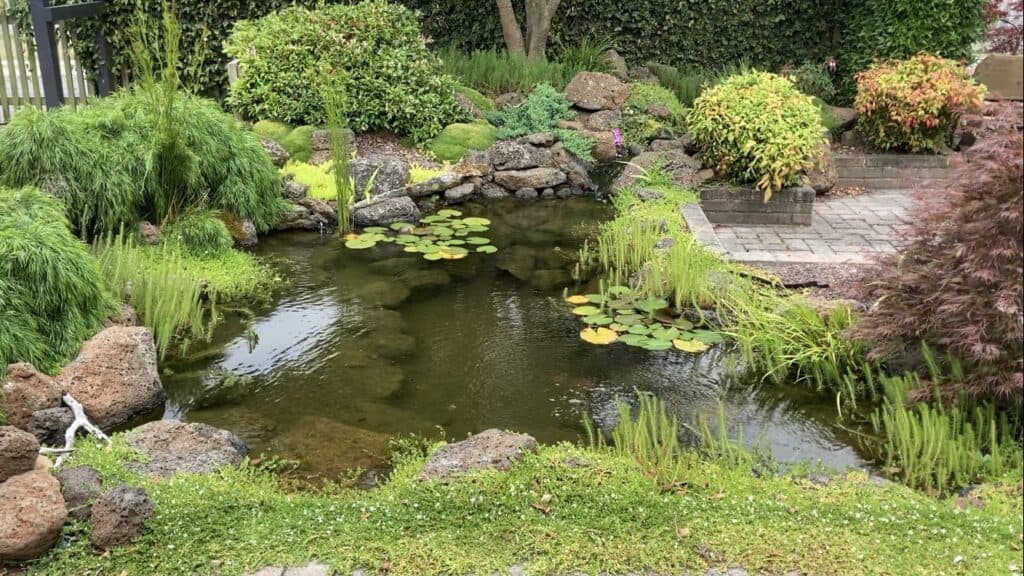
After just a couple of weeks, the bog filter turned that thick green soup into crystal-clear water. It’s been a complete success.
Massive thanks to Kev for all the advice and for sharing the knowledge that made this possible.
— Mark, Leamington Spa, England
💧 Inspired by Mark’s Pond?
If you’d like to design your own clear-water pond like Mark’s, grab the Pond Formulas Blueprint — the same resource he used to size his pump and filter correctly.
And if you’ve built a pond or bog filter you’re proud of, I’d love to see it!
Head to the Contact Page to share your DIY pond story and inspire others around the world.
About to build a pond… or already have one?
Sign up for my email list and I’ll send you DIY-friendly pond tips, along with a few helpful tools like calculators, gear recommendations, and more.