
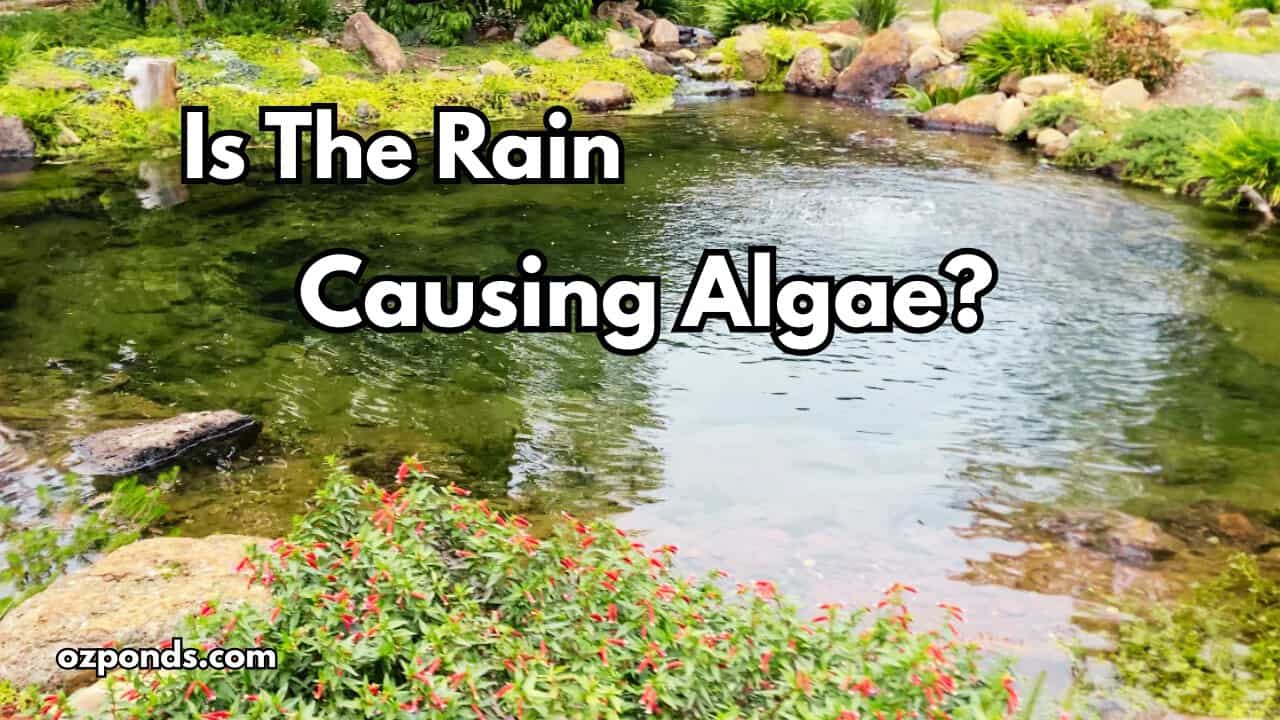
Most people think rainwater is perfect for ponds.
It’s natural.
It’s free.
It doesn’t contain chlorine.
So surely it must be the ideal water source.
But what if I told you that in some situations, rainwater can actually make a pond less stable and more prone to algae?
Now before anyone panics, I’m not saying rainwater is bad. Many healthy ponds rely heavily on rainwater. Some natural ponds receive almost all their water from rainfall.
The problem isn’t the rainwater itself.
The problem is understanding what rainwater lacks and how that affects the long-term stability of your pond.
Today I want to talk about buffering, KH, pond maturity, and why some ponds seem to battle string algae year after year while others settle into a much more stable balance.
What Is Rainwater Really?
When people talk about rainwater, they often describe it as “pure.”
And compared to many other water sources, that’s reasonably true.
Rainwater is typically very low in dissolved minerals. It contains very little calcium, magnesium, carbonate, bicarbonate and other substances that naturally occur in groundwater, rivers and lakes.
In water testing terms, rainwater usually has:
- Low Total Dissolved Solids (TDS)
- Low hardness
- Very low alkalinity (KH)
- Little buffering capacity
Rainwater is also slightly acidic because carbon dioxide dissolves into the water while it is in the atmosphere.
None of this is automatically bad.
But it does mean rainwater behaves differently from many other water sources.
Think of rainwater as very “empty” water.
It doesn’t bring much stability with it.
The Most Important Thing Rainwater Lacks
The biggest issue with rainwater isn’t pH.
It’s buffering.
Buffering is largely provided by carbonates and bicarbonates dissolved in the water. These compounds help resist sudden changes in pH.
I like to think of buffering as the shock absorbers of a pond.
Every pond is constantly producing acids.
Fish produce waste.
Leaves decompose.
Bacteria process nutrients.
Organic matter breaks down.
All of these processes generate acids.
Without buffering, those acids would gradually push the pH lower and lower.
Buffering compounds absorb much of that pressure.
Instead of every biological process causing a change in water chemistry, the buffering system smooths those changes out.
The result is a more stable pond.
Why KH Matters
KH stands for carbonate hardness, which is a measurement of your pond’s buffering capacity.
A pond with healthy KH levels can usually absorb normal biological activity without major swings in pH.
A pond with very low KH is much more sensitive.
Small changes can have larger effects.
This doesn’t necessarily mean disaster.
Many ponds operate with relatively low KH.
But it does mean the pond has less resistance to change.
And pond stability is incredibly important.
Stability Is More Important Than Perfection
One of the biggest mistakes I see in pond keeping is people chasing perfect numbers.
They become obsessed with achieving a specific pH.
Or a specific hardness level.
Or a specific test result.
Natural ponds don’t work that way.
Nature is constantly changing.
What matters is whether those changes happen gradually or suddenly.
A stable pond can tolerate a wide range of conditions.
An unstable pond struggles even when the numbers look acceptable on paper.
In my experience, pond success has much more to do with stability than perfection.
How Low Buffering Can Encourage Algae
This is where things get interesting.
Most people assume algae is simply caused by excess nutrients.
And nutrients absolutely play a role.
But algae often seems to thrive in systems that haven’t fully stabilised.
Let’s look at a few possible reasons why.
1. Plants Struggle More in Unstable Systems
Aquatic plants generally prefer stable conditions.
When water chemistry constantly shifts, plants often establish more slowly and compete less effectively.
A healthy population of aquatic plants helps remove nutrients from the water.
When plants aren’t thriving, algae often fills the gap.
2. Bacteria Prefer Stability Too
The beneficial bacteria responsible for processing waste also perform best under relatively stable conditions.
When conditions fluctuate, biological processing can become less efficient.
Instead of nutrients being steadily consumed and recycled, you can end up with periods where nutrients become more available.
Algae loves opportunity.
3. Nutrients Arrive in Pulses
This is one of the most overlooked concepts in pond ecology.
In a mature pond, nutrients are constantly being processed.
The system absorbs small changes and spreads them throughout the food web.
In an immature or unstable pond, nutrients often arrive in bursts.
A rain event.
A handful of leaves.
Extra fish food.
A dead plant.
Instead of being absorbed smoothly, these inputs can create temporary opportunities for algae growth.
Filamentous algae is extremely good at exploiting those opportunities.
The Difference Between a Mature Pond and a New Pond
One reason older ponds often become easier to manage is that they develop biological depth.
Over time a pond accumulates:
- Beneficial bacteria
- Fungi
- Biofilms
- Sediments
- Plant roots
- Organic matter
- Microorganisms
All of these contribute to stability.
A mature pond becomes better at handling change.
When nutrients enter the system, they are quickly intercepted by countless organisms already living there.
The pond develops resilience.
This is one reason I often tell people to be patient.
Many pond problems improve as the ecosystem matures.
Why I Don’t Like Over-Cleaning Ponds
This idea also explains why I generally avoid over-cleaning.
When people see algae, sediment or organic matter, the temptation is to remove everything.
The pond gets scrubbed.
The filter gets thoroughly cleaned.
The gravel gets washed.
The water gets replaced.
Unfortunately, a lot of beneficial biology gets removed as well.
You may improve the appearance temporarily while making the system less stable in the long run.
I’m not suggesting ponds should never be cleaned.
I’m suggesting that stability matters.
Sometimes a little bit of sediment is helping more than people realise.
How Natural Systems Stay Stable
One thing that’s often overlooked is that natural ponds continuously receive minerals from their surrounding environment.
Water moves through soil.
It flows over rock.
It passes through wetlands.
As it moves, it picks up minerals that contribute to buffering and stability.
Large lakes and natural ponds are part of entire catchments.
Backyard ponds are different.
Especially rainwater-fed ponds.
If most of your water comes from rainfall, your pond may receive very little mineral input unless those minerals are being supplied elsewhere.
That’s one reason some rainwater-fed ponds benefit from additional buffering sources.
Ways to Improve Pond Stability
If your pond relies heavily on rainwater and struggles with instability, there are a few things worth considering.
Add More Biological Surface Area
More biological surface area means more places for beneficial organisms to live.
Examples include:
- Bog filters
- Gravel
- Rock
- Plant roots
- Timber
- Wetland areas
The more habitat available, the more biological processing your pond can support.
Increase Plant Diversity
Plants do far more than simply remove nutrients.
They create habitat.
They support microorganisms.
They stabilise ecosystems.
A diverse pond is usually a more resilient pond.
Consider Natural Buffering Materials
Materials containing calcium carbonate can slowly contribute buffering capacity.
Examples include:
- Limestone
- Shell grit
- Crushed coral
- Aragonite
These materials tend to dissolve more readily when the water becomes acidic, which can help provide passive buffering over time.
Avoid Large Swings
Try not to make sudden changes unless absolutely necessary.
Large cleanouts.
Massive water changes.
Removing all plant growth.
Cleaning every filter at once.
These actions can sometimes create more instability than the original problem.
Is Rainwater Good or Bad for a Pond?
In my opinion, that’s the wrong question.
Rainwater isn’t good.
Rainwater isn’t bad.
Rainwater is simply one part of a much larger system.
Over time, the water in your pond starts to reflect everything around it.
The rocks.
The plants.
The sediments.
The biology.
The fish.
The microorganisms.
The pond develops its own character and its own stability.
You’ll still see seasonal changes.
You’ll still get algae from time to time.
That’s completely normal.
The goal isn’t to create a perfectly controlled environment.
The goal is to build a system that can handle change.
Because when you get that right, the pond doesn’t need to be perfect.
It just needs to work.
Design Your Pond Using The Same System I Use
- A simple system that has helped people around the world design clear, low-maintenance ponds without spending a fortune.
- Includes access to the Private Ozponds community and Virtual Kev, a tool that helps you plan your pond step-by-step.
Frequently Asked Questions
Does rainwater cause string algae?
Not directly. However, ponds with very low buffering capacity and limited biological maturity may be more prone to instability, which can create opportunities for filamentous algae.
What is KH in a pond?
KH (carbonate hardness) measures the buffering capacity of water. It helps stabilise pH and resist sudden chemical changes.
Can rainwater lower KH?
Yes. Rainwater typically contains very little alkalinity, so repeated additions of rainwater can gradually reduce KH in some ponds.
Is low KH bad for ponds?
Not necessarily. Some natural aquatic systems operate with very low KH. The important factor is whether the ecosystem remains stable and adapted to those conditions.
How do I increase buffering in my pond?
Common approaches include using limestone, shell grit, crushed coral, aragonite, or source water that naturally contains more minerals. Always make changes gradually.
Final Thoughts
The longer I keep ponds, the less I focus on chasing numbers.
Instead, I focus on building ecosystems.
Healthy plants.
Good circulation.
Lots of biological surface area.
Reasonable stocking levels.
Stable conditions.
Because when the ecosystem is strong, it can absorb change without falling apart.
And that’s what pond keeping is really about.
About to build a pond… or already have one?
Sign up for my email list and I’ll send you DIY-friendly pond tips, along with a few helpful tools like calculators, gear recommendations, and more.