

When I first started building ponds, I wasn’t chasing complexity.
I wanted something that looked natural and was easy to live with. I didn’t want high-tech filtration, constant water testing, or cleaning filters every weekend. The idea of a pond that worked with nature — not against it — really resonated with me.
But when we say nature, what does that actually mean in a pond?
It isn’t magic.
And it isn’t just plants.
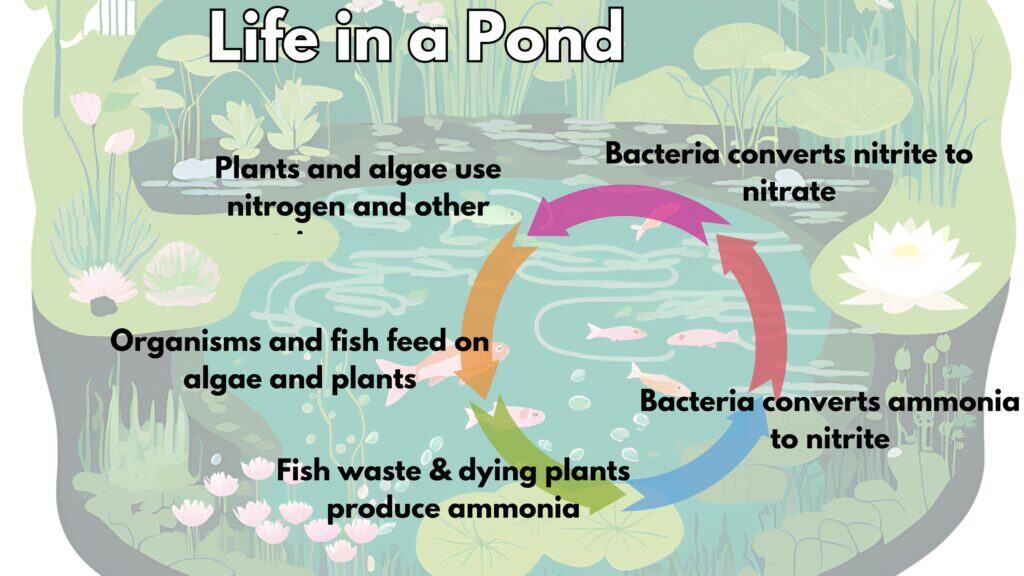
An ecosystem pond works because many small, natural processes are happening at the same time:
- Bacteria processing nitrogen waste
- Fungi and microorganisms breaking down fish waste and dead plant material
- Plants absorbing nutrients as they grow
- Small animals grazing on algae and leftovers
- Larger animals feeding on smaller ones
All of these things working together form an ecosystem.
If this way of thinking about ponds makes sense to you, stick around — I’ll break it all down step by step.
But first, if you don’t already know me, my name’s Kev. My aim is to help people build and maintain ponds and water features without spending a fortune.
When we build an ecosystem pond, we don’t start with products.
We start by creating the right environment for natural processes to do the work.
Surface Area: Where the Work Really Happens
One of the most important ideas behind an ecosystem pond is surface area.
Rocks, pebbles, timber, sand, and even dirt aren’t just there to make the pond look natural — they’re there because they create enormous amounts of usable surface area.
Every surface in a pond eventually becomes colonised.
Rocks, gravel, plant roots, timber, even the liner itself all develop something called biofilm.
Biofilm isn’t just one thing. It’s a living layer made up of bacteria, fungi, algae, and other microorganisms all working together.
- Bacteria process nitrogen waste from fish
- Fungi and microbes break down solid waste and dead plant material
- Algae within the biofilm absorb nutrients
- Tiny organisms feed on each other, recycling energy over and over again
Instead of waste building up, it’s constantly being processed.
When we add rock and pebble over the liner, we massively increase the available biological “real estate.” A flat piece of liner provides very little habitat. Cover that same area with natural materials and you create hundreds of times more space for life to do the work.
There’s also a practical side benefit: these materials help the pond visually disappear into the landscape. Hard edges soften, liner is hidden, and the pond starts to feel like it belongs there.
In ecosystem ponds, the things that make them work are often the same things that make them look natural.
Bare-bottom ponds can look very clean, but all those natural processes still need somewhere to happen. In that case, they’re forced into a dedicated filter — which usually means more management, more cleaning, and less forgiveness.
In an ecosystem pond, the entire pond becomes part of the filtration system. Filters can still help — and often do — but they support the ecosystem rather than replace it.
If you want help working out proportions for biological filtration, there are free calculators on the site — including a bog filter size calculator — to take some of the guesswork out of planning.
Plants: More Than Decoration
Plants are another critical part of an ecosystem pond — and not just for looks.
Plants consume nitrogen and nutrients from the water, working alongside bacteria rather than trying to replace them. They also compete with algae for both nutrients and sunlight.
But the goal isn’t for plants to dominate the pond.
We don’t want plants dominating, bacteria dominating, or algae dominating. In a healthy ecosystem, nothing “wins” — everything balances.
Plants are interesting because they’re both consumers and producers. They absorb nutrients, and when leaves die back or roots shed, they become food for microorganisms. Plants — and even algae — capture energy from the sun and turn it into organic matter that feeds the rest of the food chain.
That’s why plants shouldn’t be an afterthought. We need to design spaces where they can root, grow, and interact with the water. They’re a functional part of the system.
Of course, plants also soften the pond visually. They create shade, hide structure, and help the pond feel natural in the landscape. And ponds that look natural often behave more naturally too.
In an ecosystem pond, plants aren’t just there to look good — they’re working.
Flow: Gently Connecting the System
Flow is an interesting one, because not all ponds actually need a pump or dedicated filter.
You can build ponds that rely purely on still water, plants, and natural processes — and in the right situation, that works just fine.
Personally, I add pumps and filtration to almost all of my ponds. Part of that is simply because I like the sound of running water. Moving water brings life to a pond. It adds oxygen, and oxygen is critical for almost all the natural processes we’ve talked about.
Flow also allows water to move through areas rich in bacteria and plant roots. That’s where biological filtration really comes to life. My favourite filter for this is a bog filter, because it truly embraces the ecosystem approach.
Filtration also helps capture sediment and decomposing organic material. We don’t need to remove everything all the time, but every bit we remove is less work for the ecosystem later on.
Because over time, organic material always accumulates.
Sunlight hits the pond every day.
Dust and pollen blow in.
Fish eat, grow, breed, and eventually die.
Plants boom in warm weather and die back in cooler months.
Land animals visit the pond and leave things behind.
Even bacteria slow down in cooler weather, which means waste processing isn’t constant year-round. Sediment slowly builds up.
This is where pumps and filters really help. On most backyard ponds, they dramatically reduce how often hands-on cleaning is needed.
A simple ecosystem pond flow usually looks like this:
A pump sits in an intake bay, skimmer, or reservoir → water moves through a biological filter (often a bog) → and returns to the pond, sometimes via a stream or waterfall.
And just like everything else in an ecosystem pond, all of this equipment can be hidden. Pipes, pumps, and filters disappear behind rocks, plants, timber, and gravel.
Flow isn’t about power or forcing water to behave.
It’s about gently connecting all the living parts of the pond into one working system.
Animals & Bioload: Biology Has Limits
No matter how well we design a pond, biology still has limits.
Every animal creates load.
Fish, turtles, ducks, frogs — they all eat, grow, and produce waste. Larger animals place much higher demand on the system than small ones.
Feeding plays a huge role too. Every handful of food is imported energy the ecosystem has to process.
This is why wildlife ponds are often incredibly stable — the load placed on them is low.
Designing with restraint here makes everything easier. And if you’re unsure how big is “big enough,” that’s where planning tools and references really help.
Time, Maturity & Seasonal Reality
One thing that doesn’t get talked about enough with ecosystem ponds is time.
New ponds behave very differently to mature ones. Fluctuations are normal. Algae phases are normal. Most of the time, the ecosystem simply isn’t finished forming yet.
Seasonal changes matter too. Biology speeds up in summer and slows down in winter. Maintenance becomes seasonal, not weekly.
Over-intervening during these natural phases often causes more problems than it fixes.
Mature ponds recover faster, tolerate small mistakes, and need far less input. That’s when ecosystem ponds really start to feel effortless.
Time isn’t something to overcome — it’s one of the most important design tools we have.
What “Low Maintenance” Really Means
Low maintenance doesn’t mean no maintenance.
It means predictable, occasional, thoughtful intervention.
A system that forgives missed weekends.
A pond that changes with the seasons instead of needing constant correction.
To me, a successful ecosystem pond gives something back. It’s calming. It attracts life. It feels alive.
If you want more help planning or troubleshooting your own pond, there’s a large library of free articles, calculators, and real DIY builds here on the website — and for those who want my exact step-by-step system, that option’s there too. No pressure. Just options.
An ecosystem pond isn’t something you manage every weekend.
It’s something you design carefully, observe often, and interfere with as little as possible.
That’s what working with nature really looks like.
About to build a pond… or already have one?
Sign up for my email list and I’ll send you DIY-friendly pond tips, along with a few helpful tools like calculators, gear recommendations, and more.